There's something a bit oddball about the notion of a $16,500 integrated amplifier—until you stop to consider that the market is fairly drenched with preamps and power amps that, together, cost that much and more. And putting both pre- and power amp in a single chassis cuts down on storage (one less shelf), accessories (one less pair of cable), and electrical outlets (one socket freed up).
 Still, it must be a tough sell; it seems a novelty, along the lines of the $100 Kobe beef burger or the $1000 caviar omelet offered at certain Manhattan restaurants. The kind of people who tend to stick with burgers and omelets think such prices are comically insane. The kind of people who don't chafe at these prices figure they might as well go all the way and order the dry-aged porterhouse or the blini and Beluga.
Maybe it's the categories—burger, omelet, integrated amplifier—that are off-putting—or, more to the point, the usual associations with these categories. I've never eaten Kobe beef, but some who have say that it tastes fabulous, as sumptuous as a good steak in its own way. Just because most burgers are diner food doesn't mean they have to be. Just because most integrated amps are designed as compromises doesn't mean they have to be, either.
So here we have Krell Industries, maker of no-holds-barred, power-pumping behemoth amps, brazenly treading this uncertain terrain with the FBI—a Fully Balanced Integrated (hence the initials) amplifier that, judging from its appearance and design (to say nothing of that $16,500 price tag), aims to give no ground to its separate-components brethren.
Description and Design
Still, it must be a tough sell; it seems a novelty, along the lines of the $100 Kobe beef burger or the $1000 caviar omelet offered at certain Manhattan restaurants. The kind of people who tend to stick with burgers and omelets think such prices are comically insane. The kind of people who don't chafe at these prices figure they might as well go all the way and order the dry-aged porterhouse or the blini and Beluga.
Maybe it's the categories—burger, omelet, integrated amplifier—that are off-putting—or, more to the point, the usual associations with these categories. I've never eaten Kobe beef, but some who have say that it tastes fabulous, as sumptuous as a good steak in its own way. Just because most burgers are diner food doesn't mean they have to be. Just because most integrated amps are designed as compromises doesn't mean they have to be, either.
So here we have Krell Industries, maker of no-holds-barred, power-pumping behemoth amps, brazenly treading this uncertain terrain with the FBI—a Fully Balanced Integrated (hence the initials) amplifier that, judging from its appearance and design (to say nothing of that $16,500 price tag), aims to give no ground to its separate-components brethren.
Description and Design
The FBI isn't Krell's first stab at an integrated amp. In the mid-1990s they put out the KAV-300i, which evolved a decade later into the KAV-400xi. Priced at $2350 and $2500, respectively, the KAVs were pitched to the entry level of the high-end market, a realm that until then Krell had largely bypassed. (The less expensive KAV-400xi was scaled down but not dumbed down; Wes Phillips, in the February 2005 Stereophile, called it his "favorite Krell"—by which he didn't mean the "best Krell," but still...) The FBI is something else entirely. It weighs 104 lbs, and puts out 300Wpc (600Wpc into 4 ohms, 1200Wpc into 2 ohms) with vanishingly low distortion at frequencies ranging from subway rumble to dog whistle. The preamp and amp sections have separate circuits and separate toroidal transformers; the preamp's is rated at 25VA, the amp's at 3000VA with a capacitance of 40,800µF per channel. Each channel has 20 TO-3-cased output transistors and 10 TO-3-cased regulators.
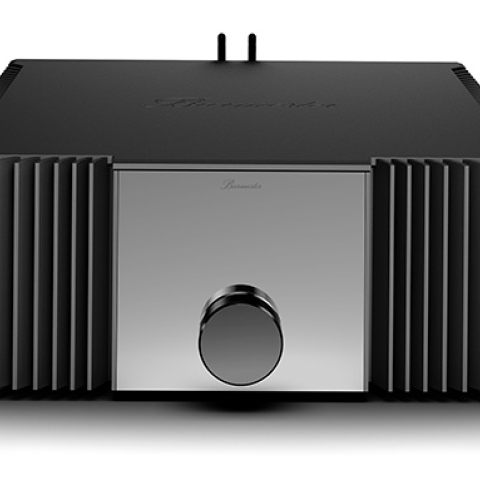
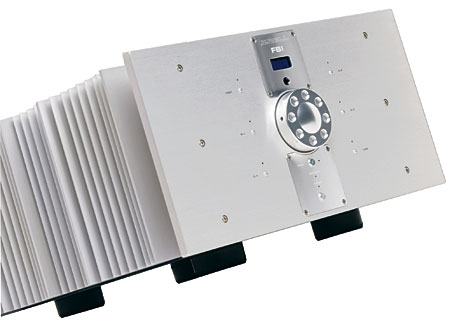
The chassis—compact but beefy, an anodized aluminum faceplate covering massive heatsinks—looks like that of Krell's FPB-300cx power amplifier, with a huge, analog volume knob tacked on the front. This is no coincidence—the FBI is an FPB-300cx with a line-stage preamp built in.
Krell's cx series of amps, introduced in 2004, was a modification of the c series, which came to market in 2000 and featured two innovations: Krell Current Mode and Current Audio Signal Transmission (or CAST). The first involved circuit topologies that manipulated the audio signal in the current domain as opposed to the standard voltage domain. Dan D'Agostino, Krell's proprietor, hit on this idea while designing A/V processors. The high bandwidth of video signals forced him to work in the current domain (voltage-based circuits aren't optimal for video's high bandwidth), which led him to wonder if the current domain might expand the bandwidth of audio signals too—and it did. According to Jim Ludoviconi, Krell's technical manager, the audio bandwidth in the current domain exceeds that of the voltage domain by "an order of magnitude."
This discovery led to CAST, which used Krell Current Mode not only in the circuits within a component but also in the connection between components. This approach would have two advantages, in theory. First, there would be no need to convert the signal from current to voltage and back to current; it would flow as one continuous stream of current. Second, whereas signals in the voltage domain go from low to high impedance, signals in the current domain go from high to low impedance. As a result, factors that inevitably (but unpredictably) corrupt an audio signal in the voltage domain would be sharply reduced, if not eliminated. These factors include stray capacitance and inductance, which build up on circuit boards, and strange interactive effects caused by the impedance of cables connecting a preamp and power amp. (D'Agostino has reportedly sent a signal through 5000 feet of Krell's proprietary CAST cable with minimal loss or distortion.)
In the c and cx power amps, the CAST input was moot at the time unless you happened to have a Krell KCT line-stage amp, the only preamp with a CAST output. In the FBI, the line stage and power amp are in the same enclosure; the signal between them goes down a multipinned header from one circuit board to the other. The CAST circuitry is activated as a matter of course. If you go further, and hook the FBI up to a CD player with a CAST output (more about that later), the signal passes in a continuous, unaltered stream from source to speakers.
No surprise, the FBI's line stage is based on the KCT, though it also employs some of the circuitry in Krell's later Evolution 2 preamp. Especially notable here, according to Ludoviconi, is the Evolution's Current Mirror, which makes a "copy" of a signal in the input stage, in order to isolate it from the inevitably intruding noise from a high-bandwidth signal. The line stage, like the Evolution, also uses LEDs, which have a much higher tolerance than traditional diodes; as a result, Ludoviconi claims, circuits perform more predictably at the critical low-level stages.
The catch is that running in the current domain requires a lot of transistors—up to twice as many, watt for watt, as the voltage domain—which means that an amp like this must be heavier and more expensive, and run hotter, than it otherwise would.
A few convenience features: First, power is activated by a toggle switch on the back panel. Pushing the power button on the front panel turns the amp from stand-by to full-tilt; the warm-up time, before you hear its full sonic bloom, is negligible. Second, the wireless remote has a 12-volt trigger, which lets you control other components in the system, even non-Krell ones. (I was able to select tracks from a Simaudio CD player, for instance.) Third, a "Theater Throughput" circuit (which I never used) allows the signal from a surround-sound processor to pass through the FBI at unity gain.
Setup
I did all of my listening through Verity Audio's Parsifal Ovation loudspeakers and Nirvana speaker cable. I listened to LPs, CDs, and SACDs. For a digital source, I began with the Simaudio Moon CD5.3, which has only RCA outputs. After I got used to the FBI's sound (it didn't take long; I've heard many Krell amps over the years, including, not long ago, the FPB-400cx), I switched to Krell's Evolution 505 SACD/CD player (borrowed from Wes Phillips), which has RCA, balanced, and CAST outputs. I began with the RCAs, to introduce the new elements one at a time. (I spent a few months last year with Krell's SACD Standard player, which is sonically similar.) Then I moved briefly to the balanced outputs. With my Nirvana interconnects, I've never noticed much, if any, difference between balanced and unbalanced hookups (after having adjusted the volume knob to compensate for the 6dB gain); the same was true here.
Still, it must be a tough sell; it seems a novelty, along the lines of the $100 Kobe beef burger or the $1000 caviar omelet offered at certain Manhattan restaurants. The kind of people who tend to stick with burgers and omelets think such prices are comically insane. The kind of people who don't chafe at these prices figure they might as well go all the way and order the dry-aged porterhouse or the blini and Beluga.
Maybe it's the categories—burger, omelet, integrated amplifier—that are off-putting—or, more to the point, the usual associations with these categories. I've never eaten Kobe beef, but some who have say that it tastes fabulous, as sumptuous as a good steak in its own way. Just because most burgers are diner food doesn't mean they have to be. Just because most integrated amps are designed as compromises doesn't mean they have to be, either.
The FBI isn't Krell's first stab at an integrated amp. In the mid-1990s they put out the KAV-300i, which evolved a decade later into the KAV-400xi. Priced at $2350 and $2500, respectively, the KAVs were pitched to the entry level of the high-end market, a realm that until then Krell had largely bypassed. (The less expensive KAV-400xi was scaled down but not dumbed down; Wes Phillips, in the February 2005 Stereophile, called it his "favorite Krell"—by which he didn't mean the "best Krell," but still...) The FBI is something else entirely. It weighs 104 lbs, and puts out 300Wpc (600Wpc into 4 ohms, 1200Wpc into 2 ohms) with vanishingly low distortion at frequencies ranging from subway rumble to dog whistle. The preamp and amp sections have separate circuits and separate toroidal transformers; the preamp's is rated at 25VA, the amp's at 3000VA with a capacitance of 40,800µF per channel. Each channel has 20 TO-3-cased output transistors and 10 TO-3-cased regulators.
I did all of my listening through Verity Audio's Parsifal Ovation loudspeakers and Nirvana speaker cable. I listened to LPs, CDs, and SACDs. For a digital source, I began with the Simaudio Moon CD5.3, which has only RCA outputs. After I got used to the FBI's sound (it didn't take long; I've heard many Krell amps over the years, including, not long ago, the FPB-400cx), I switched to Krell's Evolution 505 SACD/CD player (borrowed from Wes Phillips), which has RCA, balanced, and CAST outputs. I began with the RCAs, to introduce the new elements one at a time. (I spent a few months last year with Krell's SACD Standard player, which is sonically similar.) Then I moved briefly to the balanced outputs. With my Nirvana interconnects, I've never noticed much, if any, difference between balanced and unbalanced hookups (after having adjusted the volume knob to compensate for the 6dB gain); the same was true here.