All of a sudden, it seems there's a renaissance in in-ear monitors. Used to be there was just Etymotic, but now Etymotic, Shure, and Ultimate Ears are all producing high-performance in-ear headphones. It's almost enough to make me suspect we audiophiles have become a marketing juggernaut.
 I suspect, however, that the renaissance in hi-fi in-ear 'phones is the result of a different juggernaut: the paradigm-shifting Apple iPod, which has sold in the kazillions. Apparently, some small percentage of all those consumers have noticed that the freebie earbuds sound like day-old crap. And a small percentage of those are willing to spend a significant chunk of change on headphones, especially if they can claim to be the best. At $900, the Ultimate Ears UE-10 Pro better be a contender for the title.
Heard melodies are sweet
I suspect, however, that the renaissance in hi-fi in-ear 'phones is the result of a different juggernaut: the paradigm-shifting Apple iPod, which has sold in the kazillions. Apparently, some small percentage of all those consumers have noticed that the freebie earbuds sound like day-old crap. And a small percentage of those are willing to spend a significant chunk of change on headphones, especially if they can claim to be the best. At $900, the Ultimate Ears UE-10 Pro better be a contender for the title.
Heard melodies are sweet
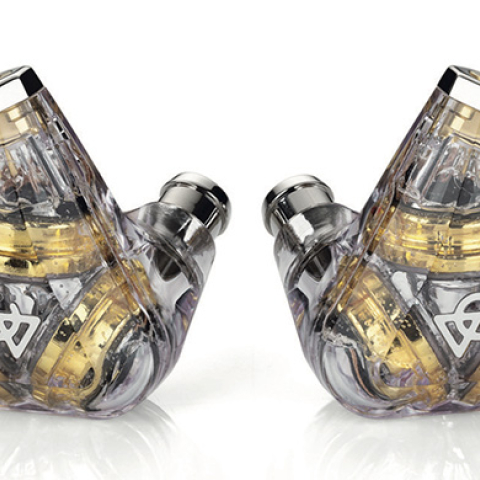
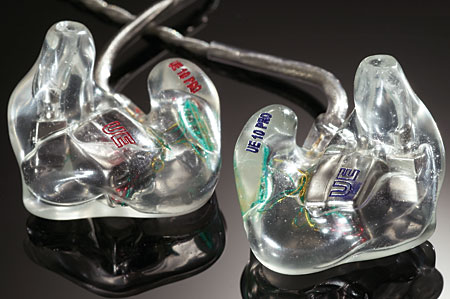
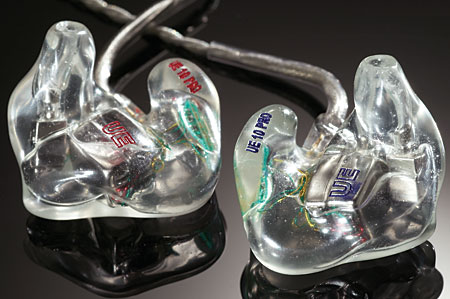
Actually, the UE-10 Pros are $900 plus the cost of custom ear molds from an audiologist; typically, around $50. Call UE if you're contemplating a pair and they'll recommend an audiologist in your area who is capable of doing the molds to their standards. The UE-10s require full-shell molds of the ears' crus of helix, tragus, and antitragus. In this age of mini hearing aids, the procedure is relatively specialized.
The reason you need that big a mold is twofold: First, it gives you full occlusion of the ear canal—and 26dB isolation, UE claims. Second, UE needs a lot of space inside to mount three balanced armature drivers and a crossover. That's two bass drivers—paralleled to reduce the load and increase headroom—and a "tweeter." A resistor in the passive crossover network "flattens" the UE-10's bass curve to make the low and midrange frequencies align better with the highs.
In May I visited the Ultimate Ears factory and watched technicians assembling UE-10s. The balanced armature drivers are tiny boxes connected to "port tubes," which direct the sound output. Once the three drivers and crossover are assembled, they're affixed to the ear-mold shell, with the port tubes running through the ear-canal tube. The port lines are then trimmed by a technician running test tones to measure the response against UE's theoretical "flat response." Since everyone's ear canals are a different shape, this is a crucial step.
I say "flat" because the ear canal itself has a huge effect on the sound your eardrum receives, and the insertion point of a driver—in this case, just millimeters away from the eardrum—has a pronounced effect on that sound. Think of the ear canal as a horn loudspeaker in reverse: it filters and amplifies sounds in the 1500–2700Hz region. Therefore, if you stick a transducer with truly flat response down past that filter, it will sound way down in that region, so you have to have a 2kHz-ish boost to make it sound flat.
Music does not exist until its sound is heard
In his review of the less-expensive UE-5cs, John Atkinson stressed the importance of a good seal between the ear module and the ear canal, and that achieving one is somewhat a matter of practice. I concur. My first impression of the UE-10s was that the deep insertion point gave me a "shouty" presentation, but that went away when I turned down the music. I would have turned it down anyway—the degree of isolation from environmental sounds provided by the UE-10s was superlative. I was immediately impressed with the natural, ungimmicky sound of voices, whether Dave Alvin's throaty baritone on Out in California (Hightone 8144, Apple Lossless Processing file), or Cantus in its latest, There Lies the Home (which I've heard in several provisional mixes as it lurches its way toward release). There was no paucity of instrumental clarity with the UE-10s, but voices really shone, acquiring a clarity and focus I associate with the best small, stand-mounted monitor loudspeakers.
The very top end of the UE-10s was also special. String harmonics and the long decay of tones in large reverberant spaces were illuminated with startling focus. This means you need to be careful to feed 'em right. Take a compressed contemporary recording with a scant 1dB of dynamic range—say, almost anything you'll hear on pop radio—and you'll peel your eardrums with bright, sibilant sound. Take something well-recorded and mastered, such as Stereophile's "Recording of the Month" for January 1999, Jácaras!, and the sound will pop your eyes open with its fidelity, life, and snap (Harmonia Mundi 907212, CD/ALP file).
But did that double-woofer arrangement pay off in the down-low department? That depends, I reckon, on what you consider to be "real" bass. When I was first shaking down the UE-10s, I thought the bass veered from lean to overblown, but some of that was learning to achieve a good seal with the ear molds—miss the seal and you miss the bass. It's that simple.
But bass EQ varies from recording to recording, and once you start focusing on one sonic attribute, you can drive yourself nuts obsessing over whether those normal variations are caused by the device under test or have always been there. Ultimately, you pretty much have to relax and think of England—or anything other than bass qua bass.
My epiphany came, as have so many, while listening to Aretha Franklin's I Never Loved Another Man the Way I Love You (CD, Mobile Fidelity UDCD 574). It was Tommy Cogbill's Fender bass lead-in to "Do Right Woman, Do Right Man" that sold me—it was so fat, so ripe and plummy, and so proportional to the rest of the sound that I just relaxed and began to hear the bass as a part of the music.
And it was good bass—very good. Not best I've ever heard good, but focused, taut, and appropriate.
What is heard must be pondered over
Are the Ultimate Ears UE-10 Pros for you? Even more than with most audio components, that's a very personal issue. First, there's price—at $900 plus, they're a luxury. But you also have to assess how you use headphones. Do you need isolation? If you don't, or if you actually need to hear what's going on around you, the UE-10s' good fit will be a bad fit for you—probably not those jogging 'phones you've been looking for. If you're looking for an extra bump in the bottom, the taut, bass-balanced UE-10s may not strike your fancy. And if your ear canals are sensitive, in-ear monitors may not be for you at all.
I think of the UE-10 Pros as a tool that gives me isolation and accurate sound in places I'd never otherwise have it—which is, after all, what these in-ear monitors were designed to deliver to musicians. If success is achieving what you've set out to accomplish, the UE-10 Pros are more than a success; they're a phenomenon.
I suspect, however, that the renaissance in hi-fi in-ear 'phones is the result of a different juggernaut: the paradigm-shifting Apple iPod, which has sold in the kazillions. Apparently, some small percentage of all those consumers have noticed that the freebie earbuds sound like day-old crap. And a small percentage of those are willing to spend a significant chunk of change on headphones, especially if they can claim to be the best. At $900, the Ultimate Ears UE-10 Pro better be a contender for the title.
Heard melodies are sweet
Actually, the UE-10 Pros are $900 plus the cost of custom ear molds from an audiologist; typically, around $50. Call UE if you're contemplating a pair and they'll recommend an audiologist in your area who is capable of doing the molds to their standards. The UE-10s require full-shell molds of the ears' crus of helix, tragus, and antitragus. In this age of mini hearing aids, the procedure is relatively specialized.
In his review of the less-expensive UE-5cs, John Atkinson stressed the importance of a good seal between the ear module and the ear canal, and that achieving one is somewhat a matter of practice. I concur. My first impression of the UE-10s was that the deep insertion point gave me a "shouty" presentation, but that went away when I turned down the music. I would have turned it down anyway—the degree of isolation from environmental sounds provided by the UE-10s was superlative. I was immediately impressed with the natural, ungimmicky sound of voices, whether Dave Alvin's throaty baritone on Out in California (Hightone 8144, Apple Lossless Processing file), or Cantus in its latest, There Lies the Home (which I've heard in several provisional mixes as it lurches its way toward release). There was no paucity of instrumental clarity with the UE-10s, but voices really shone, acquiring a clarity and focus I associate with the best small, stand-mounted monitor loudspeakers.
Are the Ultimate Ears UE-10 Pros for you? Even more than with most audio components, that's a very personal issue. First, there's price—at $900 plus, they're a luxury. But you also have to assess how you use headphones. Do you need isolation? If you don't, or if you actually need to hear what's going on around you, the UE-10s' good fit will be a bad fit for you—probably not those jogging 'phones you've been looking for. If you're looking for an extra bump in the bottom, the taut, bass-balanced UE-10s may not strike your fancy. And if your ear canals are sensitive, in-ear monitors may not be for you at all.