HistoriCAL Introduction
California Audio Labs is a child of the digital age. Originally, they made a noise by offering modified CD players with tube output stages, a practice for which I found no intellectual justification. On the other hand, the results were successful, even if (probably) due to the CAL units' softening of the harshness of early digital sound.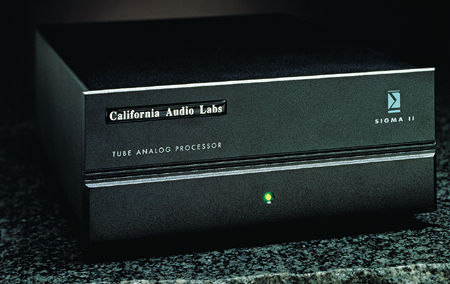 As digital reproduction has matured, CAL (no relation to me) has consistently offered a wide array of well-received digital products, culminating in the CL-10 (Stereophile, Vol.19 No.11) and CL-15 (Vol.21 No.11) CD players, as well as the CL-20 (Vol.22 No.1) DVD player, an admirable performer on which I rely. As we move into the world of home theater and multichannel sound, CAL has replaced the CL-20 with the more glamorous and advanced CL-2500, part of its new line of sophisticated controllers and multichannel amplifiers.
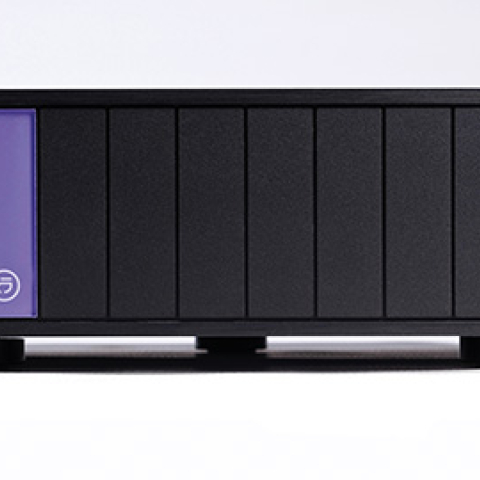
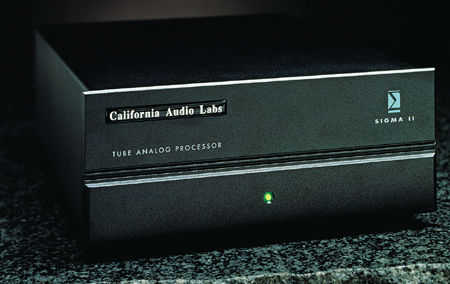
However, the two-channel audio products remain to carry on CAL's original style, and one of the more venerable of these is the Sigma—a solid, compact, shoebox-sized D/A processor with a single direct-coupled 12AX7A tube serving as the analog signal output driver for both channels. The steel chassis has only an illuminated input switch and an LED on the front, while the rear bears S/PDIF RCA-electrical and TosLink-optical inputs, a pair of analog output RCAs, an IEC power connector, and a power switch. Recently, the Sigma II was upgraded to full 24/96 input and decoding ability; while its external appearance is the same (apart from a removable "24/96" sticker), the real changes are under the lid (footnote 1).
First, the new version is 10% heavier, and draws a bit more power from the line. Second, all performance specs are improved, with the exception that it still requires a minimum 10k ohms input impedance for the succeeding component (these days, not a major demand). Third, the rarely used de-emphasis facility is now accomplished in the digital domain. Inside, the main board bristles with voltage regulators and filters, and sports an impressively large shielded power transformer in addition to the lonely 12AX7. I was surprised to find that the tidy daughterboard with the new digital chip set—Crystal CS8414 low-jitter receiver and Burr-Brown PCM 1728E multilevel delta-sigma DAC—bears the label, "Alpha 96kHz/24-bit D/A Upgrade!" That tells me that the Sigma II shares quite a lot, under the skin, with its senior partner. Upgrades to this spec for extant Sigma IIs are available from CAL.
AnalytiCAL Description
As digital reproduction has matured, CAL (no relation to me) has consistently offered a wide array of well-received digital products, culminating in the CL-10 (Stereophile, Vol.19 No.11) and CL-15 (Vol.21 No.11) CD players, as well as the CL-20 (Vol.22 No.1) DVD player, an admirable performer on which I rely. As we move into the world of home theater and multichannel sound, CAL has replaced the CL-20 with the more glamorous and advanced CL-2500, part of its new line of sophisticated controllers and multichannel amplifiers.
However, the two-channel audio products remain to carry on CAL's original style, and one of the more venerable of these is the Sigma—a solid, compact, shoebox-sized D/A processor with a single direct-coupled 12AX7A tube serving as the analog signal output driver for both channels. The steel chassis has only an illuminated input switch and an LED on the front, while the rear bears S/PDIF RCA-electrical and TosLink-optical inputs, a pair of analog output RCAs, an IEC power connector, and a power switch. Recently, the Sigma II was upgraded to full 24/96 input and decoding ability; while its external appearance is the same (apart from a removable "24/96" sticker), the real changes are under the lid (footnote 1).
First, the new version is 10% heavier, and draws a bit more power from the line. Second, all performance specs are improved, with the exception that it still requires a minimum 10k ohms input impedance for the succeeding component (these days, not a major demand). Third, the rarely used de-emphasis facility is now accomplished in the digital domain. Inside, the main board bristles with voltage regulators and filters, and sports an impressively large shielded power transformer in addition to the lonely 12AX7. I was surprised to find that the tidy daughterboard with the new digital chip set—Crystal CS8414 low-jitter receiver and Burr-Brown PCM 1728E multilevel delta-sigma DAC—bears the label, "Alpha 96kHz/24-bit D/A Upgrade!" That tells me that the Sigma II shares quite a lot, under the skin, with its senior partner. Upgrades to this spec for extant Sigma IIs are available from CAL.
AnalytiCAL Description
Setup is a piece of cake: Plug in your source, connect the outputs, and power up. (The output is muted for one minute at power-up, but the Sigma II is clearly intended to be left on; its power switch is on the rear panel.) The green LED goes on, and, after the recommended initial 30-minute warmup, it's ready to go. A front-panel switch selects coax or TosLink input, and is illuminated if the selected input has a signal. There is no way that the push-on/push-off selector can tell you which input is selected, as CAL seems to assume that you will have only one active. Nor is there (other than the switch illumination showing the presence of a digital carrier signal) any indication of sampling frequency, word length, or pre-emphasis. CAL's attitude: Turn it on and forget it. Kal did. The Sigma II is self-effacing enough that I found it hard to pay attention to, and therefore hard to describe. So let me conclude at the beginning by saying that there was nothing out of joint about the way music passed through the Sigma II. Whether the source was CD or 24/96 DVD, whether the link was coax or TosLink, whether the signal was pre-emphasized (rare these days) or not, the Sigma II performed at levels that sounded near the state of the art. It injected very little personality into the reproduction chain, and there was never—repeat, never—any need to switch over to a fancy, expensive processor for the sake of musical enjoyment. That happened only when I needed to describe the Sigma II's sound by comparison with other DACs.
CritiCAL Comparisons
The available competition in the main system were the Mark Levinson No.360 D/A converter, the Meridian 508.24 CD player and the Meridian 800 DVD player—all class-A (or better!) components. While the Sigma II was the equal of none of these, it was not embarrassed by the comparisons. At the bottom end, all the big-buck DACs had greater extension and tautness, but above about 50Hz, the Sigma II was slightly fuller than absolutely natural. Above the bass, contention was close. In overall balance, the Sigma II was more like the slightly cool Meridians than like the abstemious Levinson. Rickie Lee Jones' characteristically nasal sound (Pop Pop, Geffen GEFD-24426) was somewhat less so through the Sigma II than through the other DACs. Above the voice fundamentals, the Sigma II's highs were not as etched as the Meridian's, and less pellucid than the Levinson's. Where the Sigma II revealed a weakness was in its resolving of extremely fine detail in these higher frequencies. Still, it was damn good, and capable of consistently revealing the subtle delicacies that distinguish 24/96 recordings from their standard CD counterparts. But in A/B comparisons with the Levinson No.360 the Sigma II was not as completely revealing. Through the Levinson, choruses (eg, the children's voices on "Another Brick in the Wall II," Pink Floyd, The Wall, Burmester CDII) can, with a change in one's mental state, be heard either as a single "voice" or as a group of individuals singing. With the Sigma II, it was difficult for me to hear individual voices. Mind you, this was revealed only with A/B switching: the degree of confusion of detail was as small as it was unaggressive. In matters of dynamics, micro- or macro-, the little Sigma II was up to the stiff competition.
LogiCAL Competition
But in A/B comparisons with the Levinson No.360 the Sigma II was not as completely revealing. Through the Levinson, choruses (eg, the children's voices on "Another Brick in the Wall II," Pink Floyd, The Wall, Burmester CDII) can, with a change in one's mental state, be heard either as a single "voice" or as a group of individuals singing. With the Sigma II, it was difficult for me to hear individual voices. Mind you, this was revealed only with A/B switching: the degree of confusion of detail was as small as it was unaggressive. In matters of dynamics, micro- or macro-, the little Sigma II was up to the stiff competition.
LogiCAL Competition
As well as CAL's Sigma II fit into my main system, it was even more at home in the weekend system, where the obvious competition was the $399 MSB LinkDAC. In this contest, the differences were consistent: the Sigma II always played to my taste. The LinkDAC's major advantage in this face-off was in the sheer slam and weight of its deep bass. The Sigma II was satisfying at these depths, but lacked the LinkDAC's ability to move large objects. Elsewhere in the spectrum, including the rest of the bass, the Sigma II scored over the LinkDAC with its warmer, more rounded sound. Carmen Lundy's lush, soft voice ("When Your Lover Has Gone," from JVC's JVC XRCD2 Sampler) and k.d. lang's riper, warmer voice (Drag, Warner Bros. 46623-2) were slightly fuller on the Sigma II, with the better integration of voice and ambience creating a more focused presence. With the LinkDAC, those voices sounded somewhat disembodied. Full orchestra (Shostakovich, Waltzes, Orbelian/Moscow CO, Delos DE 3257) was glorious on the Sigma II, whose soundstage was deeper but no wider than the LinkDAC's. The step up to 24/96 sources was beneficial with both DACs, but their personalities were consistently expressed. Like the voices described above, Chuck Mangione's horn on The Feeling's Back (24/96, Chesky CHDVD 194) had more body and focus with the Sigma II, and the spacing of the ensemble voices was more apparent. By the way, the transport in these comparisons was the California Audio Labs CL-20; its analog output, although solid-state and PowerBoss and all that jazz, sounded quite similar to the Sigma II's. The CL-20 plumbed the depths below 50Hz with more authority, but even there, the difference was pretty inconsequential. Thus, I saw no good reason to add the Sigma II to the CL-20, and certainly none to add the MSB—although the LinkDAC is essential to my enjoyment of DMX cable music!
PractiCAL Conclusions
This short review could have been shorter: California Audio Labs' Sigma II DAC is an honest and superbly consistent component. It offers limited opportunity for control and display interaction, but that is concomitant with its talent for getting out of the music's way. At its asking price of $750, the Sigma II falls close to the point of inflection on the price/performance curve, where more money brings invreasingly smaller benefits. I acknowledge the superb return on investment with the overachieving $399 MSB LinkDAC, but still: spend less and you get less. But to get much more, you have to spend a lot more: $4495 for the Mark Levinson No.360. Indeed, aside from cantankerous critics playing A/B games with kilobuck DACs, most would find little to criticize, and much to enjoy, in the Sigma II. Footnote 1: The original Sigma was reviewed for Stereophile by Robert Harley in October 1992, Vol.15 No.10.—John Atkinson
California Audio Labs is a child of the digital age. Originally, they made a noise by offering modified CD players with tube output stages, a practice for which I found no intellectual justification. On the other hand, the results were successful, even if (probably) due to the CAL units' softening of the harshness of early digital sound.
As digital reproduction has matured, CAL (no relation to me) has consistently offered a wide array of well-received digital products, culminating in the CL-10 (Stereophile, Vol.19 No.11) and CL-15 (Vol.21 No.11) CD players, as well as the CL-20 (Vol.22 No.1) DVD player, an admirable performer on which I rely. As we move into the world of home theater and multichannel sound, CAL has replaced the CL-20 with the more glamorous and advanced CL-2500, part of its new line of sophisticated controllers and multichannel amplifiers.
However, the two-channel audio products remain to carry on CAL's original style, and one of the more venerable of these is the Sigma—a solid, compact, shoebox-sized D/A processor with a single direct-coupled 12AX7A tube serving as the analog signal output driver for both channels. The steel chassis has only an illuminated input switch and an LED on the front, while the rear bears S/PDIF RCA-electrical and TosLink-optical inputs, a pair of analog output RCAs, an IEC power connector, and a power switch. Recently, the Sigma II was upgraded to full 24/96 input and decoding ability; while its external appearance is the same (apart from a removable "24/96" sticker), the real changes are under the lid (footnote 1).
Setup is a piece of cake: Plug in your source, connect the outputs, and power up. (The output is muted for one minute at power-up, but the Sigma II is clearly intended to be left on; its power switch is on the rear panel.) The green LED goes on, and, after the recommended initial 30-minute warmup, it's ready to go. A front-panel switch selects coax or TosLink input, and is illuminated if the selected input has a signal. There is no way that the push-on/push-off selector can tell you which input is selected, as CAL seems to assume that you will have only one active. Nor is there (other than the switch illumination showing the presence of a digital carrier signal) any indication of sampling frequency, word length, or pre-emphasis. CAL's attitude: Turn it on and forget it. Kal did. The Sigma II is self-effacing enough that I found it hard to pay attention to, and therefore hard to describe. So let me conclude at the beginning by saying that there was nothing out of joint about the way music passed through the Sigma II. Whether the source was CD or 24/96 DVD, whether the link was coax or TosLink, whether the signal was pre-emphasized (rare these days) or not, the Sigma II performed at levels that sounded near the state of the art. It injected very little personality into the reproduction chain, and there was never—repeat, never—any need to switch over to a fancy, expensive processor for the sake of musical enjoyment. That happened only when I needed to describe the Sigma II's sound by comparison with other DACs.
The available competition in the main system were the Mark Levinson No.360 D/A converter, the Meridian 508.24 CD player and the Meridian 800 DVD player—all class-A (or better!) components. While the Sigma II was the equal of none of these, it was not embarrassed by the comparisons. At the bottom end, all the big-buck DACs had greater extension and tautness, but above about 50Hz, the Sigma II was slightly fuller than absolutely natural. Above the bass, contention was close. In overall balance, the Sigma II was more like the slightly cool Meridians than like the abstemious Levinson. Rickie Lee Jones' characteristically nasal sound (Pop Pop, Geffen GEFD-24426) was somewhat less so through the Sigma II than through the other DACs. Above the voice fundamentals, the Sigma II's highs were not as etched as the Meridian's, and less pellucid than the Levinson's. Where the Sigma II revealed a weakness was in its resolving of extremely fine detail in these higher frequencies. Still, it was damn good, and capable of consistently revealing the subtle delicacies that distinguish 24/96 recordings from their standard CD counterparts.
But in A/B comparisons with the Levinson No.360 the Sigma II was not as completely revealing. Through the Levinson, choruses (eg, the children's voices on "Another Brick in the Wall II," Pink Floyd, The Wall, Burmester CDII) can, with a change in one's mental state, be heard either as a single "voice" or as a group of individuals singing. With the Sigma II, it was difficult for me to hear individual voices. Mind you, this was revealed only with A/B switching: the degree of confusion of detail was as small as it was unaggressive. In matters of dynamics, micro- or macro-, the little Sigma II was up to the stiff competition.
As well as CAL's Sigma II fit into my main system, it was even more at home in the weekend system, where the obvious competition was the $399 MSB LinkDAC. In this contest, the differences were consistent: the Sigma II always played to my taste. The LinkDAC's major advantage in this face-off was in the sheer slam and weight of its deep bass. The Sigma II was satisfying at these depths, but lacked the LinkDAC's ability to move large objects. Elsewhere in the spectrum, including the rest of the bass, the Sigma II scored over the LinkDAC with its warmer, more rounded sound. Carmen Lundy's lush, soft voice ("When Your Lover Has Gone," from JVC's JVC XRCD2 Sampler) and k.d. lang's riper, warmer voice (Drag, Warner Bros. 46623-2) were slightly fuller on the Sigma II, with the better integration of voice and ambience creating a more focused presence. With the LinkDAC, those voices sounded somewhat disembodied. Full orchestra (Shostakovich, Waltzes, Orbelian/Moscow CO, Delos DE 3257) was glorious on the Sigma II, whose soundstage was deeper but no wider than the LinkDAC's. The step up to 24/96 sources was beneficial with both DACs, but their personalities were consistently expressed. Like the voices described above, Chuck Mangione's horn on The Feeling's Back (24/96, Chesky CHDVD 194) had more body and focus with the Sigma II, and the spacing of the ensemble voices was more apparent. By the way, the transport in these comparisons was the California Audio Labs CL-20; its analog output, although solid-state and PowerBoss and all that jazz, sounded quite similar to the Sigma II's. The CL-20 plumbed the depths below 50Hz with more authority, but even there, the difference was pretty inconsequential. Thus, I saw no good reason to add the Sigma II to the CL-20, and certainly none to add the MSB—although the LinkDAC is essential to my enjoyment of DMX cable music!
This short review could have been shorter: California Audio Labs' Sigma II DAC is an honest and superbly consistent component. It offers limited opportunity for control and display interaction, but that is concomitant with its talent for getting out of the music's way. At its asking price of $750, the Sigma II falls close to the point of inflection on the price/performance curve, where more money brings invreasingly smaller benefits. I acknowledge the superb return on investment with the overachieving $399 MSB LinkDAC, but still: spend less and you get less. But to get much more, you have to spend a lot more: $4495 for the Mark Levinson No.360. Indeed, aside from cantankerous critics playing A/B games with kilobuck DACs, most would find little to criticize, and much to enjoy, in the Sigma II. Footnote 1: The original Sigma was reviewed for Stereophile by Robert Harley in October 1992, Vol.15 No.10.—John Atkinson