At the beginning of last month's As We See It, I wrote that I've lately been focused on "analog things." I proceeded to write about refurbishing and modding my old McIntosh tuner. That's "analog thing" #1.
So, what other analog things have I been focused on? Here's #2: I looked around and found no truly satisfying explanation of the skating force. In the wild—in hi-fi discussion forums, for example—you should expect most of what you read on this topic to be wrong, but it's not just that: Even tonearm manufacturers are often vague on this point.
The skating force cannot be understood without some analysis and thought, but my goal here is to keep things as conceptual as possible: no calculations, no fancy diagrams, just correct ideas that you can easily hold in your head.
Ultimately, the source of the force is the tonearm itself, though it starts with the frictional force between the groove and the stylus. That frictional force acts in the direction of the record's rotation, which is tangential (parallel) to the groove, with no component toward the center of the record, which is the direction the skating force is known to pull. That's the mystery: How do we get from a purely tangential force to a force that pulls inward? First consider another question:
If a frictional force is acting on the stylus, then why doesn't the stylus move? The question may seem dumb because the answer is so obvious, but it gets us closer to understanding the skating force. The stylus doesn't move because it's connected to the cartridge, which is connected to the tonearm, which is connected to the turntable at the pivot point. All those mechanical connections hold the stylus in place. The usual Physics 101 framing would be something like this: The tonearm applies whatever force is needed to offset that tangential frictional force.
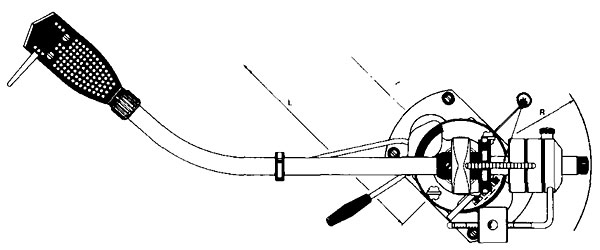
One of the key characteristics of a pivoted tonearm—one of the things that allow it to do what it does—is that it can move freely from side to side, around the pivot point, with very little friction. That means it can only oppose forces that act along its length—or more precisely, toward or away from its pivot point.
I have now mentioned two key directions in space: the direction the frictional force acts (tangential to the record groove at the point of stylus contact) and the direction the tonearm's counterforce acts (along a line joining the point of contact with the pivot point).
Because these two lines are not parallel, the tonearm cannot act against the frictional force directly. The only way the tonearm can completely counter the frictional force is to apply a force that's a little larger than the frictional force that pulls toward the pivot point, so there's a residual force toward the center of the record.
That is how a force tangential to the groove ends up as a force toward the center of the record. That residual force is the skating force.
 How large is the skating force? I borrowed the title of this column from a paper published in two parts in Audio in 1967, by James H. Kogen, who worked at Shure. You can find the paper online at audio-creative.nl. I like it, though J.R. Boisclair of WallyTools—who ought to know—finds some of its measurements suspect. For that reason, I also searched out other resources. The best I found were Boisclair's own site and the blog of Korf Audio founder and chief engineer Alexey Korf.
Kogen measured the skating force under a wide range of conditions. For a 0.35 × 0.7mil elliptical stylus profile, he measured a skating force that was about 0.2gm per gram of tracking force—a ratio of about 20%. For a 0.7mil conical stylus, the skating force was a bit lower, 15%–18%. Boisclair says these numbers are too high, that a better estimate is 10%.
Anything that increases friction will raise the skating force: A dirty stylus. Dirty records. Friction is higher where the music is louder due to larger groove modulations. Kogen even found a different skating force with different pressings of the same record.
The skating force varies across the record surface, but not dramatically. Boisclair's analysis is best. He found that the force varies less than 20% across the record surface. That's small enough that you can ignore the variation.
Is the skating force smaller with a 12" tonearm? With a 12" arm, the line connecting the stylus contact point with the tonearm pivot point is closer to being tangential with the record groove, so the component pulling toward the middle is smaller. So yes, the skating force is smaller. Which is not to say it's negligible.
Why worry about this at all? Applying antiskate isn't essential, but it's a good idea for a few reasons. The effect of the skating force is to squeeze the stylus against the inner groove wall. The suspension is compressed on that side and stretched on the other. When it is set correctly, your cartridge—specifically the suspension—is able to relax into the groove and play music the way it was designed to. The skating force also modulates the tracking force, making it larger at the inside wall and smaller at the outside wall. This can result in tracking misbehavior, which can degrade your sound in subtle ways that don't sound like obvious mistracking. What's more, your records and your stylus may wear prematurely and unevenly. This has been demonstrated in studies.
What should the anti-skating force be set to? That is the key question. Unfortunately, it's hard to answer because skating-force devices on turntables are inconsistent, and manufacturers rarely tell us how they're calibrated. The user manual for your tonearm is likely to say, "set the antiskate dial to the value corresponding to the tracking force"—but it doesn't tell you what you're accomplishing by doing that. Hopefully it is not applying an antiskating force equal to the tracking force, as many assume, since that would be way too high.
In fact, most tonearms appear to set the anti-skating force at some fraction of the numerical value you dial in, measured in grams. Alexey at Korf Audio measured the antiskating force in a range of tonearms at different antiskate settings and found that the ratio of anti-skating force applied to what the dial indicated varied from about 5% to about 30%. So just knowing what your anti-skate is really set at is a formidable challenge. If you can figure that out, your goal should be to set the anti-skating force to about 10% of the tracking force, then listen and refine. More next time
How large is the skating force? I borrowed the title of this column from a paper published in two parts in Audio in 1967, by James H. Kogen, who worked at Shure. You can find the paper online at audio-creative.nl. I like it, though J.R. Boisclair of WallyTools—who ought to know—finds some of its measurements suspect. For that reason, I also searched out other resources. The best I found were Boisclair's own site and the blog of Korf Audio founder and chief engineer Alexey Korf.
Kogen measured the skating force under a wide range of conditions. For a 0.35 × 0.7mil elliptical stylus profile, he measured a skating force that was about 0.2gm per gram of tracking force—a ratio of about 20%. For a 0.7mil conical stylus, the skating force was a bit lower, 15%–18%. Boisclair says these numbers are too high, that a better estimate is 10%.
Anything that increases friction will raise the skating force: A dirty stylus. Dirty records. Friction is higher where the music is louder due to larger groove modulations. Kogen even found a different skating force with different pressings of the same record.
The skating force varies across the record surface, but not dramatically. Boisclair's analysis is best. He found that the force varies less than 20% across the record surface. That's small enough that you can ignore the variation.
Is the skating force smaller with a 12" tonearm? With a 12" arm, the line connecting the stylus contact point with the tonearm pivot point is closer to being tangential with the record groove, so the component pulling toward the middle is smaller. So yes, the skating force is smaller. Which is not to say it's negligible.
Why worry about this at all? Applying antiskate isn't essential, but it's a good idea for a few reasons. The effect of the skating force is to squeeze the stylus against the inner groove wall. The suspension is compressed on that side and stretched on the other. When it is set correctly, your cartridge—specifically the suspension—is able to relax into the groove and play music the way it was designed to. The skating force also modulates the tracking force, making it larger at the inside wall and smaller at the outside wall. This can result in tracking misbehavior, which can degrade your sound in subtle ways that don't sound like obvious mistracking. What's more, your records and your stylus may wear prematurely and unevenly. This has been demonstrated in studies.
What should the anti-skating force be set to? That is the key question. Unfortunately, it's hard to answer because skating-force devices on turntables are inconsistent, and manufacturers rarely tell us how they're calibrated. The user manual for your tonearm is likely to say, "set the antiskate dial to the value corresponding to the tracking force"—but it doesn't tell you what you're accomplishing by doing that. Hopefully it is not applying an antiskating force equal to the tracking force, as many assume, since that would be way too high.
In fact, most tonearms appear to set the anti-skating force at some fraction of the numerical value you dial in, measured in grams. Alexey at Korf Audio measured the antiskating force in a range of tonearms at different antiskate settings and found that the ratio of anti-skating force applied to what the dial indicated varied from about 5% to about 30%. So just knowing what your anti-skate is really set at is a formidable challenge. If you can figure that out, your goal should be to set the anti-skating force to about 10% of the tracking force, then listen and refine. More next time
How large is the skating force? I borrowed the title of this column from a paper published in two parts in Audio in 1967, by James H. Kogen, who worked at Shure. You can find the paper online at audio-creative.nl. I like it, though J.R. Boisclair of WallyTools—who ought to know—finds some of its measurements suspect. For that reason, I also searched out other resources. The best I found were Boisclair's own site and the blog of Korf Audio founder and chief engineer Alexey Korf.
Kogen measured the skating force under a wide range of conditions. For a 0.35 × 0.7mil elliptical stylus profile, he measured a skating force that was about 0.2gm per gram of tracking force—a ratio of about 20%. For a 0.7mil conical stylus, the skating force was a bit lower, 15%–18%. Boisclair says these numbers are too high, that a better estimate is 10%.
Anything that increases friction will raise the skating force: A dirty stylus. Dirty records. Friction is higher where the music is louder due to larger groove modulations. Kogen even found a different skating force with different pressings of the same record.