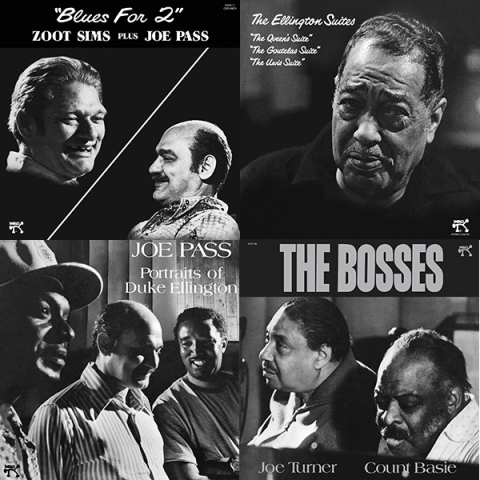
Way back in my ignorant youth I thought that Pablo Records, the label of jazz producer/promoter legend Norman Granz, was where jazz artists went to fade away, where they were put out to pasture. I thought the black discs inside Pablo's black-and-white jackets, which depicted jazz greats tracking sessions in their twilight years, couldn't compete with the music of younger jazz guns. I didn't want to hear medium-tempo swing grooves in cocktail-softened blowing "jams," or moldy standards like "Satin Doll." I wanted flamethrowers. Blazing jazz-rock tempos. Acetylene solos scorching my eardrums.
Not much that's good comes with age, but wisdom does at least some of the time, for listeners and musicians alike.
Many years on from my jazz-drumming youth, I'm a more knowledgeable collector, of jazz vinyl especially, and I'm a better listener. I know what to listen for. Analogue Productions' Chad Kassem knows, too. Years beyond his wild youth, Kassem is a shrewd purveyor of jazz reissues. His ongoing Pablo Records reissue campaign is evidence of his good ear and his dedication to all things jazz vinyl.
(Another example: The recent Miles Davis title Birth of the Blue was Kassem's idea.)
The latest additions to Kassem's Acoustic Sounds web store include four new Pablo albums, part of the scheduled reissue of 30 limited-edition titles from the 350 original Pablo releases, remastered from the original analog master tapes by Matthew Lutthans at The Mastering Lab, pressed on 180gm vinyl at Quality Record Pressings, and housed in Stoughton tip-on jackets.
Another example of Kassem's good taste: He hired Stereophile's Tom Fine to write an essay to introduce the series. As Tom wrote, after establishing the label in 1973, Granz often gathered his musicians, many from his old label Verve, at Group IV Studios in Los Angeles. He insisted on clean sightlines between musicians and on a recording process that used a Trident console and Studer tape machines. Multiple takes and editing were frowned upon. The resulting sessions have a sense of live action taking place before your ears.
What do veteran jazz musicians know that many younger ones don't? One thing is how to connect with fellow musicians to achieve ensemble unity. After all those years of playing solos—storytelling, essentially—they develop a deeper grasp of tone, of how to craft and inhabit a groove. Those qualities can't be taught or rushed; you can try to teach them, but they come only with experience. That hard-earned wisdom shines in these remastered Pablo Records reissues. They have the additional advantage of being some of the best-sounding recordings these legends ever made.
Count Basie and Joe Turner's The Bosses (AAPJ 183) is a romp through the blues, but these blues feel good and swing like mad, all the while revealing nuances of subtlety and control employed by master musicians firing on all cylinders. Featuring a knockout cast of sidemen—Ray Brown, Louis Bellson, Zoot Sims, Eddie "Lockjaw" Davis—The Bosses plows through a party of midtempo grooves with shout choruses and wailing solos that for all their heat emit elan and relaxation. They go down easy like a good single malt at midnight. When Turner growls "I ain't ever loved but three women in my life: my mother, my sister, and the woman who wrecked my life," you're hearing the blues in all its joy, misery, empathy, and humor.
Set deep on a nearly panoramic stage, The Ellington Suites (AAPJ 187) evokes the grand sonority of two of my favorites from Duke Ellington: Masterpieces by Ellington (1951) and Ellington Indigos (1958). The Queen's Suite (1959), recorded at RCA Studios in New York, is especially fine, akin to hearing a forest awaken with creatures welcoming the dawn, the players weaving the tapestry of Ellington's masterful arrangements. Panned hard left and right yet still natural sounding, the brass and reeds play as a single organism bending in the summer breeze. On The Queen's Suite, the instruments are exceptionally clear, from rich brass and reeds and resonant bass drum to ringing cymbal bells and Duke's piano, which darts throughout the music like a sprite.
Guitarist Joe Pass was unsure if Blues for Two (AAPJ 188), a duet recording with tenor saxophonist Zoot Sims, would work: "It would be a little unusual for me, since I do not come from the 4-to-a-bar rhythm guitar school." Though he doesn't storm the bar like Freddie Green, Pass's comping and solos are so elegant and effortless that he makes it sound easy. As Pass swoops, supports, and soars, Sims follows suit, the two intertwining like climbers on some rockface, like vertical Twister. Their performance is a dance of blues ("Blues For 2"), Brazilian ("Dindi"), and—yes, corny—standards ("Pennies from Heaven") that make you forget the songs and revel in the musicianship. The sound is good, tonally rich, solid, and physical, nearly 3D. But the sound is even better on the other Joe Pass record.
The most "audiophile" record of this lot is Joe Pass's Portraits of Duke Ellington (AAPJ 184). Pass's electric, hollow-bodied Gibson ES-175 guitar is seamlessly coherent, from punchy upper register runs to lush chordal notes and the fat-lipped, juicy plucks that burst like mini comets. Bobby Durham's drums rattle with a tangible immediacy, his rambunctious playing captured in full resolution. Ray Brown's acoustic bass, from its authoritarian low end to sinewy walking lines, is delightful. The whole performance is bathed in studio air, including both unaccompanied solos by Pass and the trio's full-throttle explorations of classic Ellingtonia.