Photos by Jason Victor Serinus
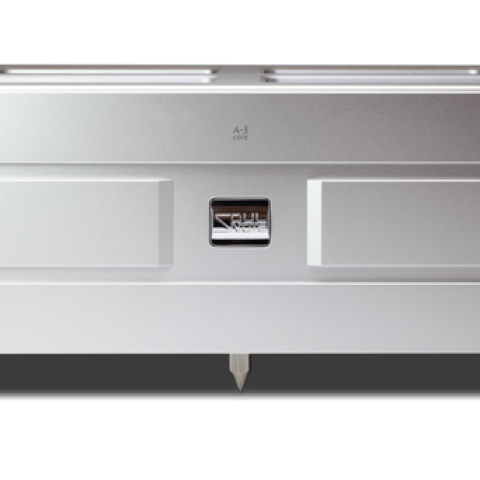
Octave Audio of Karlsbad, Germany, a longtime manufacturer of tube electronics, presented the North American debut of its new Octave Jubilee Class A mono amplifier ($85,000/pair; go here for more info) at Definitive Audio in Bellevue, Washington, (across the lake from Seattle) on January 29. The first stop in a three-city US tour by Andreas Hofmann, company president and designer, and John Quick, VP Sales & Marketing for Octave’s US distributor, Dynaudio North America, the multi-day event included two back-to-back sessions followed by open houses. Days later, Hofmann and Quick continued on to AudioVision San Francisco and Paragon Sight and Sound in Michigan.
"We picked up Octave because its sound tugs at the heartstrings," said Definitive's Hans Brackmann as he introduced Hofmann. Hofmann then explained that Octave, which his father founded in 1968 as a custom transformer-winding factory, continues to manufacture all its transformers in-house. Virtually all other components of Octave products are locally sourced.
 In 1977, Hofmann embraced the design philosophy of "tubes for sound-relevant circuit parts, and modern semiconductors for tube circuit periphery." As Octave’s chief engineer, he has striven ever since to transcend the inherent problems of tubes.
 Octave’s Jubilee Class A monos made their debut in a mouthwatering system that included an Innuos Nazaré music server/streamer and PhoenixNET Ethernet switch, dCS Varèse five-piece DAC, Octave Jubilee preamplifier ($42,000) (see my reviews here, here, and here), Octave phono module ($6000) with Black Box preamp passive power supply ($2350) and MC RCA step-up transformer ($3250), Clearaudio Master Jubilee turntable with Unify 9" tonearm and Goldfinger v2.1 MC cartridge, Wilson Audio Chronosonic XVX loudspeakers and Subsonic subwoofers, Transparent cabling, Shunyata Typhon T2 power conditioner with Omega-X-QR cables, and HRS VXR equipment stand.
The first track, an LP version of Beth Hart & Joe Bonamassa's "Your Heart is as Black as Night," surprised me with its neutrality and lack of classic tube signature. A digital file of Paul Simon's “Graceland” exhibited perfect bass control and displayed the beauty of Simon’s voice at its finest and most relaxed. Another file of The Stones' 1968 classic, "Sympathy for the Devil," demonstrated that the Octave Jubilee Class mono amplifiers can maintain control at high volume. The final selection, my bass torture test of choice, was the second half of the second movement of Shostakovich’s Symphony No. 11, performed by the Boston Symphony Orchestra under Andris Nelsons. Through a front end identical to my own left me hungering for the day when a surprise inheritance enables me to enlarge the music room to accommodate bigger loudspeakers (like the ones used here) with the midrange depth and stunning bass this stellar system delivered. Color me eager to review.
Octave’s Jubilee Class A monos made their debut in a mouthwatering system that included an Innuos Nazaré music server/streamer and PhoenixNET Ethernet switch, dCS Varèse five-piece DAC, Octave Jubilee preamplifier ($42,000) (see my reviews here, here, and here), Octave phono module ($6000) with Black Box preamp passive power supply ($2350) and MC RCA step-up transformer ($3250), Clearaudio Master Jubilee turntable with Unify 9" tonearm and Goldfinger v2.1 MC cartridge, Wilson Audio Chronosonic XVX loudspeakers and Subsonic subwoofers, Transparent cabling, Shunyata Typhon T2 power conditioner with Omega-X-QR cables, and HRS VXR equipment stand.
The first track, an LP version of Beth Hart & Joe Bonamassa's "Your Heart is as Black as Night," surprised me with its neutrality and lack of classic tube signature. A digital file of Paul Simon's “Graceland” exhibited perfect bass control and displayed the beauty of Simon’s voice at its finest and most relaxed. Another file of The Stones' 1968 classic, "Sympathy for the Devil," demonstrated that the Octave Jubilee Class mono amplifiers can maintain control at high volume. The final selection, my bass torture test of choice, was the second half of the second movement of Shostakovich’s Symphony No. 11, performed by the Boston Symphony Orchestra under Andris Nelsons. Through a front end identical to my own left me hungering for the day when a surprise inheritance enables me to enlarge the music room to accommodate bigger loudspeakers (like the ones used here) with the midrange depth and stunning bass this stellar system delivered. Color me eager to review.
 Quick shows the Octave V70 Class A integrated
In another sizable demo room in Definitive’s greatly expanded, excellently appointed store, Quick showed Octave’s V70 Class A integrated amp ($12,750) with auto-bias (see the review by Rob Schryer), Super Black Box power supply booster ($3750) with the integrated's optional built-in MC phono input ($950). In an impressive system that also included a dCS Rossini Apex DAC with Rossini Clock, Innuos Stream3 Streamer/Server, Clearaudio Ovation Turntable with Universal 9" tonearm and Stradivari v2 MC cartridge, Wilson Audio Sabrina V loudspeakers, Shunyata power and signal cables, and an HRS EXR equipment stand, a percussion track that my trusty SoundHound app failed to identify sounded fabulous. as in alive, natural, transparent, clean, and completely controlled. Male singing group Cantus’s beautiful rendition of “Shenandoah,” recorded by John Atkinson over two decades ago. (See the article on the making of this CD here. The clarity with which the vocal lines were separated was exceptional.
 Octave’s V80 SE integrated amp has a built-in headphone amp and outputs 120–150Wpc, depending upon choice of output tubes. "Octave electronics are very easy on tubes," Quick said. "If you play your system daily, you can expect 10–15 years life from input tubes and 3–5 years from output tubes. Though you can source your tubes from multiple sources, Octave carefully matches and grades the tubes it sells. In addition, all Octave amps have an Eco Mode that saves electricity and tube life and shortens warm-up time from 45 minutes to approximately 15 minutes." He also praised Octave’s "Super Black Box," a reasonably priced external power supply that produces better dynamics and lower noise.
 In another setup, we heard the Octave Audio V80 SE class-AB manual bias integrated amplifier ($15,000) with Super Black Box ($3750) and Phono EQ.2 ($2150). This fine system included a CH Precision C1.2 DAC and X1 power supply, Innuos Statement NG music streamer/server, Clearaudio Reference Jubilee turntable with Universal 9" tonearm and Jubilee MC cartridge, JBL Summit Pumori loudspeakers with Wilson Audio Submerge subwoofers, Transparent signal cables, Shunyata Everest-X and power cables, and an HRS EXR equipment stand. (Look atop the large, unheard CH Precision unit to see how small Octave’s Phono EQ .2 seems.)
 Jimi Hendrix’s "Born Under a Bad Sign" sounded coherent, firm, and perfectly sorted throughout its multi-octave range, and Ella Fitzgerald’s marvelous "Cry Me a River," from the LP Clap Hands, Here Comes Charlie, was perfection.
Look for more Octave reviews in future issues of Stereophile.
Jimi Hendrix’s "Born Under a Bad Sign" sounded coherent, firm, and perfectly sorted throughout its multi-octave range, and Ella Fitzgerald’s marvelous "Cry Me a River," from the LP Clap Hands, Here Comes Charlie, was perfection.
Look for more Octave reviews in future issues of Stereophile.