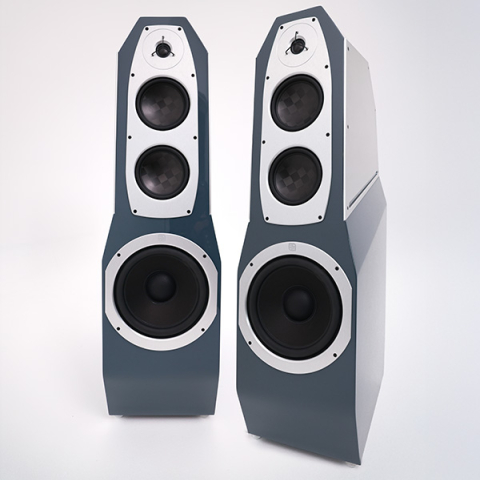
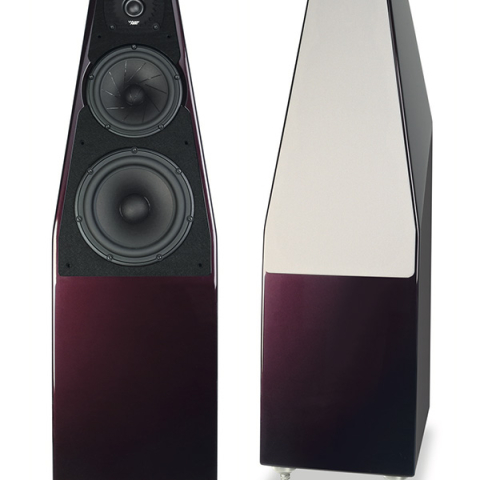
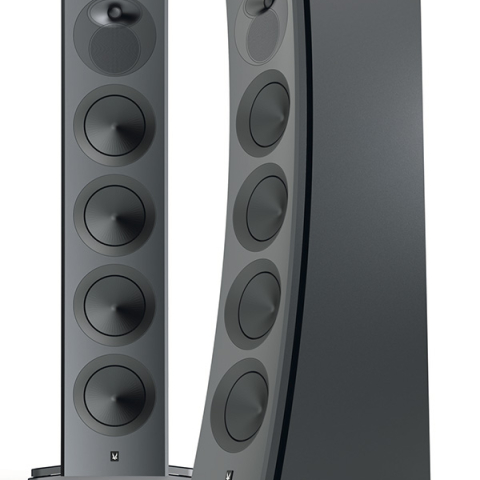
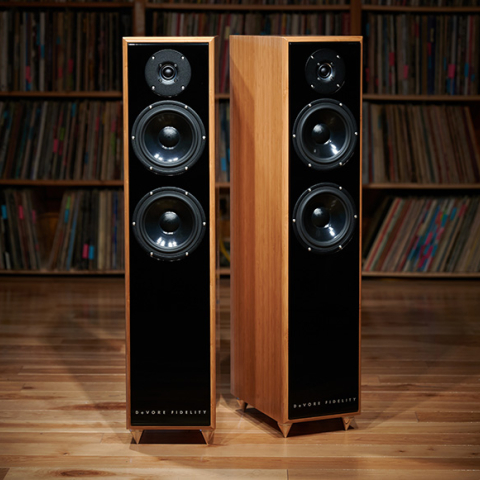
Monitor Audio's Platinum PL300 II loudspeakers weigh 120 lbs each, and my listening room is on the second floor, but I was spared the heavy lifting. The speakers were delivered by Sheldon Ginn, Jeffrey Ginn, and Jamie Arseneau—respectively, the VP of Sales and Marketing, Account Manager, and Service Manager of Kevro International, Monitor Audio's North American distributor. We set up the PL300 IIs, ensuring that the distance from each speaker to my listening seat was the same, then optimized the toe-in: the speakers ended up almost directly facing the listener position, close to where I'd had Wilson Audio's Sabrinas.
We then listened to selections from a few CDs. The sound was so good that I had difficulty maintaining the requisite Stereophile reviewer's poker face. However, Sheldon Ginn knew the reviewing protocol well enough not to ask what I thought of the sound, and the Kevro team departed. I continued listening for a while, tweaking the speaker positions a bit. Then my wife and I went out for lunch, leaving Monitor Audio's Bringing Sound to Life: System De-Tox Disk (CD) playing on repeat.
"How do you like the speakers?" she asked. A reviewer's spouse is allowed to ask such questions.
"It's too soon to say. Right now, I'd say they sound really good. But I'll have to do much more listening. I'll also have to think about how they compare with the Wilson Sabrinas, which I liked a lot."
"You poor boy."
"Yes," I said with a heavy sigh. "It's a dirty job. But somebody has to do it."
Design
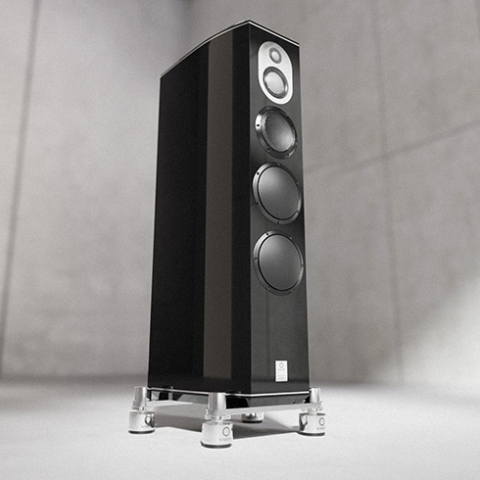
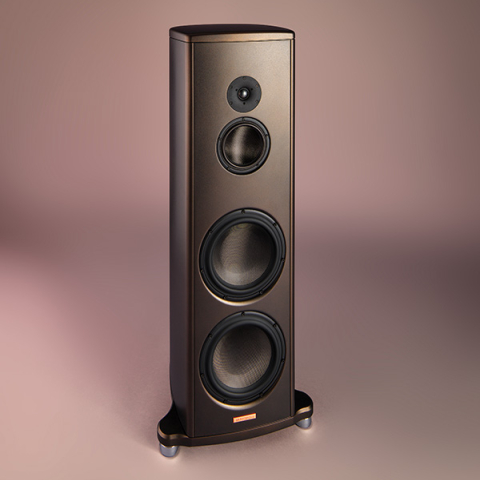
Apart from having three grilles for its four drivers rather than a single grille covering all, the Platinum PL300 II looks identical to the model it replaces, the Platinum PL300. Both have pair-matched veneers of natural wood (Santos Rosewood on the review samples), hand-coated with 11 layers of clear-gloss lacquer and polished to reveal the luster in the grain, with the front baffle covered in Inglestone leather. The speakers are simply gorgeous, with a quality of finish easily up to that of fine furniture.
The changes from the original PL300 are on the inside, and involve almost every aspect of the speaker's functioning. The first indication of these is the weight: the PL300 II weighs 120.0 lbs, compared to 96.4 lbs for the Series I. Sheldon Ginn told me that the greater weight of the PL300 II is attributable mostly to its drivers (magnets, etc.). The price of the PL300 was $11,000/pair, compared to almost $15,000/pair for the PL300 II. If you're the sort of person who judges the values of audio components on the basis of cost per pound, the PL300 II is just a bit more expensive than the PL300. But that, of course, is saying nothing about either model's technology or sound quality.
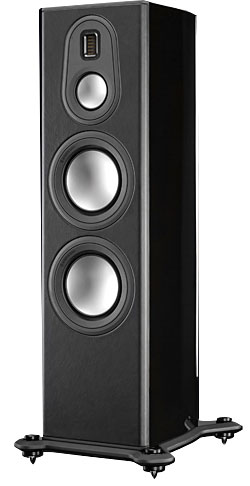 At the top of the PL300 II's cabinet is what represents the greatest change: the tweeter. The Series I had a ribbon tweeter, whereas the Series II uses, for the first time in a Monitor Audio product, a version of the Heil Air Motion Transformer (AMT), a kind of folded ribbon used in various forms by a number of manufacturers. According to a Monitor Audio white paper on the design of the Platinum II series, AMT tweeters typically have a null in their frequency response at 40kHz, with a –3dB point at about 28kHz. Research by Monitor engineers found that this null could be eliminated by reducing the roll height of the diaphragm and increasing the number of rolls, the result being what they call a Micro Pleated Diaphragm (MPD). According to the white paper, the elimination of the null allows the MPD to produce uniform output to over 100kHz. Compared to dome tweeters, or the ribbon tweeter used in the Platinum I models, the MPD has a much greater surface area that requires less excursion to produce a given output, resulting in higher sensitivity and higher power handling.
Other improvements claimed for the MPD tweeter are flatter impedance, better damping, superior transient response, lower distortion, and "a clean sonic character free of any harmonic artefacts."
Monitor's Rigid Diaphragm Technology (RDT) midrange and bass drive-units, used originally in the Platinum Is, have undergone substantial development, and are now designated RDTII. As with the MPD tweeter, a high priority was the reduction of harmonic distortion. The specific technical improvements are too numerous to describe in detail here; suffice it to say that distortion above 300Hz is said to have been reduced by 8dB, which represents a 60% reduction in the energy of harmonic components. The 4" RDTII midrange driver has uniform output to over 6kHz—more than an octave above the frequency (3.4kHz) at which this driver hands off to the tweeter. The crossover's midrange and tweeter sections use air-core inductors to minimize distortion and component interaction, with custom-made, 1%-tolerance, metalized polypropylene capacitors selected, by means of extensive listening tests, for best sound quality.
Monitor's technical director, Dean Hartley, is particularly proud of the company's new, patented Dynamic Coupling Filter (DCF), a nylon ring that fits between the voice-coil and the cone. The DCF acts as a solid part up to the crossover frequency, but above that frequency it acts as a damped spring, effectively adding a mechanical first-order filter to complement the electrical network, to result in a compound attenuation of 18dB/octave.
Nor have the PL300 II's mechanical components been neglected. Improvements thereto include: 1) the curved, multilayered cabinet, cast in Monitor's Anti-Resonant Composite (ARC), a thermo-set polymer loaded with minerals; 2) new internal bracing for structural integrity; 3) long bolts tightened to a specific torque to secure the drivers to the cabinet; 4) Bitumastic internal damping; 5) Tapered Line Exposure (TLE), a tapered, parabolic enclosure for the midrange drivers, also cast in ARC; 6) the second generation of Monitor's Hi-Velocity Vent technology, which accelerates the flow of air through the speaker's ports while reducing turbulence; and 7) rhodium-plated copper speaker terminals.
In discussing the design of the Platinum II models, Dean Hartley—who has been with Monitor for 18 years—said that the design has benefited greatly from the use of computer modeling, which, he says, "can take you . . . maybe 95% of the way there." The development of the Platinum IIs began in 2014, and, in addition to computer modeling, involved building a lot of prototypes. "We still use our ears!"
Tweaks
At the top of the PL300 II's cabinet is what represents the greatest change: the tweeter. The Series I had a ribbon tweeter, whereas the Series II uses, for the first time in a Monitor Audio product, a version of the Heil Air Motion Transformer (AMT), a kind of folded ribbon used in various forms by a number of manufacturers. According to a Monitor Audio white paper on the design of the Platinum II series, AMT tweeters typically have a null in their frequency response at 40kHz, with a –3dB point at about 28kHz. Research by Monitor engineers found that this null could be eliminated by reducing the roll height of the diaphragm and increasing the number of rolls, the result being what they call a Micro Pleated Diaphragm (MPD). According to the white paper, the elimination of the null allows the MPD to produce uniform output to over 100kHz. Compared to dome tweeters, or the ribbon tweeter used in the Platinum I models, the MPD has a much greater surface area that requires less excursion to produce a given output, resulting in higher sensitivity and higher power handling.
Other improvements claimed for the MPD tweeter are flatter impedance, better damping, superior transient response, lower distortion, and "a clean sonic character free of any harmonic artefacts."
Monitor's Rigid Diaphragm Technology (RDT) midrange and bass drive-units, used originally in the Platinum Is, have undergone substantial development, and are now designated RDTII. As with the MPD tweeter, a high priority was the reduction of harmonic distortion. The specific technical improvements are too numerous to describe in detail here; suffice it to say that distortion above 300Hz is said to have been reduced by 8dB, which represents a 60% reduction in the energy of harmonic components. The 4" RDTII midrange driver has uniform output to over 6kHz—more than an octave above the frequency (3.4kHz) at which this driver hands off to the tweeter. The crossover's midrange and tweeter sections use air-core inductors to minimize distortion and component interaction, with custom-made, 1%-tolerance, metalized polypropylene capacitors selected, by means of extensive listening tests, for best sound quality.
Monitor's technical director, Dean Hartley, is particularly proud of the company's new, patented Dynamic Coupling Filter (DCF), a nylon ring that fits between the voice-coil and the cone. The DCF acts as a solid part up to the crossover frequency, but above that frequency it acts as a damped spring, effectively adding a mechanical first-order filter to complement the electrical network, to result in a compound attenuation of 18dB/octave.
Nor have the PL300 II's mechanical components been neglected. Improvements thereto include: 1) the curved, multilayered cabinet, cast in Monitor's Anti-Resonant Composite (ARC), a thermo-set polymer loaded with minerals; 2) new internal bracing for structural integrity; 3) long bolts tightened to a specific torque to secure the drivers to the cabinet; 4) Bitumastic internal damping; 5) Tapered Line Exposure (TLE), a tapered, parabolic enclosure for the midrange drivers, also cast in ARC; 6) the second generation of Monitor's Hi-Velocity Vent technology, which accelerates the flow of air through the speaker's ports while reducing turbulence; and 7) rhodium-plated copper speaker terminals.
In discussing the design of the Platinum II models, Dean Hartley—who has been with Monitor for 18 years—said that the design has benefited greatly from the use of computer modeling, which, he says, "can take you . . . maybe 95% of the way there." The development of the Platinum IIs began in 2014, and, in addition to computer modeling, involved building a lot of prototypes. "We still use our ears!"
Tweaks
I began listening to the Platinum PL300 IIs with my McIntosh Laboratory MC275LE, a tubed power amplifier with separate output terminals for connecting loudspeakers with impedances of 4, 8, or 16 ohms. In my review of the Wilson Sabrina, I found that while the Sabrina is specified as having a nominal impedance of 4 ohms, I preferred the sound through the Mac's 8 ohm terminals. The PL300 II is also specced at 4 ohms, and I thought that it, too, might sound better through the MC275LE's 8 ohm terminals. But not this time. The sound through the 4 ohm terminals was more coherent, with, apparently, better integration between the drivers. The PL300 II's two rear-firing ports load only the bass drivers; the midrange-and-tweeter module has its own sealed cabinet-within-a-cabinet. When I first talked with Sheldon Ginn about reviewing one of the Platinum II models, he gave me a choice: the PL200 II or the PL300 II. I'd reviewed the PL200 six years before, which might have made the PL200 II the obvious choice, but I was interested in what Monitor could do with a speaker a step higher in size and price—a price about the same as that of Wilson's Sabrina, which I'd just reviewed. Ginn said that the original PL300 had a bass response that tended to overload rooms as small as mine (16' long by 14' wide by 7.5' high), and that considerable effort had been made to ensure that the PL300 II would provide a more neutral bass response in a wider range of environments, including the small rooms that are common in the UK (and in my house). He thought it would be a good match. As soon we set up the speakers, and before any serious attempts at optimizing the speaker positions, it was obvious that bass overload was not going to be a problem. Nonetheless, each PL300 II comes with two port bungs—foam inserts that effectively turn this ported design into a sealed box, reducing the possibility of bass boom. I thought I'd better give them a try.
I listened to the speakers first with the ports open, then with both ports plugged, and, finally, with only the bottom port plugged. The sound with both ports plugged was too lean. With only the bottom port plugged, the difference was more subtle, but after going back and forth, single bottom port plugged and then unplugged, and listening to music with considerable low- and midbass content, I decided that I preferred the sound with both ports open. Later listening with Theta Digital's high-powered, solid-state Prometheus monoblock amplifiers—which provide better control over bass response—didn't change this conclusion.
The original PL200 and PL300 each had a single metal grille that covered the entire front of the speaker; these were magnetically attached, which made it easy to compare the effects of the grilles on the sound. (Like most speakers I've reviewed, the PL200 sounded better without its grille.) However, the PL300 II has separate grilles for the tweeter-midrange module and each woofer, and they're attached differently; installing or removing them requires a special tool (provided). The owner's manual provides no instructions in the use of this tool, and even Sheldon Ginn had trouble figuring out how to use it. (Hint: think can opener.)
A white paper on the Platinum II series states that the grilles were designed to be acoustically transparent: the sound should be the same, whether they're on or off. That's pretty much what I found. In fact, if anything, I had a slight preference for the sound with the grilles. When I asked Dean Hartley about what might account for this preference, he told me that while the design aim was for the grilles to be acoustically transparent, the speakers were voiced with the grilles on, so one might expect them to sound better that way. So that's how I did all of my critical listening.
The PL300 II comes with a plinth that allows leveling (a spirit level is included), and a set of spikes that the manual recommends using on carpeted, not wooden or hard floors. My listening room has a wooden floor, so I first listened to the speakers without spikes. (The speakers have integral rubber pads.) However, I've reviewed a number of speakers that sounded better in this room with spikes, and felt I should try them with the PL300 IIs.
Whenever I try a tweak, I go back and forth several times, trying to determine a) whether the tweak makes an audible difference, and, if so, b) whether the difference is a positive one (better, more natural sound, higher resolution, etc.). Comparing the sound of any floorstanding speaker with or without spikes is not that easy: you have to be very careful not to shift the speakers' positions in any other way. Sheldon and Jeff Ginn (they're brothers) made another house call, and we compared the PL300 IIs' sound with and without the spikes. There was a difference, but it was marginal, and required swapping the spikes in and out several times before I could get a handle on it. In the end, we decided that the bass was a bit tighter with the spikes, but it was a close thing. If you owned these speakers, and were concerned about spikes causing damage to a wooden floor, I would suggest using the speakers without spikes and just not worrying about it.
The owner's manual suggests running-in the speakers with 50–70 hours of playing Monitor's System De-Tox Disk, and notes that, "like fine wine, the performance will improve with age." I'm a believer in break-in—I've reviewed speakers for which it had an obvious positive effect—but in the case of the PL300 II, any improvements were minimal. I was later told that my review samples had already gotten 50 hours of break-in at the factory.
Listening
The original Platinum PL200, listed in Class A of our "Recommended Components," was one of my favorites of the speakers I've reviewed. I first heard its successor, the PL200 II, at the 2016 Consumer Electronics Show, where it impressed me as representing a significant improvement over the already excellent original. My expectations for the Platinum PL300 II were high. However, my experiences with the PL 200 and PL 200 II didn't prepare me for the sound of the PL300 II. Right out of the box, the PL300 II had an utterly natural sound that drew me into the music.
Apart from having three grilles for its four drivers rather than a single grille covering all, the Platinum PL300 II looks identical to the model it replaces, the Platinum PL300. Both have pair-matched veneers of natural wood (Santos Rosewood on the review samples), hand-coated with 11 layers of clear-gloss lacquer and polished to reveal the luster in the grain, with the front baffle covered in Inglestone leather. The speakers are simply gorgeous, with a quality of finish easily up to that of fine furniture.
At the top of the PL300 II's cabinet is what represents the greatest change: the tweeter. The Series I had a ribbon tweeter, whereas the Series II uses, for the first time in a Monitor Audio product, a version of the Heil Air Motion Transformer (AMT), a kind of folded ribbon used in various forms by a number of manufacturers. According to a Monitor Audio white paper on the design of the Platinum II series, AMT tweeters typically have a null in their frequency response at 40kHz, with a –3dB point at about 28kHz. Research by Monitor engineers found that this null could be eliminated by reducing the roll height of the diaphragm and increasing the number of rolls, the result being what they call a Micro Pleated Diaphragm (MPD). According to the white paper, the elimination of the null allows the MPD to produce uniform output to over 100kHz. Compared to dome tweeters, or the ribbon tweeter used in the Platinum I models, the MPD has a much greater surface area that requires less excursion to produce a given output, resulting in higher sensitivity and higher power handling.
Other improvements claimed for the MPD tweeter are flatter impedance, better damping, superior transient response, lower distortion, and "a clean sonic character free of any harmonic artefacts."
Monitor's Rigid Diaphragm Technology (RDT) midrange and bass drive-units, used originally in the Platinum Is, have undergone substantial development, and are now designated RDTII. As with the MPD tweeter, a high priority was the reduction of harmonic distortion. The specific technical improvements are too numerous to describe in detail here; suffice it to say that distortion above 300Hz is said to have been reduced by 8dB, which represents a 60% reduction in the energy of harmonic components. The 4" RDTII midrange driver has uniform output to over 6kHz—more than an octave above the frequency (3.4kHz) at which this driver hands off to the tweeter. The crossover's midrange and tweeter sections use air-core inductors to minimize distortion and component interaction, with custom-made, 1%-tolerance, metalized polypropylene capacitors selected, by means of extensive listening tests, for best sound quality.
I began listening to the Platinum PL300 IIs with my McIntosh Laboratory MC275LE, a tubed power amplifier with separate output terminals for connecting loudspeakers with impedances of 4, 8, or 16 ohms. In my review of the Wilson Sabrina, I found that while the Sabrina is specified as having a nominal impedance of 4 ohms, I preferred the sound through the Mac's 8 ohm terminals. The PL300 II is also specced at 4 ohms, and I thought that it, too, might sound better through the MC275LE's 8 ohm terminals. But not this time. The sound through the 4 ohm terminals was more coherent, with, apparently, better integration between the drivers. The PL300 II's two rear-firing ports load only the bass drivers; the midrange-and-tweeter module has its own sealed cabinet-within-a-cabinet. When I first talked with Sheldon Ginn about reviewing one of the Platinum II models, he gave me a choice: the PL200 II or the PL300 II. I'd reviewed the PL200 six years before, which might have made the PL200 II the obvious choice, but I was interested in what Monitor could do with a speaker a step higher in size and price—a price about the same as that of Wilson's Sabrina, which I'd just reviewed. Ginn said that the original PL300 had a bass response that tended to overload rooms as small as mine (16' long by 14' wide by 7.5' high), and that considerable effort had been made to ensure that the PL300 II would provide a more neutral bass response in a wider range of environments, including the small rooms that are common in the UK (and in my house). He thought it would be a good match. As soon we set up the speakers, and before any serious attempts at optimizing the speaker positions, it was obvious that bass overload was not going to be a problem. Nonetheless, each PL300 II comes with two port bungs—foam inserts that effectively turn this ported design into a sealed box, reducing the possibility of bass boom. I thought I'd better give them a try.
The original Platinum PL200, listed in Class A of our "Recommended Components," was one of my favorites of the speakers I've reviewed. I first heard its successor, the PL200 II, at the 2016 Consumer Electronics Show, where it impressed me as representing a significant improvement over the already excellent original. My expectations for the Platinum PL300 II were high. However, my experiences with the PL 200 and PL 200 II didn't prepare me for the sound of the PL300 II. Right out of the box, the PL300 II had an utterly natural sound that drew me into the music.