Sound Quality
When I first listened to the Mark Levinson No.53, its sound most reminded me of that of the Soulution 710 stereo amplifier that I reviewed in August 2011: fast, precise, detailed, somewhat lean overall, and more interested in correctly producing the initial transient than in fleshing out the texture-producing sustain. In "Yulunga," from Dead Can Dance's Into the Labyrinth (LP, 4AD), the hand drum crackled with taut definition, while the metal percussive accent that floats above was noticeably and appropriately metallic. The shaker was reproduced as cleanly as I've ever heard it; the sound of each seed (or whatever) inside it was precisely rendered and compactly sized. But the hand drum, too, sounded somewhat metallic. Clean, orderly, and precise, with a pitch-black backdrop, the No.53's reproduction of this album was in many ways compelling, though stage depth was less pronounced than I've grown accustomed to, and the picture was generally dry.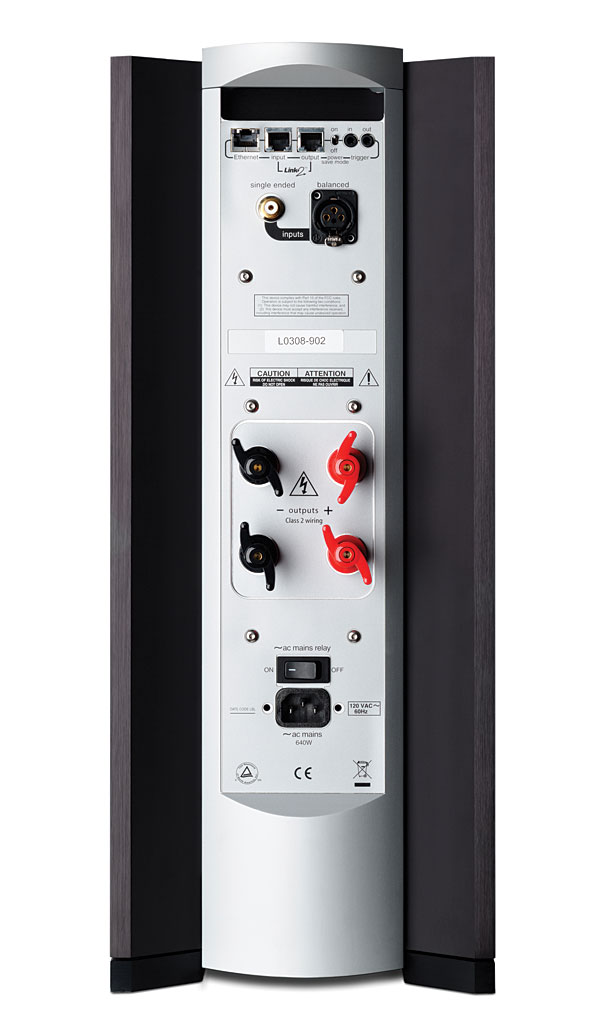 As promised, the No.53's bottom end was fast, taut, and very well extended through the Wilson Audio Specialties Alexandria XLF speakers (review in the works)—the bass transients in "Yulunga" were superbly defined. The depth-charge bass notes a few minutes in had full extension and notably clean delineation of the transients, though they could have used some additional weight, and definitely more body. The amp gripped that bass bomb and held it cleanly until it was time to let it go. Then it seemed to dissipate unusually cleanly and quickly.
If you like your midband rich, you won't get it from the No.53; but if you like it transparent, open, and lightning-fast, that the ML could do—it was much like the Soulution 710 in that way.
I sat down and began cycling through CD-resolution and higher-rez files, using an iPad to control my Meridian (née Sooloos) Digital Music Server via Meridian's Core Control app. Decoding duties were performed by MSB's Platinum Diamond DAC IV, which produces the best digital sound I've ever heard, particularly in terms of top-end cleanness, transient clarity, image size, and three-dimensionality.
I went through everything from "It's Good News Week," by Hedgehoppers Anonymous, to Howlin' Wolf's "Smokestack Lightning," to Arvo Pärt's Kanon Pokajanen, with the Estonian Philharmonic and Chamber Choir conducted by Tõnu Kaljuste (ECM New Series 1654/55), and noted the overall transient precision, superb if not unprecedented speed and clarity, resolution of inner detail, and black backgrounds. However, there was also a dose of listening fatigue partly caused by high-frequency hardness, and partly by the overall dryness, which also produced well-rendered outlines but little in the way of nuanced textures: all outer shell, very little creamy center.
Women's voices were problematic through the No.53. For instance, "Fields of Gold," from an out-of-print edition of Eva Cassidy's Songbird (LP, S&P 501), features a pristine recording of her stunningly pure voice, bathed in reverberation. The voice should be pinpoint sharp in the best sense of that phrase, compact in size, and well separated from the engulfing reverb. That reverb should be a cushion, not a trap. Through the No.53s Cassidy's voice was pinpoint sharp but the reverb, instead of being airy and ethereal, sounded like a hard haze that obscured detail at low levels and became fatiguing at higher ones. Reverb should be experienced as an event separate from the main one, but with every record or file I played through the No.53s, instruments, voices, and reverb seemed to blend into a single event.
As seems to be the case with switching amps, no matter how carefully designed, the higher in frequency the music goes, the more problems there are. That also holds true the more you turn up the volume. Generally speaking, the louder I played the No.53s, the more pronounced the haze. The more high-frequency content in the music—women's voices, cymbals, reverberant backdrops—the more the haze intruded on and obscured the images, forcing me to turn down the volume.
As promised, the No.53's bottom end was fast, taut, and very well extended through the Wilson Audio Specialties Alexandria XLF speakers (review in the works)—the bass transients in "Yulunga" were superbly defined. The depth-charge bass notes a few minutes in had full extension and notably clean delineation of the transients, though they could have used some additional weight, and definitely more body. The amp gripped that bass bomb and held it cleanly until it was time to let it go. Then it seemed to dissipate unusually cleanly and quickly.
If you like your midband rich, you won't get it from the No.53; but if you like it transparent, open, and lightning-fast, that the ML could do—it was much like the Soulution 710 in that way.
I sat down and began cycling through CD-resolution and higher-rez files, using an iPad to control my Meridian (née Sooloos) Digital Music Server via Meridian's Core Control app. Decoding duties were performed by MSB's Platinum Diamond DAC IV, which produces the best digital sound I've ever heard, particularly in terms of top-end cleanness, transient clarity, image size, and three-dimensionality.
I went through everything from "It's Good News Week," by Hedgehoppers Anonymous, to Howlin' Wolf's "Smokestack Lightning," to Arvo Pärt's Kanon Pokajanen, with the Estonian Philharmonic and Chamber Choir conducted by Tõnu Kaljuste (ECM New Series 1654/55), and noted the overall transient precision, superb if not unprecedented speed and clarity, resolution of inner detail, and black backgrounds. However, there was also a dose of listening fatigue partly caused by high-frequency hardness, and partly by the overall dryness, which also produced well-rendered outlines but little in the way of nuanced textures: all outer shell, very little creamy center.
Women's voices were problematic through the No.53. For instance, "Fields of Gold," from an out-of-print edition of Eva Cassidy's Songbird (LP, S&P 501), features a pristine recording of her stunningly pure voice, bathed in reverberation. The voice should be pinpoint sharp in the best sense of that phrase, compact in size, and well separated from the engulfing reverb. That reverb should be a cushion, not a trap. Through the No.53s Cassidy's voice was pinpoint sharp but the reverb, instead of being airy and ethereal, sounded like a hard haze that obscured detail at low levels and became fatiguing at higher ones. Reverb should be experienced as an event separate from the main one, but with every record or file I played through the No.53s, instruments, voices, and reverb seemed to blend into a single event.
As seems to be the case with switching amps, no matter how carefully designed, the higher in frequency the music goes, the more problems there are. That also holds true the more you turn up the volume. Generally speaking, the louder I played the No.53s, the more pronounced the haze. The more high-frequency content in the music—women's voices, cymbals, reverberant backdrops—the more the haze intruded on and obscured the images, forcing me to turn down the volume.
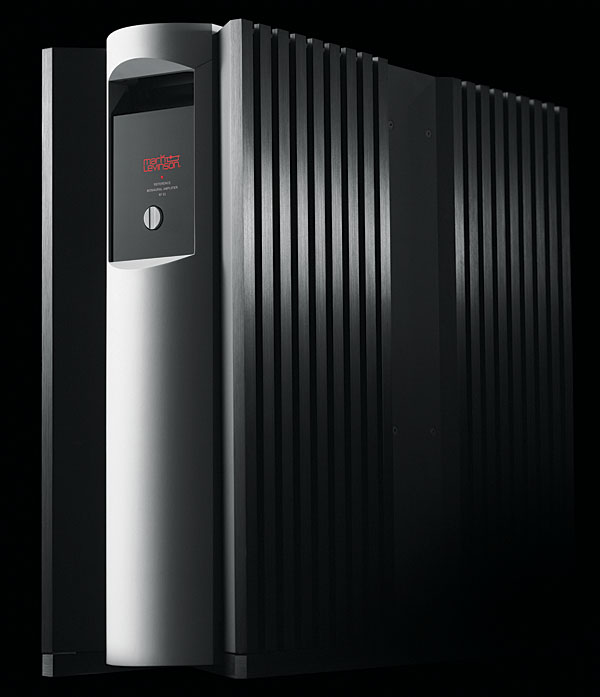 Singer Johnny Hartman's baritone on John Coltrane and Johnny Hartman (LP, Impulse!/ORG 017) should produce a warm, rich, graceful, round, full voice between the speakers. The No.53s managed great clarity and edge definition, as they did with everything I played, analog or digital, but Hartman's voice sounded grayed-out. Turning up the volume helped fill it in a bit, but as soon as Hartman or Coltrane accented something with an increase in loudness, particularly in the upper octaves, the haze seemed to increase, pressing against an imaginary wall that prevented it from expressing itself spatially. The soundstages of familiar recordings were noticeably flattened.
Cables to the Rescue?
Singer Johnny Hartman's baritone on John Coltrane and Johnny Hartman (LP, Impulse!/ORG 017) should produce a warm, rich, graceful, round, full voice between the speakers. The No.53s managed great clarity and edge definition, as they did with everything I played, analog or digital, but Hartman's voice sounded grayed-out. Turning up the volume helped fill it in a bit, but as soon as Hartman or Coltrane accented something with an increase in loudness, particularly in the upper octaves, the haze seemed to increase, pressing against an imaginary wall that prevented it from expressing itself spatially. The soundstages of familiar recordings were noticeably flattened.
Cables to the Rescue?
I wondered if swapping out the TARA Labs Omega Gold speaker cables, with their airy, extended top end, for something warmer and more inviting, might help. I had on hand the softer- and richer-sounding Stealth Dream V10, as well as AudioQuest's William E. Low Signature Series. I tried both. The overall balance became warmer and more burnished on top, but that seemed to mute the clarity of the very top end and the transient precision—among the No.53's best qualities—while accentuating and laying bare the haze and glare still inhabiting the upper octaves. Conclusions
I found the sound of the No.53 very fast and clean, though very lean. They resolved a remarkable amount of genuine detail but were harmonically threadbare, sounded somewhat hard and mechanical on top, and had a hazy overlay just below that. The bass was fast, lean, taut, and well damped—rhythm'n'pacing were among the No.53's strongest suits. But overall, the nature of the sound induced listening fatigue. I rarely listened for more than an hour at a time, which for me is unusual. Mark Levinson's No.53 is beautifully built, technologically impressive, and physically attractive in an industrial high-tech kind of way. If you prefer powerful, muscular solid-state amps—I'm already sold on them—and you're shopping in the $50,000 range, find a retailer who can demonstrate for you a pair of No.53s, and give them a long, serious listen. You might like the sound, especially if your goal is to firm up a system that sounds too warm and loose. But be careful—at first, you might be bowled over by their speed, clarity, and seeming resolution of detail. Longer-term listening, however, might reveal that those pinpoints of detail appear because the surrounding context has been stripped away.
When I first listened to the Mark Levinson No.53, its sound most reminded me of that of the Soulution 710 stereo amplifier that I reviewed in August 2011: fast, precise, detailed, somewhat lean overall, and more interested in correctly producing the initial transient than in fleshing out the texture-producing sustain. In "Yulunga," from Dead Can Dance's Into the Labyrinth (LP, 4AD), the hand drum crackled with taut definition, while the metal percussive accent that floats above was noticeably and appropriately metallic. The shaker was reproduced as cleanly as I've ever heard it; the sound of each seed (or whatever) inside it was precisely rendered and compactly sized. But the hand drum, too, sounded somewhat metallic. Clean, orderly, and precise, with a pitch-black backdrop, the No.53's reproduction of this album was in many ways compelling, though stage depth was less pronounced than I've grown accustomed to, and the picture was generally dry.
As promised, the No.53's bottom end was fast, taut, and very well extended through the Wilson Audio Specialties Alexandria XLF speakers (review in the works)—the bass transients in "Yulunga" were superbly defined. The depth-charge bass notes a few minutes in had full extension and notably clean delineation of the transients, though they could have used some additional weight, and definitely more body. The amp gripped that bass bomb and held it cleanly until it was time to let it go. Then it seemed to dissipate unusually cleanly and quickly.
Singer Johnny Hartman's baritone on John Coltrane and Johnny Hartman (LP, Impulse!/ORG 017) should produce a warm, rich, graceful, round, full voice between the speakers. The No.53s managed great clarity and edge definition, as they did with everything I played, analog or digital, but Hartman's voice sounded grayed-out. Turning up the volume helped fill it in a bit, but as soon as Hartman or Coltrane accented something with an increase in loudness, particularly in the upper octaves, the haze seemed to increase, pressing against an imaginary wall that prevented it from expressing itself spatially. The soundstages of familiar recordings were noticeably flattened.
I wondered if swapping out the TARA Labs Omega Gold speaker cables, with their airy, extended top end, for something warmer and more inviting, might help. I had on hand the softer- and richer-sounding Stealth Dream V10, as well as AudioQuest's William E. Low Signature Series. I tried both. The overall balance became warmer and more burnished on top, but that seemed to mute the clarity of the very top end and the transient precision—among the No.53's best qualities—while accentuating and laying bare the haze and glare still inhabiting the upper octaves. Conclusions
I found the sound of the No.53 very fast and clean, though very lean. They resolved a remarkable amount of genuine detail but were harmonically threadbare, sounded somewhat hard and mechanical on top, and had a hazy overlay just below that. The bass was fast, lean, taut, and well damped—rhythm'n'pacing were among the No.53's strongest suits. But overall, the nature of the sound induced listening fatigue. I rarely listened for more than an hour at a time, which for me is unusual. Mark Levinson's No.53 is beautifully built, technologically impressive, and physically attractive in an industrial high-tech kind of way. If you prefer powerful, muscular solid-state amps—I'm already sold on them—and you're shopping in the $50,000 range, find a retailer who can demonstrate for you a pair of No.53s, and give them a long, serious listen. You might like the sound, especially if your goal is to firm up a system that sounds too warm and loose. But be careful—at first, you might be bowled over by their speed, clarity, and seeming resolution of detail. Longer-term listening, however, might reveal that those pinpoints of detail appear because the surrounding context has been stripped away.