Jim Austin briefly discusses MQA in his review of the Explorer2 in this issue, but a more complete description of MQA can be found in an article posted on Stereophile's website at the end of 2014.
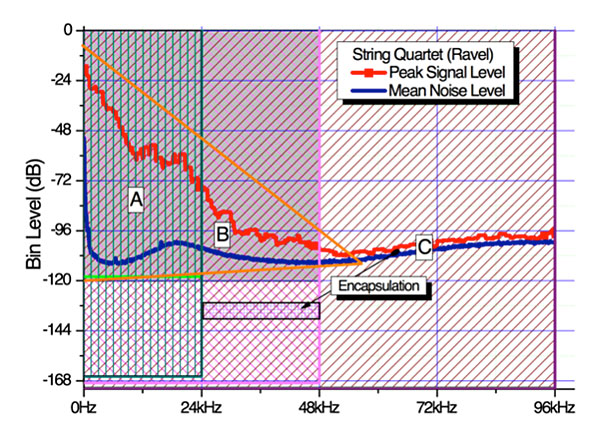
MQA involves two fundamental concepts, discussed in a paper presented to the Audio Engineering Society in October 2014 (footnote 1), the first responsible for a potential improvement in sound quality, the second responsible for a large reduction in the bandwidth required for storage and streaming of high-resolution files:
MQA can compensate for the time-domain errors of both the original A/D converters used to make a recording and the D/A converter used to play it back. This results in the complete recording/playback chain having an impulse response equivalent to a few feet of air, and temporal resolution of the same form and order as that of the temporal sensitivity of the ear-brain.
With files sampled at 2x, 4x, or 8x the baseband rate of 44.1 or 48kHz, the information in the one, two, or three ultrasonic octaves can be encoded and packed below the music's baseband noise floor in a 24-bit container. (Bob Stuart says the buried data, which are encoded to resemble noise and are uncorrelated with the music, lie beneath the analog signal's noisefloor.) This "audio origami" results in a much smaller file size than the hi-rez PCM equivalent, yet when the file is unfolded, the resolution and bandwidth of the original file are preserved. If an MQA file is played without MQA decoding or time-domain correction, the sound quality will be that of the baseband file—ie, the same as a CD—meaning that the record company need stock only a single inventory.
As well as the bandwidth benefit for streaming, there is another commercial benefit for the record industry with MQA that is not true of lossless packing schemes such as FLAC: the record company will no longer be selling a duplicate of their hi-rez master, with all the implications for piracy that that implies. Instead, they are selling something that might well sound identical to the master, but doesn't allow the master to be re-created.
The only way of testing MQA's time-domain correction is through listening, so I sent Bob Stuart the 24/88.2 masters of some of my recordings, for him to produce MQA versions. I will be reporting on the sound-quality differences I hear between the original and MQA files in a future issue. But in the meantime, I examined the files' properties.
The reduction in file size is significant. The 24/88.2 WAV master file for my recording of the Portland State Chamber Choir's 2014 performance of "Amazing Grace" is 169.5MB. The MQA-encoded FLAC version is just 51.5MB: 30% of the original size. For reference, the 24/88.2 Apple Lossless version is 90.7MB, or 53.3% of the original, and the version on the CD (footnote 2), limited to 16-bit/44.1kHz, is 55.7MB, or 33%. MQA, therefore, gives the greatest reduction in file size and thus necessary streaming bandwidth, yet potentially possesses the same bandwidth and resolution as the hi-rez original.
Does it preserve those hi-rez qualities? To answer that question, I played both the original file and the MQA file with Audirvana running on a Mac mini and with the Explorer2 selected as the playback device. (Although Audirvana reported the MQA file as a 24-bit FLAC sampled at 44.1kHz, the Explorer2's second white LED illuminated to indicate 88.2kHz data, and its first LED turned green to indicate MQA encoding; with actual artist/producer authentication, it would turn blue.) I recorded the analog line output of the Explorer2 with a 24-bit Ayre Acoustics QA-9 A/D converter so I could compare the frequency-domain properties of the decoded files with those of the originals using Adobe Audition's FFT engine. I also recorded the analog output of the undecoded MQA files played back with our review sample of the original Explorer.
Fig.1 shows a spectral analysis of the entire "Amazing Grace" 24/88.2 master file with the levels plotted in white (highest) through yellow, red, magenta, and blue. It is difficult to see at the scale this graph is printed, but the spectrum does reveal content extending to 27kHz or so at the musical climaxes. This content would, of course, be eliminated when the file was converted to 44.1kHz for release on CD.

 The cyan and red traces in fig.2 were taken with the original Meridian Explorer being fed with the MQA FLAC file. It can't unpack the MQA data, of course, so plays the file as a 24/44.1 file. The traces overlay the WAV and MQA spectra up to 12kHz, above which the noise floor starts to rise, peaking between 20 and 22kHz before being rolled off by the Explorer's reconstruction filter. There is another small peak evident just below 44.1kHz. Fig.3 compares a spectral analysis of the hi-rez WAV file's noise floor (footnote 3) played on the Explorer2 with that of the undecoded MQA file played on the original Explorer. Again, the undecoded noise floor starts to rise in the treble, this time covering a broader bandwidth than in fig.2, but again peaking between 20 and 22kHz.
 This is very much a preliminary report, but it suggests that the "audio origami" aspect of MQA does work as advertised, folding super-baseband content under the recording's analog noise floor to achieve a dramatic reduction in file size/streaming bandwidth. There is no such thing as a free lunch, of course, and the tradeoff is that a decoded MQA recording is basically limited to an effective resolution of less than 24 bits. But D/A converters offering 19 bits' worth of resolution or more are rare, in my experience, and what might be at most a loss of theoretical resolution may well be outweighed by MQA's time-domain correction. And that brings us back to listening.—John Atkinson
Footnote 1: See Stuart, J. Robert, and Craven, Peter, "A Hierarchical Approach to Archiving and Distribution." See also the free download "Journal of the Audio Engineering Society. Footnote 2: Into Unknown Worlds. Footnote 3: I used "Amazing Grace" for this report as it is one of the quietest recordings I have engineered. Its noise floor has basically a red spectrum, dominated by environmental noise at low frequencies and tilted down at high frequencies.
Fig.1 "Amazing Grace," Portland State Chamber Choir, 24/88.2 WAV file, spectral analysis of complete track (left top, right bottom).
Fig.2 shows a more conventional spectral plot for the track as a whole. The spectra of the original WAV file (blue and magenta traces) are exactly overlaid by the spectra of the MQA FLAC file decoded by the Meridian Explorer2 (green and gray traces), indicating that the MQA encode/decode process does accurately preserve the frequency-domain characteristics of the original hi-rez file up to the Nyquist frequency of 44.1kHz, despite the baseband lossless-encoded file being less than one-third its size.
Fig.2. "Amazing Grace," complete track, spectrum of original WAV file played on Meridian Explorer2 (left channel blue, right magenta); MQA FLAC file decoded by the Explorer2 (left green, right gray); MQA FLAC file played without decoding by the original Explorer (left cyan, right, red) (10dB/vertical div.).
Fig.3 "Amazing Grace," noise floor, spectrum of original WAV file played by the Explorer2 (left channel blue, right red) and of MQA FLAC file played without decoding by the original Explorer (left green, right, gray) (10dB/vertical div.).
This behavior with undecoded MQA data is very similar to what happens when a 24-bit file is decimated to 16 bits using the POW-R narrowband Nyquist dithering scheme. Provided that MQA's encoding of the super-baseband information results in data that resemble random noise components that are not correlated with the musical information, therefore, playback of a 24-bit MQA-encoded file on a non-MQA D/A converter should be benign.
Footnote 1: See Stuart, J. Robert, and Craven, Peter, "A Hierarchical Approach to Archiving and Distribution." See also the free download "Journal of the Audio Engineering Society. Footnote 2: Into Unknown Worlds. Footnote 3: I used "Amazing Grace" for this report as it is one of the quietest recordings I have engineered. Its noise floor has basically a red spectrum, dominated by environmental noise at low frequencies and tilted down at high frequencies.