To those who were into audio in the late 1980s and early '90s, the name Audio Alchemy is a familiar one. I've owned DACs and jitter-reducing devices made by Audio Alchemy and Perpetual Technologies (the first successor to the original AA) and found them to provide excellent performance at modest prices. Indeed, at the time, many in the industry felt that the Audio Alchemy products were underpriced, leaving too little room for profit, and that this led to the company's demise. The new Audio Alchemy—led by its original designer, Peter Madnick, and having on staff other employees from the old AA—is what Madnick describes as a "grown-up" version of the original company, maintaining "the brand's original ethos of superior technology and value." And the prices, while quite reasonable for the performance they seem to offer, appear high enough to allow the new AA to survive.
As I awaited delivery of review samples of Audio Alchemy's DPA-1M—a monoblock based on a class-D amplifier module from the Dutch company Hypex Electronics—I received the March 2016 issue of Stereophile, which included Kal Rubinson's reviews of NAD's Masters Series M2 stereo power amplifier and Theta Digital's Dreadnaught D multichannel amplifier. Both use modules from Hypex. (Are we in the Hypex era of amplifiers?)
More to the point, I also had on hand a pair of Theta's Hypex-based Prometheus monoblocks, which I used to good effect in my review of Wilson Audio Specialties' Sabrina loudspeaker. The Prometheus sells for $12,000/pair—not exactly a bargain price. It's also big (9" wide by 13.5" high by 19.8" deep) and heavy (54.1 lbs each), and so doesn't deliver on class-D's promise of being small and light.
But the Audio Alchemy DPA-1M is small (10.4" W by 3" H by 11.5") and light (16.1 lbs each), and costs $3990/pair (the materially identical DPA-1 Stereo costs $1995), and so comes closer to fulfilling the promise of class-D. But what about the sound? All in the fullness of time—but bear in mind that, on the Hypex website, a white paper by Bruno Putzeys, chief engineer of research and development, mentions a reviewer (unidentified, but not one who writes for Stereophile) who "yammered" that it was no fun writing about amplifiers based on Hypex modules, because they just sound clean and neutral. I'll try to keep any yammering to a minimum.
Design
Hypex offers a number of class-D amplifier output-stage modules that fall into their UcD and NCore categories; the differences among these, which are highly technical and mostly beyond my understanding, are described at www.hypex.nl. Suffice it to say that Bruno Putzeys describes NCore, the more recent design, as superior to UcD. The Audio Alchemy DPA-1M uses one of the earlier UcD modules, which Audio Alchemy's Peter Madnick told me he actually prefers to the NCores in this design. The DPA-1M is specified as producing 325W into 8 ohms or 400W into 4 ohms, whereas the NCore-powered Theta Prometheus outputs 250W into 8 ohms, 500W into 4 ohms, or 850W into 2 ohms. (The DPA-1M's output into 2 ohms is not specified.) Despite its relatively modest price, the DPA-1M is a fully balanced design, with a pair of hermetically sealed gold-on-gold relays that permit switching between its balanced and single-ended inputs. My Convergent Audio Technology (CAT) SL-1 Black Path Edition preamp has only single-ended outputs, but I've found it to work well with a variety of amplifiers, including balanced designs, and so it was with the DPA-1M. Noise levels were extremely low. The DPA-1M combines an analog class-A input stage with a class-D output stage and runs at 80% efficiency (compared to the 30% typical of class-AB amps).
 Madnick told me that, inside the DPA-1M, the signal is fed to a differential pair of JFETs feeding a low-power MOSFET driver stage. The circuit is servo-controlled to cancel any offset and to avoid having to use coupling capacitors in the signal path. This input circuit is powered by a dedicated power supply with ultra-low-noise voltage regulators. The class-D Hypex output module is powered from a switching power supply. The DPA-1M is a bridged design, which Madnick considers "the best-sounding way to do it." Of course, the sonic characteristics of the DPA-1M depend not only on its circuit topologies, but on the choice of specific components, PCB layout, and fabrication materials, as well as the selection of internal wiring and, one assumes, various proprietary factors. The DPA-1M's fit'n'finish are excellent, with no indication of any corners being cut in achieving its relatively low price, yet the amp avoids the sort of "audio jewelry" appearance that makes me wonder how much of a product's price was determined by its cosmetics.
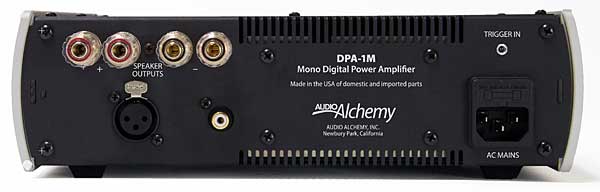
The DPA-1M has the usual controls and indicators expected of a modern power amplifier, and then some. The Power button lights up to indicate status; press it and the amp goes into a 15-second warm-up mode, during which its output is muted. As mentioned earlier, you can select the single-ended (RCA) or the balanced (XLR) input by pressing a button. There's a 12V DC trigger input. A front-panel LED indicates if the amplifier is clipping. (In the time I had them here, neither amp's clipping LED lit up.) A Mute button does just what you'd think it might. The Gain button toggles between 20 and 26dB, which can be useful in matching the gain of the preamp. I tried both settings, compensating for the difference at the preamp, but could hear no difference in sound quality. I used the 26dB setting, which was closer to the 27.8dB gain of the Theta Digital Prometheus amplifier I used in my comparisons.
Because the Wilson Sabrinas were already in my listening room, I relied on them for reviewing the DPA-1Ms, thus relieving me from having to get used to some other speakers. The Wilsons also got the nod for their proven ability to reveal the sonic characteristics of amplifiers driving them, and for the simple reason that Wilson Audio Specialties have themselves used DPA-1Ms to demonstrate the Sabrinas, suggesting there's reason to believe that these speakers and amps are a good match.
Sound
Madnick told me that, inside the DPA-1M, the signal is fed to a differential pair of JFETs feeding a low-power MOSFET driver stage. The circuit is servo-controlled to cancel any offset and to avoid having to use coupling capacitors in the signal path. This input circuit is powered by a dedicated power supply with ultra-low-noise voltage regulators. The class-D Hypex output module is powered from a switching power supply. The DPA-1M is a bridged design, which Madnick considers "the best-sounding way to do it." Of course, the sonic characteristics of the DPA-1M depend not only on its circuit topologies, but on the choice of specific components, PCB layout, and fabrication materials, as well as the selection of internal wiring and, one assumes, various proprietary factors. The DPA-1M's fit'n'finish are excellent, with no indication of any corners being cut in achieving its relatively low price, yet the amp avoids the sort of "audio jewelry" appearance that makes me wonder how much of a product's price was determined by its cosmetics.
The DPA-1M has the usual controls and indicators expected of a modern power amplifier, and then some. The Power button lights up to indicate status; press it and the amp goes into a 15-second warm-up mode, during which its output is muted. As mentioned earlier, you can select the single-ended (RCA) or the balanced (XLR) input by pressing a button. There's a 12V DC trigger input. A front-panel LED indicates if the amplifier is clipping. (In the time I had them here, neither amp's clipping LED lit up.) A Mute button does just what you'd think it might. The Gain button toggles between 20 and 26dB, which can be useful in matching the gain of the preamp. I tried both settings, compensating for the difference at the preamp, but could hear no difference in sound quality. I used the 26dB setting, which was closer to the 27.8dB gain of the Theta Digital Prometheus amplifier I used in my comparisons.
Because the Wilson Sabrinas were already in my listening room, I relied on them for reviewing the DPA-1Ms, thus relieving me from having to get used to some other speakers. The Wilsons also got the nod for their proven ability to reveal the sonic characteristics of amplifiers driving them, and for the simple reason that Wilson Audio Specialties have themselves used DPA-1Ms to demonstrate the Sabrinas, suggesting there's reason to believe that these speakers and amps are a good match.
Sound
The owner's manual for the DPA-1M makes no mention of a need for a break-in period, which made me wonder if this is because Audio Alchemy doesn't consider break-in to be important, or because they run-in the amps at the factory. When I e-mailed Peter Madnick about this, he replied: "There should be no serious evaluation of the amps until 100–200 hours of break-in." (Good thing I asked!) Pressed further about whether just leaving the amps on can be considered break-in, or if he meant actual time spent playing music, Madnick said that they do about 50/50. My descriptions of the sound of the DPA-1M are based on the amps having been on for at least 200 hours, of which about 100 hours were spent playing music (often when I was out of the house).
Hypex offers a number of class-D amplifier output-stage modules that fall into their UcD and NCore categories; the differences among these, which are highly technical and mostly beyond my understanding, are described at www.hypex.nl. Suffice it to say that Bruno Putzeys describes NCore, the more recent design, as superior to UcD. The Audio Alchemy DPA-1M uses one of the earlier UcD modules, which Audio Alchemy's Peter Madnick told me he actually prefers to the NCores in this design. The DPA-1M is specified as producing 325W into 8 ohms or 400W into 4 ohms, whereas the NCore-powered Theta Prometheus outputs 250W into 8 ohms, 500W into 4 ohms, or 850W into 2 ohms. (The DPA-1M's output into 2 ohms is not specified.) Despite its relatively modest price, the DPA-1M is a fully balanced design, with a pair of hermetically sealed gold-on-gold relays that permit switching between its balanced and single-ended inputs. My Convergent Audio Technology (CAT) SL-1 Black Path Edition preamp has only single-ended outputs, but I've found it to work well with a variety of amplifiers, including balanced designs, and so it was with the DPA-1M. Noise levels were extremely low. The DPA-1M combines an analog class-A input stage with a class-D output stage and runs at 80% efficiency (compared to the 30% typical of class-AB amps).
Madnick told me that, inside the DPA-1M, the signal is fed to a differential pair of JFETs feeding a low-power MOSFET driver stage. The circuit is servo-controlled to cancel any offset and to avoid having to use coupling capacitors in the signal path. This input circuit is powered by a dedicated power supply with ultra-low-noise voltage regulators. The class-D Hypex output module is powered from a switching power supply. The DPA-1M is a bridged design, which Madnick considers "the best-sounding way to do it." Of course, the sonic characteristics of the DPA-1M depend not only on its circuit topologies, but on the choice of specific components, PCB layout, and fabrication materials, as well as the selection of internal wiring and, one assumes, various proprietary factors. The DPA-1M's fit'n'finish are excellent, with no indication of any corners being cut in achieving its relatively low price, yet the amp avoids the sort of "audio jewelry" appearance that makes me wonder how much of a product's price was determined by its cosmetics.
The DPA-1M has the usual controls and indicators expected of a modern power amplifier, and then some. The Power button lights up to indicate status; press it and the amp goes into a 15-second warm-up mode, during which its output is muted. As mentioned earlier, you can select the single-ended (RCA) or the balanced (XLR) input by pressing a button. There's a 12V DC trigger input. A front-panel LED indicates if the amplifier is clipping. (In the time I had them here, neither amp's clipping LED lit up.) A Mute button does just what you'd think it might. The Gain button toggles between 20 and 26dB, which can be useful in matching the gain of the preamp. I tried both settings, compensating for the difference at the preamp, but could hear no difference in sound quality. I used the 26dB setting, which was closer to the 27.8dB gain of the Theta Digital Prometheus amplifier I used in my comparisons.
Because the Wilson Sabrinas were already in my listening room, I relied on them for reviewing the DPA-1Ms, thus relieving me from having to get used to some other speakers. The Wilsons also got the nod for their proven ability to reveal the sonic characteristics of amplifiers driving them, and for the simple reason that Wilson Audio Specialties have themselves used DPA-1Ms to demonstrate the Sabrinas, suggesting there's reason to believe that these speakers and amps are a good match.
The owner's manual for the DPA-1M makes no mention of a need for a break-in period, which made me wonder if this is because Audio Alchemy doesn't consider break-in to be important, or because they run-in the amps at the factory. When I e-mailed Peter Madnick about this, he replied: "There should be no serious evaluation of the amps until 100–200 hours of break-in." (Good thing I asked!) Pressed further about whether just leaving the amps on can be considered break-in, or if he meant actual time spent playing music, Madnick said that they do about 50/50. My descriptions of the sound of the DPA-1M are based on the amps having been on for at least 200 hours, of which about 100 hours were spent playing music (often when I was out of the house).