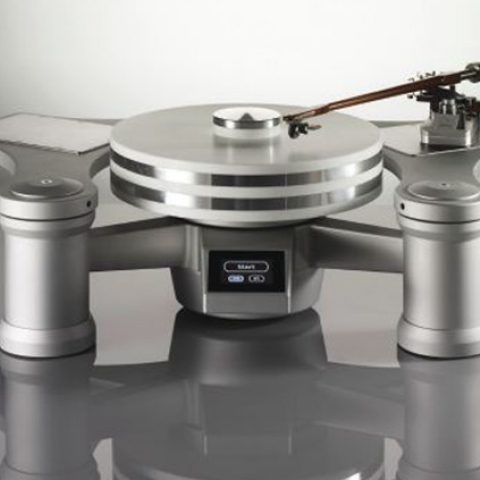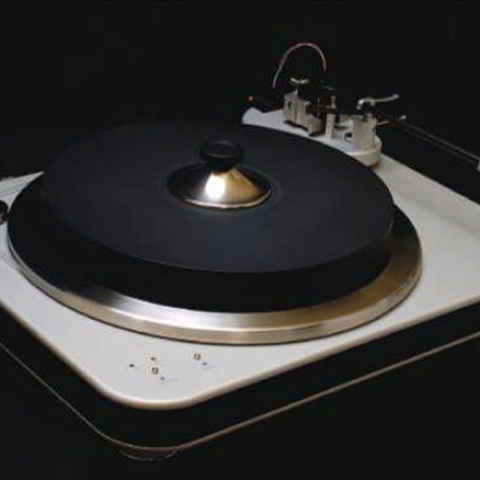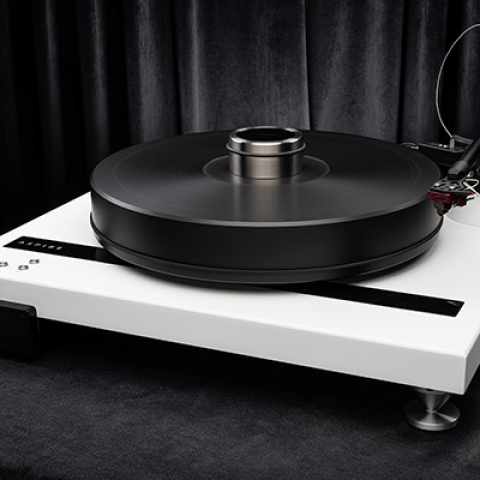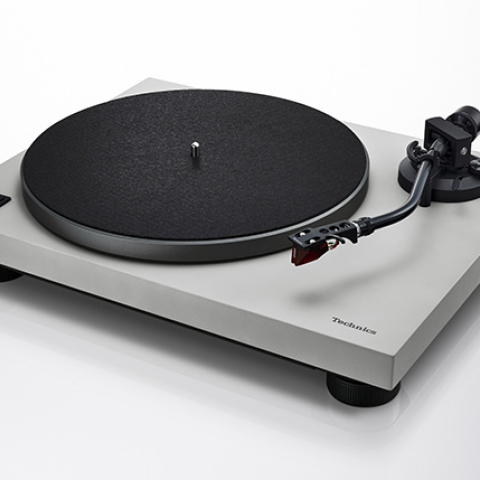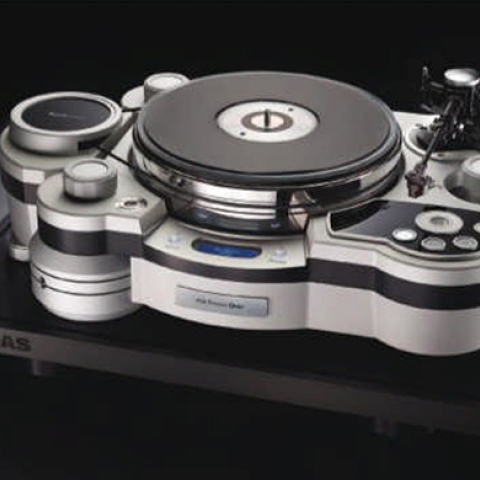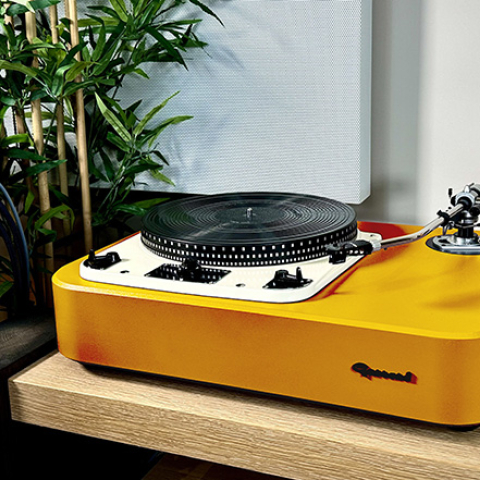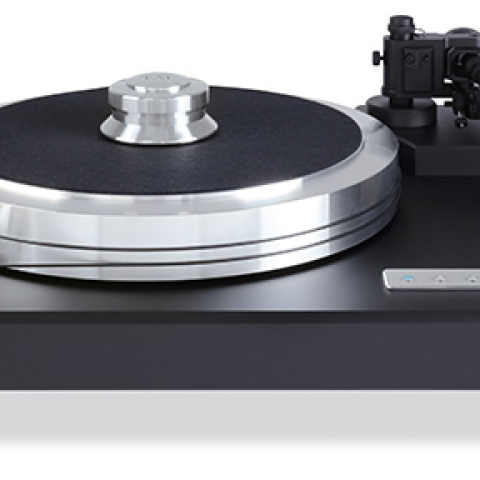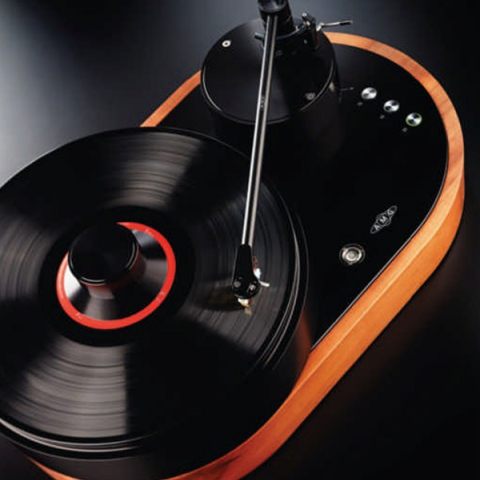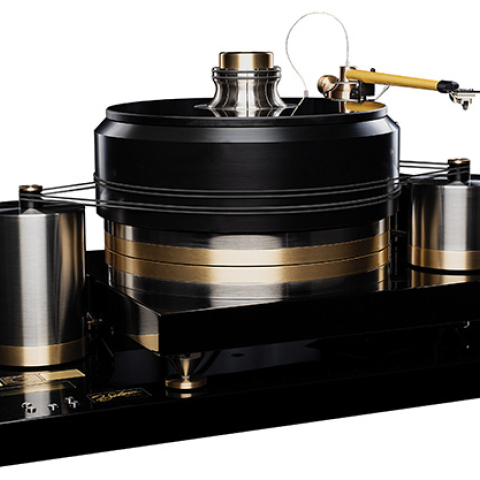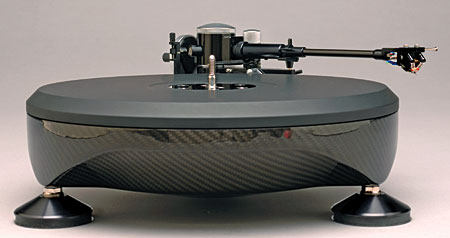
Conceptually audacious, elegantly designed, executed with space-age precision, and remarkably compact, Grand Prix Audio's direct-drive Monaco turntable ($19,500) aims to turn the tables on the belt-drive designs that have dominated analog playback for three decades.
 Beginning with the proverbial clean sheet of paper, designer and project manager Alvin Lloyd leveraged his background in race-car fabrication to create his vision of the ideal 21st-century turntable. He's used modern materials and computer-based motion-control systems to meet the goals of any turntable: to provide a stable, well-damped platform for the bearing/platter system and tonearm, and to turn the platter at the correct speed while minimizing environmental resonances as well as the mechanical noise generated by the turntable itself.
Like many designers of premium turntables, Lloyd realized that the complexity of the undertaking required individual experts as well as manufacturers who could make the custom parts to his exact tolerances for an affordable price. He assembled a team that included Indy-car and wind-tunnel designer David Bruns, with whom Lloyd has worked closely for many years; and electrical engineer Vince Capizzo, whose many accomplishments include working for SSL, a UK-based maker of mixing consoles, and designing and building audio and video gear for a variety of manufacturers. Capizzo also invented and manufactures the Digital Audio Format Translator used in mastering suites worldwide, including Bernie Grundman's.
In the "White Papers" section of his website, Lloyd points out that LPs contain only amplitude information. Spinning the disc supplies the frequency information, which is why delivering accuracy of speed in both the long term (pitch correctness) and the short term (low wow and flutter), along with low noise (rumble), are a turntable's No.1 job.
Lloyd determined that a turntable of demonstrably superior speed accuracy needed to be driven directly by its motor. Accurate, high-speed motion-control systems are now found throughout the computer- and chip-making industries. However, after thoroughly researching the field, Lloyd found industrial partners that could supply state-of-the-art low-speed systems, as well as design and build the direct-drive motor his design required.
As Lloyd's white paper details, designing a measurement protocol was almost as difficult as developing the motor and DSP-based controller technology. Measuring rumble is difficult: cutting lathes typically exhibit higher rumble figures than today's premium turntables and it's impossible to separate the rumble generated by a playback turntable from that generated by the cutting lathe and already recorded on an LP. What's more, test records are notoriously inaccurate; even at their best, they can be only as accurate as the lathe that cut the test LP's original lacquer.
Wow and flutter can be measured without a test record if the platter, like the Monaco's, incorporates an optical encoder disc, using a high-speed digital timer/counter.Grand Prix's measurement, based on four 45° rotational segments, each one-fourth of a revolution apart, demonstrated unweighted peak flutter at an impressive 0.002% or less. In the more typical RMS measurements, which average a turntable's speed deviations, high-amplitude but short-term errors can go undetected. The result can be that published RMS specs are far better than a 'table's actual performance.
Design
Beginning with the proverbial clean sheet of paper, designer and project manager Alvin Lloyd leveraged his background in race-car fabrication to create his vision of the ideal 21st-century turntable. He's used modern materials and computer-based motion-control systems to meet the goals of any turntable: to provide a stable, well-damped platform for the bearing/platter system and tonearm, and to turn the platter at the correct speed while minimizing environmental resonances as well as the mechanical noise generated by the turntable itself.
Like many designers of premium turntables, Lloyd realized that the complexity of the undertaking required individual experts as well as manufacturers who could make the custom parts to his exact tolerances for an affordable price. He assembled a team that included Indy-car and wind-tunnel designer David Bruns, with whom Lloyd has worked closely for many years; and electrical engineer Vince Capizzo, whose many accomplishments include working for SSL, a UK-based maker of mixing consoles, and designing and building audio and video gear for a variety of manufacturers. Capizzo also invented and manufactures the Digital Audio Format Translator used in mastering suites worldwide, including Bernie Grundman's.
In the "White Papers" section of his website, Lloyd points out that LPs contain only amplitude information. Spinning the disc supplies the frequency information, which is why delivering accuracy of speed in both the long term (pitch correctness) and the short term (low wow and flutter), along with low noise (rumble), are a turntable's No.1 job.
Lloyd determined that a turntable of demonstrably superior speed accuracy needed to be driven directly by its motor. Accurate, high-speed motion-control systems are now found throughout the computer- and chip-making industries. However, after thoroughly researching the field, Lloyd found industrial partners that could supply state-of-the-art low-speed systems, as well as design and build the direct-drive motor his design required.
As Lloyd's white paper details, designing a measurement protocol was almost as difficult as developing the motor and DSP-based controller technology. Measuring rumble is difficult: cutting lathes typically exhibit higher rumble figures than today's premium turntables and it's impossible to separate the rumble generated by a playback turntable from that generated by the cutting lathe and already recorded on an LP. What's more, test records are notoriously inaccurate; even at their best, they can be only as accurate as the lathe that cut the test LP's original lacquer.
Wow and flutter can be measured without a test record if the platter, like the Monaco's, incorporates an optical encoder disc, using a high-speed digital timer/counter.Grand Prix's measurement, based on four 45° rotational segments, each one-fourth of a revolution apart, demonstrated unweighted peak flutter at an impressive 0.002% or less. In the more typical RMS measurements, which average a turntable's speed deviations, high-amplitude but short-term errors can go undetected. The result can be that published RMS specs are far better than a 'table's actual performance.
Design
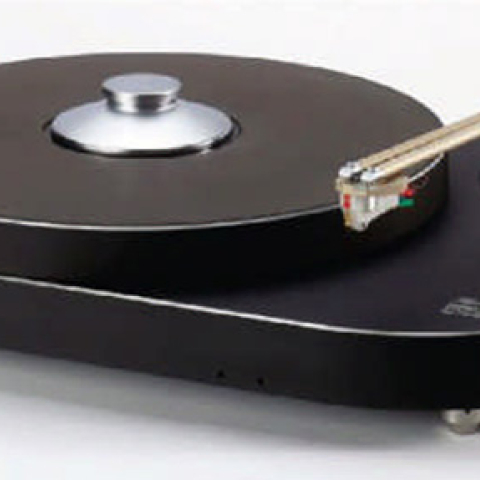
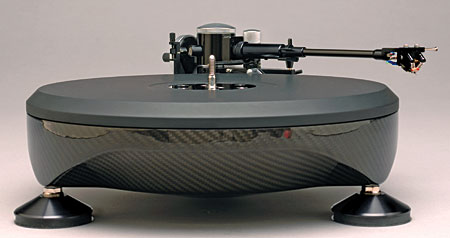
The Monaco's plinth is not much wider than the platter itself. It consists of upper and lower shells of multiple layers of carbon fiber similar to the composite material used in the monococques of competition cars. These layers are laminated under high temperature and pressure with the fibers in each layer oriented in a different direction, filled with a goop of "proprietary polymer combination," clear-coated, bonded together, then CNC-machined. Each plinth takes several days to build; the result is a strong, ultrarigid, well-damped, beautifully sculpted foundation. Three small, strategically placed cups molded into the plinth's bottom meet three footer cups; between each pair of cups goes a ball of silicon nitride. Thin Sorbothane wafers affixed to the footer bottoms absorb energy, while a smooth, low-friction plastic interface makes sliding and moving the turntable easy. The front two feet incorporate threaded inserts (Grand Prix supplies the proper tool), to permit easy leveling of the 'table.
Even the armboard mount takes advantage of the plinth construction's "moldability." It permits the swapping-out of armboards (Grand Prix supplies one pre-drilled for your tonearm) while maintaining high rigidity and stiffness. The thick alloy board deeply penetrates the plinth and is held in place by six bolts that, from below, pass through the plinth, then isolated internal hard points, and finally the armboard itself.
Beginning with the proverbial clean sheet of paper, designer and project manager Alvin Lloyd leveraged his background in race-car fabrication to create his vision of the ideal 21st-century turntable. He's used modern materials and computer-based motion-control systems to meet the goals of any turntable: to provide a stable, well-damped platform for the bearing/platter system and tonearm, and to turn the platter at the correct speed while minimizing environmental resonances as well as the mechanical noise generated by the turntable itself.
Like many designers of premium turntables, Lloyd realized that the complexity of the undertaking required individual experts as well as manufacturers who could make the custom parts to his exact tolerances for an affordable price. He assembled a team that included Indy-car and wind-tunnel designer David Bruns, with whom Lloyd has worked closely for many years; and electrical engineer Vince Capizzo, whose many accomplishments include working for SSL, a UK-based maker of mixing consoles, and designing and building audio and video gear for a variety of manufacturers. Capizzo also invented and manufactures the Digital Audio Format Translator used in mastering suites worldwide, including Bernie Grundman's.
The Monaco's plinth is not much wider than the platter itself. It consists of upper and lower shells of multiple layers of carbon fiber similar to the composite material used in the monococques of competition cars. These layers are laminated under high temperature and pressure with the fibers in each layer oriented in a different direction, filled with a goop of "proprietary polymer combination," clear-coated, bonded together, then CNC-machined. Each plinth takes several days to build; the result is a strong, ultrarigid, well-damped, beautifully sculpted foundation. Three small, strategically placed cups molded into the plinth's bottom meet three footer cups; between each pair of cups goes a ball of silicon nitride. Thin Sorbothane wafers affixed to the footer bottoms absorb energy, while a smooth, low-friction plastic interface makes sliding and moving the turntable easy. The front two feet incorporate threaded inserts (Grand Prix supplies the proper tool), to permit easy leveling of the 'table.