RCA's time-honored 6SN7 may be the coolest tube of all. The octal-based dual-triode has its own Wikipedia entry—something not even the 2A3 or 300B can boast—along with its own website. The 6SN7 is chunky, rugged, and handsome. Best of all, it's available, probably because people keep coming up with very good uses for it. In that sense, the 6SN7 is the Campbell's Cream of Mushroom Soup of the tube world.
 Developed in 1939, the 6SN7 appeared just in time for America's involvement in World War II, and its use in a variety of military settings spurred a remarkable level of demand, the influence of which continues to be felt in the new/old stock (NOS) tube marketplace. Later, in 1943, the engineers who developed the first ENIAC computer specified the 6SN7 as their dual-triode of choice—and because the 18,000-tube ENIAC contained more than 6000 6SN7s, with a weekly maintenance regimen that required frequent tube changes, demand and production remained high. As if that weren't enough, the 6SN7 became a popular choice among designers of television receivers, for use as a vertical amplifier—and, again, the RCA bean-counters smiled.
Today, the 6SN7 remains popular among high-end audio engineers, having surpassed the otherwise ubiquitous 12AX7—the miniature dual-triode that RCA developed in 1946, ostensibly as a replacement for the 6SN7—in some parts of our own community, if not the more lucrative industry of musical-instrument amplifiers. In particular, the single-ended-triode movement embraced the 6SN7 and its variants for use as a small-signal voltage amplifier. And no one exemplifies that movement more than Cary Audio's Dennis Had.
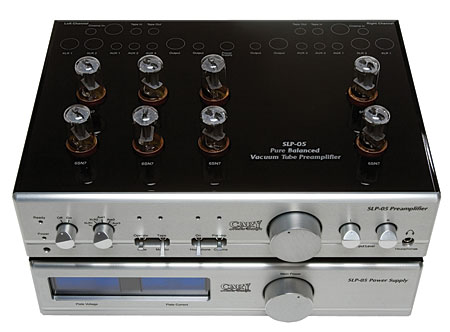
The latest result of Had's fascination with the 6SN7 is the Cary Audio SLP 05, the company's newest line-level preamplifier ($7500). In fact, the SLP 05 uses eight of them: not quite ENIAC, but more than I'm used to seeing in one place.
The SLP 05 is a two-box design in the usual sense: one chassis dedicated to the power supply, the other to the audio circuitry itself. The former uses a hefty R-core mains transformer with two sets of secondaries. Current from the 170V windings is rectified by a 5AR4C tube (chosen because that tube's cathode arrangement allows a horizontal installation), then smoothed with a pi filter and tied to the preamplifier's high-voltage rail. Current from the trannie's 14V secondary windings goes to a 35-amp full-wave rectifier bridge, after which it's sent to two sets of TO-3–style 12V regulators and complementary smoothing circuits: It's dual-mono from that point forward. That current is used to energize the filaments of the preamplifier's tubes, in a series arrangement (an important distinction, given that the heater requirement for a single 6SN7 is just over 6V).
Beyond those necessities, the SLP 05 power supply contains a rather nice luxury: a pair of English Sifam meters, for monitoring rail voltage and rail current. Thus, the most anxious audiophiles are given new freedom to worry (although, as Thelonious Monk might have said, You needn't).
Developed in 1939, the 6SN7 appeared just in time for America's involvement in World War II, and its use in a variety of military settings spurred a remarkable level of demand, the influence of which continues to be felt in the new/old stock (NOS) tube marketplace. Later, in 1943, the engineers who developed the first ENIAC computer specified the 6SN7 as their dual-triode of choice—and because the 18,000-tube ENIAC contained more than 6000 6SN7s, with a weekly maintenance regimen that required frequent tube changes, demand and production remained high. As if that weren't enough, the 6SN7 became a popular choice among designers of television receivers, for use as a vertical amplifier—and, again, the RCA bean-counters smiled.
Today, the 6SN7 remains popular among high-end audio engineers, having surpassed the otherwise ubiquitous 12AX7—the miniature dual-triode that RCA developed in 1946, ostensibly as a replacement for the 6SN7—in some parts of our own community, if not the more lucrative industry of musical-instrument amplifiers. In particular, the single-ended-triode movement embraced the 6SN7 and its variants for use as a small-signal voltage amplifier. And no one exemplifies that movement more than Cary Audio's Dennis Had.
The latest result of Had's fascination with the 6SN7 is the Cary Audio SLP 05, the company's newest line-level preamplifier ($7500). In fact, the SLP 05 uses eight of them: not quite ENIAC, but more than I'm used to seeing in one place.
The SLP 05 is a two-box design in the usual sense: one chassis dedicated to the power supply, the other to the audio circuitry itself. The former uses a hefty R-core mains transformer with two sets of secondaries. Current from the 170V windings is rectified by a 5AR4C tube (chosen because that tube's cathode arrangement allows a horizontal installation), then smoothed with a pi filter and tied to the preamplifier's high-voltage rail. Current from the trannie's 14V secondary windings goes to a 35-amp full-wave rectifier bridge, after which it's sent to two sets of TO-3–style 12V regulators and complementary smoothing circuits: It's dual-mono from that point forward. That current is used to energize the filaments of the preamplifier's tubes, in a series arrangement (an important distinction, given that the heater requirement for a single 6SN7 is just over 6V).
Beyond those necessities, the SLP 05 power supply contains a rather nice luxury: a pair of English Sifam meters, for monitoring rail voltage and rail current. Thus, the most anxious audiophiles are given new freedom to worry (although, as Thelonious Monk might have said, You needn't).
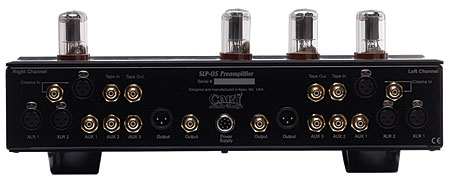 A 6'-long, eight-conductor umbilical cord, made by Kimber Kable using Teflon-coated, oxygen-free copper, brings all those useful currents to the main preamplifier chassis, where the 6SN7s do their thing. The first half of the first dual-triode provides voltage gain for the left-channel signal's positive-going half, while the second half is an anode-follower buffer. The first half of the second tube provides voltage gain for the negative-going half of the same channel's signal, while its second half is also an anode follower buffer...and so on and so forth, across four tubes and two balanced channels.
The fifth and sixth tubes are used as input buffers, solely for the SLP 05's balanced throughput: When driving a stereo amplifier from the Cary preamp's single-ended outputs, you could pull either or both of those 6SN7s from their sockets without hearing a bit of difference. (Ever the wiener, I didn't try.)
Finally, the last two tubes comprise the SLP 05's cathode-biased, push-pull headphone amplifier—for which Dennis Had claims "almost a watt!" of clean output power. Those 6SN7s are driven by the balanced output from the line stage. (Flipping the headphone switch diverts a portion of the balanced output to the grids of those tubes, but does not disable the preamplifier's balanced-output jacks.) A ¼" phone jack is provided on the Cary's front panel, and Had says that his headphone amplifier is comfortable driving loads ranging from 40 to 300 ohms.
A final note on construction: The SLP 05 benefits from a tidy mix of old and new construction techniques—circuit boards share real estate with terminal strips and nicely dressed wires—and continues the recent Cary tradition of having its exterior adorned with genuine Jaguar automotive paint: in this instance, Anthracite Black Clear Coat. The faceplate is solid aluminum alloy, anodized silver. The combination looks positively stunning.
Installation and setup
A 6'-long, eight-conductor umbilical cord, made by Kimber Kable using Teflon-coated, oxygen-free copper, brings all those useful currents to the main preamplifier chassis, where the 6SN7s do their thing. The first half of the first dual-triode provides voltage gain for the left-channel signal's positive-going half, while the second half is an anode-follower buffer. The first half of the second tube provides voltage gain for the negative-going half of the same channel's signal, while its second half is also an anode follower buffer...and so on and so forth, across four tubes and two balanced channels.
The fifth and sixth tubes are used as input buffers, solely for the SLP 05's balanced throughput: When driving a stereo amplifier from the Cary preamp's single-ended outputs, you could pull either or both of those 6SN7s from their sockets without hearing a bit of difference. (Ever the wiener, I didn't try.)
Finally, the last two tubes comprise the SLP 05's cathode-biased, push-pull headphone amplifier—for which Dennis Had claims "almost a watt!" of clean output power. Those 6SN7s are driven by the balanced output from the line stage. (Flipping the headphone switch diverts a portion of the balanced output to the grids of those tubes, but does not disable the preamplifier's balanced-output jacks.) A ¼" phone jack is provided on the Cary's front panel, and Had says that his headphone amplifier is comfortable driving loads ranging from 40 to 300 ohms.
A final note on construction: The SLP 05 benefits from a tidy mix of old and new construction techniques—circuit boards share real estate with terminal strips and nicely dressed wires—and continues the recent Cary tradition of having its exterior adorned with genuine Jaguar automotive paint: in this instance, Anthracite Black Clear Coat. The faceplate is solid aluminum alloy, anodized silver. The combination looks positively stunning.
Installation and setup
The SLP 05 had nothing up its sleeve as far as installation was concerned: My task was a simple matter of coaxing eight tubes into eight sockets (the power supply's 5AR4C is installed at the factory), connecting the two boxes together with the aforementioned umbilical, and plugging in. In standard Cary practice, soft elastomer feet, somewhat larger than average, are fitted to both enclosures. The top surface of the power supply has four round indentations, corresponding with the four feet of the preamp unit: clearly an invitation to piggyback them. Despite the ostensibly well-thought-out isolation feet, I nonetheless found that the addition of three Ayre/Cardas Myrtle Blocks under the power supply (when stacked) or both components (when separated) resulted in a slight but definite increase in the naturalness of the sound, solo voices and instruments exhibiting the greatest gains in that regard. (The Blocks' are just large enough to get the Cary's big, soft feet off the ground.)
Most of the front-panel controls reminded me of the time I'd spent with earlier Cary gear, such as the SLP 98P preamplifier I reviewed for Stereophile's February 2004 issue (and which remains in the Cary line, complemented yet not displaced by the flagship SLP 05). A nice-feeling rotary switch lets the user select among two balanced inputs and three of the single-ended variety, and toggle switches are provided for muting, tape monitoring, and switching an effects loop in and out, if so desired—as well as activating the aforementioned headphone amplifier. As suggested earlier, flipping that switch did not automatically disable the preamplifier's main output jacks; to enjoy music without waking the family, I could either silence the outputs by activating the effects-loop switch, or remember not to switch on the amplifiers.
As usual with Cary preamplifiers, each of the SLP 05's channels has its own attenuator, for adjusting left/right balance; they're effectively out of the circuit when not in use. The master volume control—an Alps two-channel potentiometer—is motorized for use with the SLP 05's remote handset, a palm-sized unit shaped like a mayonnaise jar in silhouette, with buttons only for Volume Up and Down, and Mute. As to the latter function, the SLP 05 differed somewhat from its predecessor: With the older SLP 98P, if the preamp was muted using its front-panel switch, it could not be unmuted with the remote; here, the use of the Mute button on the remote required the panel switch to be in the Mute position, and if the preamp was unmuted using its front-panel switch, it could not be muted with the remote.
Listening
In addition to my own Fi Preamplifier—a new version of which is reported to be in the works—I've been lucky enough to enjoy several genuinely great preamplifiers during the past year or so, including review samples of the EAR 912, DNM 3-C, Audio Note M2 Balanced and M3, Blue Circle Galatea Mk.II, Lamm LL2 Deluxe, and the Cary SLP 98P referred to a few paragraphs ago. With that in mind, I'd like to begin with an admittedly subjective observation:
Once a certain level of performance quality has been met, different preamplifiers exhibit the least significant sonic differences among various components in my system—certainly less than power amplifiers, and even less than different CD source components. It's been a long time since I've heard an egregiously colored preamp, or one that failed to convey at least an acceptable semblance of correct rhythms and pitch relationships, or that suffered an egregious lack of sonic naturalness or musical flow.
That's not to say I haven't liked the sound of some top-drawer preamps better than others. I remember the EAR as sounding exceptionally lusty and dramatic. And the Lamm—a sample of which I recently borrowed back for the sake of comparison in preparing this review—was and is an almost uniquely clean-, clear-, and natural-sounding player of music.
Developed in 1939, the 6SN7 appeared just in time for America's involvement in World War II, and its use in a variety of military settings spurred a remarkable level of demand, the influence of which continues to be felt in the new/old stock (NOS) tube marketplace. Later, in 1943, the engineers who developed the first ENIAC computer specified the 6SN7 as their dual-triode of choice—and because the 18,000-tube ENIAC contained more than 6000 6SN7s, with a weekly maintenance regimen that required frequent tube changes, demand and production remained high. As if that weren't enough, the 6SN7 became a popular choice among designers of television receivers, for use as a vertical amplifier—and, again, the RCA bean-counters smiled.
Today, the 6SN7 remains popular among high-end audio engineers, having surpassed the otherwise ubiquitous 12AX7—the miniature dual-triode that RCA developed in 1946, ostensibly as a replacement for the 6SN7—in some parts of our own community, if not the more lucrative industry of musical-instrument amplifiers. In particular, the single-ended-triode movement embraced the 6SN7 and its variants for use as a small-signal voltage amplifier. And no one exemplifies that movement more than Cary Audio's Dennis Had.
A 6'-long, eight-conductor umbilical cord, made by Kimber Kable using Teflon-coated, oxygen-free copper, brings all those useful currents to the main preamplifier chassis, where the 6SN7s do their thing. The first half of the first dual-triode provides voltage gain for the left-channel signal's positive-going half, while the second half is an anode-follower buffer. The first half of the second tube provides voltage gain for the negative-going half of the same channel's signal, while its second half is also an anode follower buffer...and so on and so forth, across four tubes and two balanced channels.
The fifth and sixth tubes are used as input buffers, solely for the SLP 05's balanced throughput: When driving a stereo amplifier from the Cary preamp's single-ended outputs, you could pull either or both of those 6SN7s from their sockets without hearing a bit of difference. (Ever the wiener, I didn't try.)
Finally, the last two tubes comprise the SLP 05's cathode-biased, push-pull headphone amplifier—for which Dennis Had claims "almost a watt!" of clean output power. Those 6SN7s are driven by the balanced output from the line stage. (Flipping the headphone switch diverts a portion of the balanced output to the grids of those tubes, but does not disable the preamplifier's balanced-output jacks.) A ¼" phone jack is provided on the Cary's front panel, and Had says that his headphone amplifier is comfortable driving loads ranging from 40 to 300 ohms.
The SLP 05 had nothing up its sleeve as far as installation was concerned: My task was a simple matter of coaxing eight tubes into eight sockets (the power supply's 5AR4C is installed at the factory), connecting the two boxes together with the aforementioned umbilical, and plugging in. In standard Cary practice, soft elastomer feet, somewhat larger than average, are fitted to both enclosures. The top surface of the power supply has four round indentations, corresponding with the four feet of the preamp unit: clearly an invitation to piggyback them. Despite the ostensibly well-thought-out isolation feet, I nonetheless found that the addition of three Ayre/Cardas Myrtle Blocks under the power supply (when stacked) or both components (when separated) resulted in a slight but definite increase in the naturalness of the sound, solo voices and instruments exhibiting the greatest gains in that regard. (The Blocks' are just large enough to get the Cary's big, soft feet off the ground.)
In addition to my own Fi Preamplifier—a new version of which is reported to be in the works—I've been lucky enough to enjoy several genuinely great preamplifiers during the past year or so, including review samples of the EAR 912, DNM 3-C, Audio Note M2 Balanced and M3, Blue Circle Galatea Mk.II, Lamm LL2 Deluxe, and the Cary SLP 98P referred to a few paragraphs ago. With that in mind, I'd like to begin with an admittedly subjective observation: