My stepfather wore only second-hand clothes as a child and never understood why anyone would deliberately wash the color out of his new dungarees. By the same token, the senior members of our hobby, many of whom recall with fondness the transistor's advent, don't understand why anyone would now wish to throw away their newfound power. Some people deserve to be blessed for their point of view, even as the world moves away from it.
 Whatever our world is heading toward, I'm certain that single-ended triode (SET) tube amplifiers of intentionally low power have become a part of the long-term landscape, given the simple fact that no one is terribly shocked these days whenever a new 2W amp is launched. It takes something more than that to get my attention, of course—something along the lines of the Yamamoto Soundcraft A-08 ($2250), which brings rare levels of value and noiselessness to the SET table, even as it wears its low power and handmade nature like badges.
Nor is it a surprise that Japan's audio press—in particular the well-regarded MJ Audio—has been all over the Yamamoto A-08 like a hen on a June bug. As for the English-speaking portion of the hi-fi world, our own alternative press—specifically the world of audio webzines—deserves credit for discovering this little gem. I won't mind if this review plays second fiddle to the pieces that have already appeared on 6moons.com and such discussion sites as AudioAsylum.com and AudioRoundtable.com. The truth is, the A-08 deserves the widest audience it can get.
There be not a gutter
Whatever our world is heading toward, I'm certain that single-ended triode (SET) tube amplifiers of intentionally low power have become a part of the long-term landscape, given the simple fact that no one is terribly shocked these days whenever a new 2W amp is launched. It takes something more than that to get my attention, of course—something along the lines of the Yamamoto Soundcraft A-08 ($2250), which brings rare levels of value and noiselessness to the SET table, even as it wears its low power and handmade nature like badges.
Nor is it a surprise that Japan's audio press—in particular the well-regarded MJ Audio—has been all over the Yamamoto A-08 like a hen on a June bug. As for the English-speaking portion of the hi-fi world, our own alternative press—specifically the world of audio webzines—deserves credit for discovering this little gem. I won't mind if this review plays second fiddle to the pieces that have already appeared on 6moons.com and such discussion sites as AudioAsylum.com and AudioRoundtable.com. The truth is, the A-08 deserves the widest audience it can get.
There be not a gutter
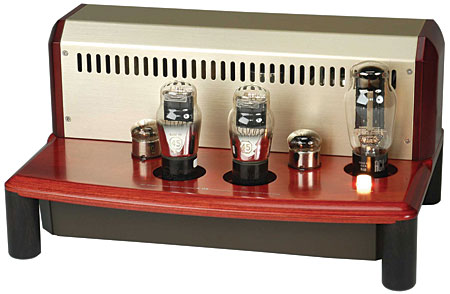
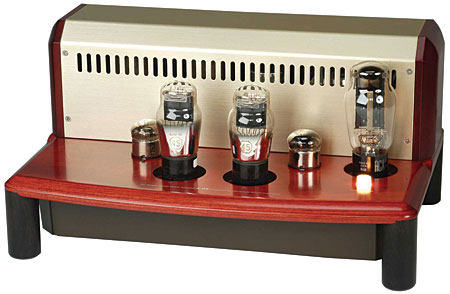
But while you're surfing around out there, be sure to visit Yamamoto's own website, too: The company's founder, Shigeki Yamamoto, speaks only Japanese, and relies on a dedicated software engine to translate his text into English. Thus the product descriptions on his pages contain such delightful free verse as "High the strength, be big even the heatproof nature," and "There be not a gutter, and take the trouble of preventing the tone quality deterioration." As far as I'm concerned, that makes at least as much sense as "I detected a midbass coloration like unto chocolate fudge." Shigeki Yamamoto's professional background includes experience as a high-tech machinist—some of the best and most expensive amplifiers on the planet use his precision-made Teflon tube sockets—and his product gallery is itself a portrait of an audio craftsman with greater-than-average determination: When Yamamoto has an idea for a new kind of capacitor housing—or horn, or moving-coil phono cartridge, or equipment stand, or whatever—he simply gets to work and makes the thing himself. That sort of talent seems out of place in a corporation, or in a field of endeavor that misguided souls have allowed to be dominated by a corporate mentality; lucky for us, domestic audio has loosened up over the past few years. (Hasn't it?) The first thing one notices about the Yamamoto A-08 is its wood chassis, accented with a champagne gold-colored alloy screen for the transformers. I hesitate to say solid wood chassis because the main portion of the A-08 is carved from what appears to be a cherry ply, albeit a fine one. The styling is serene, elegant, and eye-catching: Japanese in the very best sense.
 This single-ended triode amp has only two gain stages. Audio input spurs the signal grid of a 717A "mushroom" pentode tube, which one seldom sees driving an output triode—in fact, one seldom sees them at all—while a row of modern-looking diodes is connected to another of the tube's grids, for regulation. The 717A's anode is capacitor-coupled to the signal grid of a 45 triode, which is heated by dedicated secondary windings from the mains transformer (center-tapped with a bottom-mounted potentiometer for knocking out the hum that can come from having AC on the filaments). The plate of the 45 addresses a beautifully made C-core output transformer through a 5k ohm primary winding, and it has only a single secondary winding, for driving 8 ohm loudspeakers. Incoming AC is rectified by the near-ubiquitous 5U4G tube and smoothed with a single choke and a single large reservoir cap. As you might expect in an amplifier with a wooden chassis, grounding is something of a challenge, but the wiring of the Yamamoto A-08 is executed in a reasonably elegant manner.
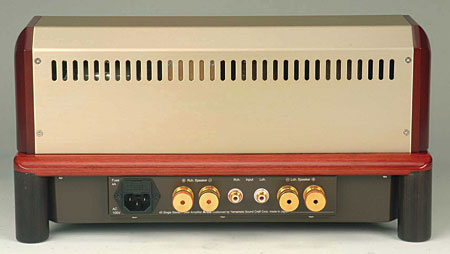
The parts quality is superb. Unsurprisingly, the A-08 uses Shigeki Yamamoto's own top-of-the-line Teflon tube sockets, and Teflon makes repeat appearances in other component parts, such as the proprietary transformer wrappings and handmade capacitors. The very nice binding posts are also his own, and Yamamoto crafts his own terminal strips from solid wood. The input pentodes are new old stock (NOS) from Raytheon; I'm told that whenever someone orders an A-08 amp, Yamamoto supplies whatever happens to be the best pair of NOS tubes on his bench. That's a charming touch—again, the craftsman is given place of pride over the corporation.
The good result was obtained
This single-ended triode amp has only two gain stages. Audio input spurs the signal grid of a 717A "mushroom" pentode tube, which one seldom sees driving an output triode—in fact, one seldom sees them at all—while a row of modern-looking diodes is connected to another of the tube's grids, for regulation. The 717A's anode is capacitor-coupled to the signal grid of a 45 triode, which is heated by dedicated secondary windings from the mains transformer (center-tapped with a bottom-mounted potentiometer for knocking out the hum that can come from having AC on the filaments). The plate of the 45 addresses a beautifully made C-core output transformer through a 5k ohm primary winding, and it has only a single secondary winding, for driving 8 ohm loudspeakers. Incoming AC is rectified by the near-ubiquitous 5U4G tube and smoothed with a single choke and a single large reservoir cap. As you might expect in an amplifier with a wooden chassis, grounding is something of a challenge, but the wiring of the Yamamoto A-08 is executed in a reasonably elegant manner.
The parts quality is superb. Unsurprisingly, the A-08 uses Shigeki Yamamoto's own top-of-the-line Teflon tube sockets, and Teflon makes repeat appearances in other component parts, such as the proprietary transformer wrappings and handmade capacitors. The very nice binding posts are also his own, and Yamamoto crafts his own terminal strips from solid wood. The input pentodes are new old stock (NOS) from Raytheon; I'm told that whenever someone orders an A-08 amp, Yamamoto supplies whatever happens to be the best pair of NOS tubes on his bench. That's a charming touch—again, the craftsman is given place of pride over the corporation.
The good result was obtained
Call me unadventurous, but I didn't even try using the 2W Yamamoto to drive my 86dB-sensitive Quad ESL-989 loudspeakers. Instead, I began by using it with my Medallion horns, fitted with 15-ohm, silver-coil Lowther PM6As (footnote 1). Then I used the A-08 to drive a new loudspeaker that's in for review, which I'd already tried with my reference electronics: the Audio Note AN-E Lexus, a high-sensitivity, two-way, reflex-loaded design with a wonderfully over-the-top outboard crossover. For now, suffice it to say that the AN-E Lexus is a very interesting product, and the Yamamoto drove it well.
The first day I tried the A-08, I thought I'd broken it. With the connections all made and the amp plugged in, I pressed its Power button and listened to the expected 60Hz hum as the amp's power-supply capacitors charged up. Then, a second and a half later, it went silent. No more hum. I assumed that the fragile-looking Yamamoto amp hadn't survived its trip from Japan, but before powering it down and searching out the broken connection I half expected to find, I lowered the needle to a groove and turned up the preamp anyway. The music startled the hell out of me.
I lifted the tonearm and walked over to one of the Audio Note speakers: only a faint hum. Only then did it dawn on me that the Yamamoto A-08 was working just fine: I'd simply never before heard a SET amp with AC heaters perform this noiselessly.
Tiring of silence, I reverted to music for the remainder of the review and was rewarded with a level of performance that went beyond what I'd expected for $2250. Hardcore SET devotees—people whose knowledge of and experience with the breed are far greater than my own (footnote 2)—revere the 45 triode for its luscious midrange and characteristically clear, extended frequency extremes, and those qualities were honored by Shigeki Yamamoto's amplifier. The A-08 was consistently open and transparent, and while it was exceptionally good at portraying the feel of acoustic instruments, its sound was completely free from excess or "unnatural" textures.
The A-08 performed like a typical SET in all the best ways. On the good-sounding CD version of Nick Drake's Five Leaves Left (Island 422 842 915-2), the A-08 consistently pulled Drake's solo voice away from the rest of the mix and presented it with the sort of realism and presence that seems to escape push-pull amps—its performance was almost as good in that regard as that of my Lamm ML2.1 monoblocks, which sell for 13 times the A-08's price. The bowed strings on such numbers as the unutterably sad "Way to Blue" were richly and sweetly textured, and perfectly tuneful as well. Electric and upright basses sounded deep but also quick and clear—surprisingly so, I'd imagine, to the audiophile whose SET experience is limited to the 300B output triode.
Quick, clear bass—not to mention a decent sense of drama and punch throughout its operating range—were no doubt responsible for the A-08's equally surprising performance with loud rock music. For almost 30 years—more than half my life!—I've tried to begin every Saturday by listening to "Death May Be Your Santa Claus," from Mott the Hoople's Brain Capers (LP, Atlantic SD 8304), and I didn't have to skip over December 17 just because there was a 2W amp in my system. Everything I love about that song, from the drummer's false start in the middle of the intro to Ian Hunter's muttered "Screw you" after the second chorus, came across loud and clear. And loud. It's interesting how different audio components can bring different elements of a recording to one's attention. In this case, it was the great, stringy tone of Verden Allen's snakes-and-ladders organ style.
The A-08 was in my system when I received the LP, just out on Classic Records, of the newly discovered live recording The Thelonious Monk Quartet with John Coltrane at Carnegie Hall (Mosaic MQ1-231). The A-08 poured a dazzling stream of texture and tone through the speakers, and while a slightly clangy piano sound appears to be endemic to this recording, the Yamamoto helped my system nail the tone of Coltrane's tenor sax. It nailed the sound of Carnegie Hall, too, and all the limber force behind drummer Shadow Wilson's crazy cymbal work on "Epistrophy." The Yamamoto was also quick enough to follow the sometimes frantic interplay between Wilson and bassist Ahmed Abdul-Malik. But beyond all that was the sheer emotional force in the music that the A-08 preserved—as on Coltrane's first solo in "Evidence," which had me smiling out loud in the empty room. That's how good this amp sounded.
It also sounded fine playing the late 19th- and early 20th-century orchestral music that I love so well, including Bruckner's Symphony 5 as conducted by the perennially underrated Jascha Horenstein (CD, Intaglio INCD 7541), or the brisker, more robust version by Hans Knappertsbusch (CD, London 448 581-2). With the Knappertsbusch in particular, the Yamamoto reproduced the loudly scored brass instruments with greater poise and less strain than I'd expected from 2W, all the while getting their tones very right-sounding. It was equally kind to the tones of massed strings in the noble-sounding second theme of the Adagio; that, along with the Yamamoto's evidently clear, unmuddled way with pitches, made for an especially moving hi-fi experience late one Saturday night. The mood was disturbed only once, when I heard a click of unhappiness during the most intense passage: the amp/speaker motor reaching their limits in my room.
Audio fear bulletin
I mentioned my Lamm ML2.1 monoblocks above, and how well the Yamamoto A-08 stood up to them. The American-made Lamms retained a number of advantages, the most obvious being the increase in sheer drama that comes from having ten times the output power. The Lamms' bass extension was also quite a bit better, notwithstanding the A-08's laudable bass clarity—and I believe the Lamms' way with pitch accuracy and their unambiguous portrayal of pitch relationships were superior, too. Finally, although the Yamamoto was commendably free from hum, the Lamms were even more so—as they should be with DC on their filaments. Another interesting comparison was between the Yamamoto A-08 and the aforementioned Fi 2A3. As I hinted above, the A-08 was quieter, and its midrange was warmer—more typically "tube-like"—than the Fi's, whether the latter was used with 45 or 2A3 tubes. I suspect the extra warmth comes from the Yamamoto's coupling caps, whereas the Fi is direct-coupled. For its part, the Fi had a greater, more bell-like clarity in its upper ranges, with note decays that sounded cleaner and more extended. I prefer the Fi's bass registers when I run it with 45s—in which case the Fi and the Yamamoto ran neck and neck, both delivering fast, detailed, yet trimly colorful reproduction, particularly of deep piano notes. These two somewhat different-sounding amps were both superb—which, I imagine, is another bone of contention where cranky seniors are concerned.
Conclusions
Here's one more thing some elder audiophiles won't want to hear: The Yamamoto A-08 was fun to have, fun to use, fun to look at, fun to swap tubes in and out of, and, most of all, fun to listen to. I'm quite sure the rest of my system thought it was fun to have around, too. A great amp: The Yamamoto A-08 is a fine alternative to dense, boring, unmusical high-end audio products. It's a handcrafted consumer-electronics product—an animal that most people thought was extinct—yet it sells for less than the price of many comparable mass-produced products. In short, it's a howling bargain. The Yamamoto A-08 stands alongside the Lamms, the Fis, the Wavacs, the Komuros, the Wavelengths, and other handcrafted amplifiers in its aspiration to transmit the soul of music by embodying some of the soul of its maker. That's all there is to it, really: It has soul.
Footnote 1: Sorry: I own two pairs of Lowthers, but both are the 15-ohm variety. Footnote 2: My previous experiences with the 45 center around that triode's use in my Fi 2A3 Stereo amp, which can be adapted to the 45 by swapping its 5V4 rectifier tube for a lower-output 5Y3. That doesn't make for an entirely fair comparison, of course; the Fi's output transformers and a few other bits are suited more for the 2A3 triode, which also draws more filament current, and so can be counted on to hum more, too.
Whatever our world is heading toward, I'm certain that single-ended triode (SET) tube amplifiers of intentionally low power have become a part of the long-term landscape, given the simple fact that no one is terribly shocked these days whenever a new 2W amp is launched. It takes something more than that to get my attention, of course—something along the lines of the Yamamoto Soundcraft A-08 ($2250), which brings rare levels of value and noiselessness to the SET table, even as it wears its low power and handmade nature like badges.
Nor is it a surprise that Japan's audio press—in particular the well-regarded MJ Audio—has been all over the Yamamoto A-08 like a hen on a June bug. As for the English-speaking portion of the hi-fi world, our own alternative press—specifically the world of audio webzines—deserves credit for discovering this little gem. I won't mind if this review plays second fiddle to the pieces that have already appeared on 6moons.com and such discussion sites as AudioAsylum.com and AudioRoundtable.com. The truth is, the A-08 deserves the widest audience it can get.
But while you're surfing around out there, be sure to visit Yamamoto's own website, too: The company's founder, Shigeki Yamamoto, speaks only Japanese, and relies on a dedicated software engine to translate his text into English. Thus the product descriptions on his pages contain such delightful free verse as "High the strength, be big even the heatproof nature," and "There be not a gutter, and take the trouble of preventing the tone quality deterioration." As far as I'm concerned, that makes at least as much sense as "I detected a midbass coloration like unto chocolate fudge." Shigeki Yamamoto's professional background includes experience as a high-tech machinist—some of the best and most expensive amplifiers on the planet use his precision-made Teflon tube sockets—and his product gallery is itself a portrait of an audio craftsman with greater-than-average determination: When Yamamoto has an idea for a new kind of capacitor housing—or horn, or moving-coil phono cartridge, or equipment stand, or whatever—he simply gets to work and makes the thing himself. That sort of talent seems out of place in a corporation, or in a field of endeavor that misguided souls have allowed to be dominated by a corporate mentality; lucky for us, domestic audio has loosened up over the past few years. (Hasn't it?) The first thing one notices about the Yamamoto A-08 is its wood chassis, accented with a champagne gold-colored alloy screen for the transformers. I hesitate to say solid wood chassis because the main portion of the A-08 is carved from what appears to be a cherry ply, albeit a fine one. The styling is serene, elegant, and eye-catching: Japanese in the very best sense.
This single-ended triode amp has only two gain stages. Audio input spurs the signal grid of a 717A "mushroom" pentode tube, which one seldom sees driving an output triode—in fact, one seldom sees them at all—while a row of modern-looking diodes is connected to another of the tube's grids, for regulation. The 717A's anode is capacitor-coupled to the signal grid of a 45 triode, which is heated by dedicated secondary windings from the mains transformer (center-tapped with a bottom-mounted potentiometer for knocking out the hum that can come from having AC on the filaments). The plate of the 45 addresses a beautifully made C-core output transformer through a 5k ohm primary winding, and it has only a single secondary winding, for driving 8 ohm loudspeakers. Incoming AC is rectified by the near-ubiquitous 5U4G tube and smoothed with a single choke and a single large reservoir cap. As you might expect in an amplifier with a wooden chassis, grounding is something of a challenge, but the wiring of the Yamamoto A-08 is executed in a reasonably elegant manner.
The parts quality is superb. Unsurprisingly, the A-08 uses Shigeki Yamamoto's own top-of-the-line Teflon tube sockets, and Teflon makes repeat appearances in other component parts, such as the proprietary transformer wrappings and handmade capacitors. The very nice binding posts are also his own, and Yamamoto crafts his own terminal strips from solid wood. The input pentodes are new old stock (NOS) from Raytheon; I'm told that whenever someone orders an A-08 amp, Yamamoto supplies whatever happens to be the best pair of NOS tubes on his bench. That's a charming touch—again, the craftsman is given place of pride over the corporation.
The good result was obtained
Call me unadventurous, but I didn't even try using the 2W Yamamoto to drive my 86dB-sensitive Quad ESL-989 loudspeakers. Instead, I began by using it with my Medallion horns, fitted with 15-ohm, silver-coil Lowther PM6As (footnote 1). Then I used the A-08 to drive a new loudspeaker that's in for review, which I'd already tried with my reference electronics: the Audio Note AN-E Lexus, a high-sensitivity, two-way, reflex-loaded design with a wonderfully over-the-top outboard crossover. For now, suffice it to say that the AN-E Lexus is a very interesting product, and the Yamamoto drove it well.
I mentioned my Lamm ML2.1 monoblocks above, and how well the Yamamoto A-08 stood up to them. The American-made Lamms retained a number of advantages, the most obvious being the increase in sheer drama that comes from having ten times the output power. The Lamms' bass extension was also quite a bit better, notwithstanding the A-08's laudable bass clarity—and I believe the Lamms' way with pitch accuracy and their unambiguous portrayal of pitch relationships were superior, too. Finally, although the Yamamoto was commendably free from hum, the Lamms were even more so—as they should be with DC on their filaments. Another interesting comparison was between the Yamamoto A-08 and the aforementioned Fi 2A3. As I hinted above, the A-08 was quieter, and its midrange was warmer—more typically "tube-like"—than the Fi's, whether the latter was used with 45 or 2A3 tubes. I suspect the extra warmth comes from the Yamamoto's coupling caps, whereas the Fi is direct-coupled. For its part, the Fi had a greater, more bell-like clarity in its upper ranges, with note decays that sounded cleaner and more extended. I prefer the Fi's bass registers when I run it with 45s—in which case the Fi and the Yamamoto ran neck and neck, both delivering fast, detailed, yet trimly colorful reproduction, particularly of deep piano notes. These two somewhat different-sounding amps were both superb—which, I imagine, is another bone of contention where cranky seniors are concerned.
Here's one more thing some elder audiophiles won't want to hear: The Yamamoto A-08 was fun to have, fun to use, fun to look at, fun to swap tubes in and out of, and, most of all, fun to listen to. I'm quite sure the rest of my system thought it was fun to have around, too. A great amp: The Yamamoto A-08 is a fine alternative to dense, boring, unmusical high-end audio products. It's a handcrafted consumer-electronics product—an animal that most people thought was extinct—yet it sells for less than the price of many comparable mass-produced products. In short, it's a howling bargain. The Yamamoto A-08 stands alongside the Lamms, the Fis, the Wavacs, the Komuros, the Wavelengths, and other handcrafted amplifiers in its aspiration to transmit the soul of music by embodying some of the soul of its maker. That's all there is to it, really: It has soul.
Footnote 1: Sorry: I own two pairs of Lowthers, but both are the 15-ohm variety. Footnote 2: My previous experiences with the 45 center around that triode's use in my Fi 2A3 Stereo amp, which can be adapted to the 45 by swapping its 5V4 rectifier tube for a lower-output 5Y3. That doesn't make for an entirely fair comparison, of course; the Fi's output transformers and a few other bits are suited more for the 2A3 triode, which also draws more filament current, and so can be counted on to hum more, too.