

Audio Physic Rhea powered subwoofer
"You can't get deep bass in your room," a reviewer from another magazine who'd never visited my room insisted recently on the phone. "Do you know how long a 20Hz bass wave is? It's 40 feet long, and your room is tiny."
Bowers & Wilkins DB1 subwoofer
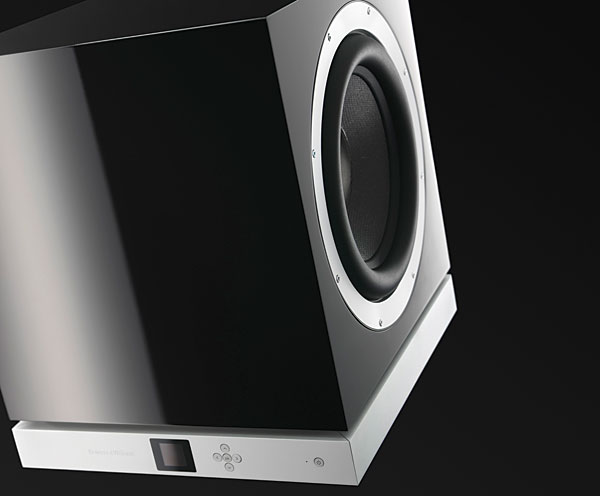
Although many high-end audio products are described as revolutionary and as breakthroughs in design when new, most audiophile components now on the market have not changed our way of relating to such products in the way the iPad has done. Once in a while, a new audio product does move in that direction by enabling the audiophile to do install a product and optimize its performance in a different way.
Celestion System 6000 loudspeaker system
In the audio field, the British have traditionally thought "small," scoring hits both with their compact loudspeakers and with medium-priced amplifiers. The continued growth of the audiophile speaker market in the US, however, which favors larger loudspeakers, has at the same time stimulated the research and design of more powerful, excellent quality amplifiers. In their turn, these have placed increased demands on the speakers they drive.
Era Acoustics Design 4 loudspeaker & SUB10 subwoofer
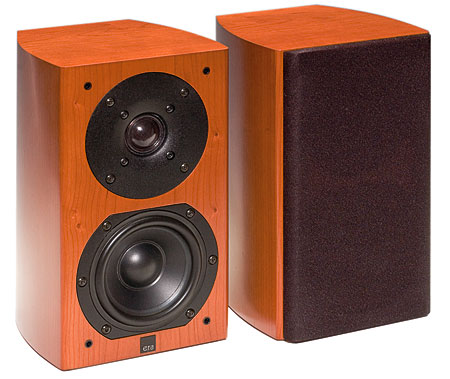
The first time I attended the Las Vegas Consumer Electronics Show, in January 1986, I didn't get there until the second day of the Show. Still, by the beginning of the fourth and final day I'd managed to visit every high-end audio exhibit, and still had time to go back for seconds to the rooms that had sounded the best. Twenty years later, CES has grown so much that it's impossible for a single writer to visit even a quarter of the exhibits in which he might be interested. And even with the sort of team">http://blog.stereophile.com/ces2007/">team reporting Stereophile now practices, covering the Show has become an exercise in applied logistics for the busy journalist: "Should I wait for the free shuttle bus? Should I get a taxi—though I might get caught in Las Vegas's increasing traffic jams, or even just get stuck at the city's interminable traffic lights? Or should I take the new monorail—though that goes nowhere near the hotel in which [insert name of hot company] is demming its products?"
Genelec HTS4B subwoofer
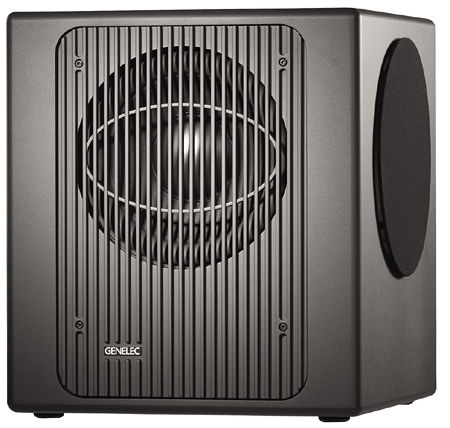
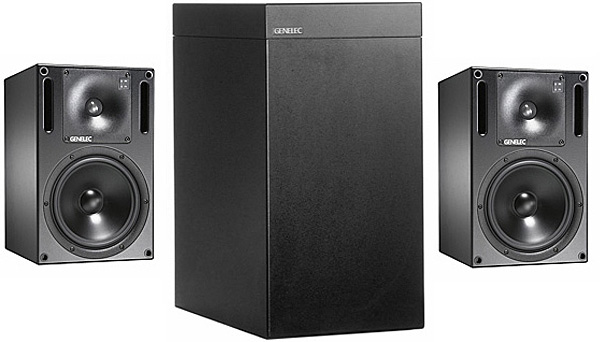
Home theater has dramatically influenced the design of aftermarket subwoofers. Multichannel processors automatically provide a properly filtered low-frequency signal to drive a subwoofer, relieving the need for the sub to be shipped with a passive crossover network or an active electronic crossover. When Genelec offered one of their subwoofers for review, I decided it was important to try to evaluate such a product, even if it meant I'd have to scramble around to find a quality external electronic crossover.
Genelec Studio Monitor 1031A loudspeaker & Studio Monitor 1092A powered subwoofer
Which loudspeakers do audio professionals listen to? And why should we care? After all, it's not as if recording engineers are the kind of refined, sensitive, music-loving types who read Stereophile. As much as they may love music, many audio pros appear only to view the original sounds of musical instruments as raw materials to be creatively reshaped and manipulated. (Okay, there are exceptions. But recordists who care about the sounds of real instruments usually record them in real acoustic spaces rather than in studios, and use as little signal processing as they can get away with.)
Gradient SW-57 subwoofer

There are two kinds of audiophiles: those who own original Quad ESL speakers and those who don't (footnote 1). This review is for the former, although the latter may find it of some interest. The Gradient SW-57 subwoofer attempts to do for the original Quad (footnote 2) what Gradient's SW-63 (footnote 3) does for the Quad ESL-63: supply the bottom octave while relieving the ESLs of the strain of reproducing low bass.
Gramophone Dreams #49: KEF KC62 subwoofer

We have inherited an infinitely vast library of recorded musical art, the majority of which is well-recorded but has yet to be fully and completely reproduced. Countless times, I've played an album and thought, am I the first person ever to hear this recording sound this clear and microscopically detailed? Audiophiles understand that in order to be fully enjoyed, great recordings need the finest possible audio reproduction. Reciprocally, the finest audio systems are best enjoyed when playing great recordings. It's a horse and carriage thing.
Gramophone Dreams #86: Harbeth P3ESR XD loudspeaker and Nelson subwoofer/stand
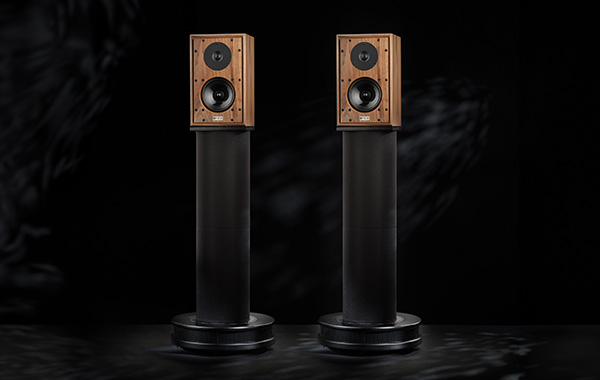
After lifelike timbres and speed-train momentum, how a loudspeaker projects its energy into my room is the main thing that determines how my sound system feels as I listen to it. When I review loudspeakers, I try to notice the unique tone and force of their "voice" as they speak into my room. Do they stand too close, stick out their chests, and brag loudly in third harmonics? Or do they have small voices that force me to lean in to make out what they're saying?
With a miniature box speaker like my reference Falcon Gold Badge LS3/5as or the similarly sized Harbeth P3ESR XDs, which I'm auditioning this month, I have to sit very close to experience any of their direct, "off-the-cone" energy. If my listening position gets too far away or the speakers are positioned too far apart or too far from the wall behind them, the sound thins and loses body.
I didn't need to sit close to those 1947 Altec A5 Voice of the Theatre horns I used to use.
James Loudspeaker EMB-1200 subwoofer

Harry Partch (1901-1974), composer and inventor of musical instruments, delighted in generating deep bass. Finding most standard orchestral instruments wanting in that department, he built the huge Marimba Eroica, which he described on his A Glimpse into the World of Harry Partch: 27 Unique Instruments (LP, Columbia MS-20576):