"I have a really special loudspeaker I want you to hear," said Immedia's Allen Perkins at Home Entertainment 2006.
I entered the Immedia room and followed Perkins to the floorstanding Sonics by Joachim Gerhard Allegrias ($15,000/pair). Yes, baby! I thought. But Perkins kept walking, all the way to a table in the rear of the showroom. He waved at a pair of tiny boxes.
 "They're, um, small," I said.
"Yes. I think the Anima is my favorite speaker in the Sonics by Joachim Gerhard product line."
"Is Sonics by Joachim Gerhard really the brand name? I think people will know Joachim designed them if you just call them Sonics."
"Maybe you will, but I'm not sure that most people follow speaker designers. Joachim made his reputation designing classic loudspeakers for Audio Physic, but that doesn't mean most people know he did that work. When he started Sonics, I argued strongly that he should put his name on it—that it was a matter of taking credit rather than bragging."
"Fair enough. But are you sure you don't want me to audition those?" I pointed to the Allegrias.
"They're great," said Perkins. "Quite extraordinary, as you'd expect for the money. But the Anima is just magical. It's not hard to drive, it's not hard to place, and it's $2600/pair, which is a lot more accessible than 15 grand."
I looked longingly at the Allegrias at the other end of the room, but Perkins is perhaps the most self-effacing promoter in hi-fi. If he'd called the Anima interesting, I'd have assumed it was at least pretty special. But magical? This I had to hear.
By magic numbers and persuasive sound
"They're, um, small," I said.
"Yes. I think the Anima is my favorite speaker in the Sonics by Joachim Gerhard product line."
"Is Sonics by Joachim Gerhard really the brand name? I think people will know Joachim designed them if you just call them Sonics."
"Maybe you will, but I'm not sure that most people follow speaker designers. Joachim made his reputation designing classic loudspeakers for Audio Physic, but that doesn't mean most people know he did that work. When he started Sonics, I argued strongly that he should put his name on it—that it was a matter of taking credit rather than bragging."
"Fair enough. But are you sure you don't want me to audition those?" I pointed to the Allegrias.
"They're great," said Perkins. "Quite extraordinary, as you'd expect for the money. But the Anima is just magical. It's not hard to drive, it's not hard to place, and it's $2600/pair, which is a lot more accessible than 15 grand."
I looked longingly at the Allegrias at the other end of the room, but Perkins is perhaps the most self-effacing promoter in hi-fi. If he'd called the Anima interesting, I'd have assumed it was at least pretty special. But magical? This I had to hear.
By magic numbers and persuasive sound
Joachim Gerhard is indeed best known for his superb run at Audio Physic, where he designed what are assuredly the Anima's direct ancestors, the two-way Step and Step SLE. He's a visiting fellow at the University of Essex's Audio Research Laboratory, and has coauthored a number of technical papers—which is a roundabout way of saying that he actually designs loudspeakers rather than simply keeps tinkering with a collection of parts in hopes of striking sonic gold.
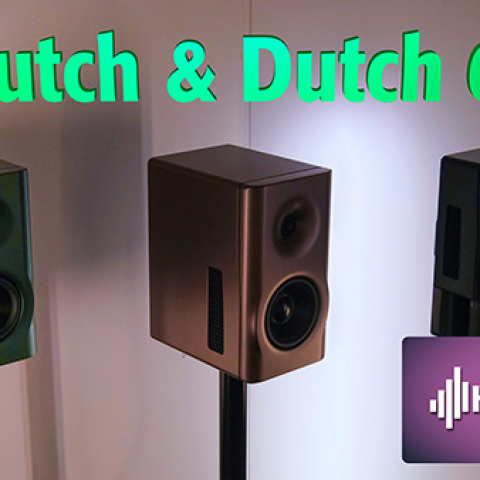
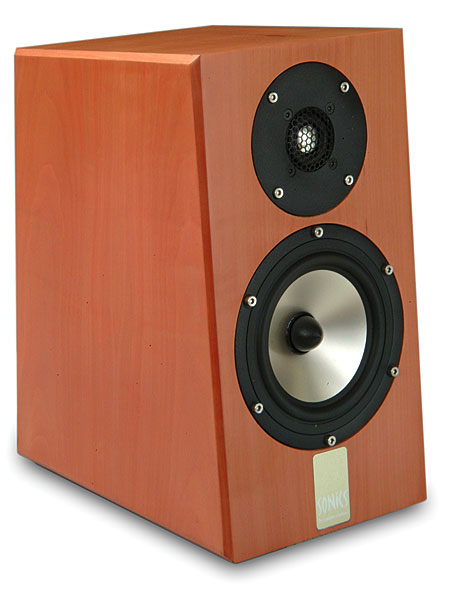
The Anima is a compact (13" H by 7" W by 9" D) two-way monitor designed to be mounted on a stand. Its gently sloping face and ported rear panel are marine-grade plywood, while the other sides are high-density fiberboard (HDF). "That's the best combination I tried," Gerhard said.
Tried how?
"By listening, mainly—but we measured it, too. One of the great things about small cabinets is that if you design them correctly, they don't get too much in the way of the sound."
The crossover is an 18dB acoustic filter with the tweeter wired in reverse, to reduce phase distortion. "That's the best way to make a steep crossover if you want to eliminate phase distortion. The crossover has only six elements, so it's quite simple. I use only polypropylene capacitors. I use special coils to eliminate low-end distortion—they're very-low-distortion ferrites, which give me very low ohmic impedance. The resistors are non-inductive. Even the cables are custom—I source them from a German wire manufacturer."
The drivers were jointly designed by Gerhard and SEAS, which Gerhard has collaborated with for over 20 years. "The 22mm tweeter is a new SEAS design. I also use it in the Allegretto speakers. It has a wide surround and a small membrane, which has the advantage of having a very high breakup point, around 40kHz. The smallness of the driver makes it extremely stiff and low in mass, but the large surround allows it to go deeper than it otherwise would be able to.
"The 6" woofer's voice-coil is quite long and the magnetic field has a wide gap. The stiffening of the membrane makes a big difference. The aluminum cone is anodized on both sides, so it's aluminum sandwiched between layers of aluminum oxide. I measure the breakup frequency between 7kHz and 8kHz. The cone's flare is quite steep, which also makes it stiffer." That woofer also has a perky little waveguide over its dust cap.
Gerhard considered the Anima for a moment. "I think it is quite adequate as a loudspeaker." Quite adequate? "It sounds very much like I designed it to."
Modest guy. No wonder Perkins had to twist his arm to name the company after himself.
Scenes shifted with a swiftness so like magic
As much as I love what compact, stand-mounted monitors do, my 13' by 25' by 8' upstairs listening room is too big for me to ask a speaker the size of the Animas to fill it, so I decided to audition them in the well-treated, 9' by 15' by 7.5' listening room next to my downstairs office. I used 24" Foundation stands, placing the speakers about 20" from the sidewalls and 24" from the front wall, which meant there was about 54" between them. That placed me about 7' away from them in my comfy chair, with a few feet between my listening spot and the wall behind me. I'm so specific about all of this because I found that inches mattered. The Anima wanted space around it—not too much, or I lost low-end impact; and not too little, or the speakers' eerie re-creation of solidity was compromised. Ditto for the space between my sweet spot and the rear wall—avoid the scourge of the comb filter!
Oh yeah—unless you hate hearing harmonic overtones, lose the Animas' grilles.
Thy sweet magic comes together
It took me about half a disc to ditch the grilles. The 24-bit/96kHz DVD of Work of Art's Lift (DVD, Soundkeeper SR4001) lacked the inner details of guitars, banjo, and lute that I'd come to expect from listening to it through Wilson Audio's WATT/Puppy 8s. I'm not saying I expected the Animas to rival the big rig upstairs, but with their grilles on, the music just sounded dead. Naked, however, the Anima revealed detail and sizzle galore. I'd admired Soundkeeper engineer Barry Diament's wonderfully recorded disc on CD, but his higher-rez DVD is an ear-opener. It's not that there's so much going on in those extended high frequencies, but it's obvious that they're not there at all on the "Red Book" CD. It's not so much a question of night and day as one of life and death. And man, was the Anima good at letting me hear what was going on up there.
"They're, um, small," I said.
"Yes. I think the Anima is my favorite speaker in the Sonics by Joachim Gerhard product line."
Joachim Gerhard is indeed best known for his superb run at Audio Physic, where he designed what are assuredly the Anima's direct ancestors, the two-way Step and Step SLE. He's a visiting fellow at the University of Essex's Audio Research Laboratory, and has coauthored a number of technical papers—which is a roundabout way of saying that he actually designs loudspeakers rather than simply keeps tinkering with a collection of parts in hopes of striking sonic gold.
As much as I love what compact, stand-mounted monitors do, my 13' by 25' by 8' upstairs listening room is too big for me to ask a speaker the size of the Animas to fill it, so I decided to audition them in the well-treated, 9' by 15' by 7.5' listening room next to my downstairs office. I used 24" Foundation stands, placing the speakers about 20" from the sidewalls and 24" from the front wall, which meant there was about 54" between them. That placed me about 7' away from them in my comfy chair, with a few feet between my listening spot and the wall behind me. I'm so specific about all of this because I found that inches mattered. The Anima wanted space around it—not too much, or I lost low-end impact; and not too little, or the speakers' eerie re-creation of solidity was compromised. Ditto for the space between my sweet spot and the rear wall—avoid the scourge of the comb filter!
It took me about half a disc to ditch the grilles. The 24-bit/96kHz DVD of Work of Art's Lift (DVD, Soundkeeper SR4001) lacked the inner details of guitars, banjo, and lute that I'd come to expect from listening to it through Wilson Audio's WATT/Puppy 8s. I'm not saying I expected the Animas to rival the big rig upstairs, but with their grilles on, the music just sounded dead. Naked, however, the Anima revealed detail and sizzle galore. I'd admired Soundkeeper engineer Barry Diament's wonderfully recorded disc on CD, but his higher-rez DVD is an ear-opener. It's not that there's so much going on in those extended high frequencies, but it's obvious that they're not there at all on the "Red Book" CD. It's not so much a question of night and day as one of life and death. And man, was the Anima good at letting me hear what was going on up there.