When someone is described as having "written the book" on a subject, it is generally taken as a figure of speech. But veteran speaker designer Joseph D'Appolito, PhD, quite literally "wrote the book." His Testing Loudspeakers (Audio Amateur Press, 1998) is an invaluable resource for those of us who, lacking any talent for designing speakers ourselves, nevertheless find the subject of speaker performance endlessly fascinating. So when Snell's PR consultant, Bryan Stanton, contacted me a while back about reviewing the LCR7, the first design D'Appolito had seen through from start to finish for the Massachusetts-based company since he had replaced David Smith as Snell's chief engineer, I suffered from more than a little anxiety.
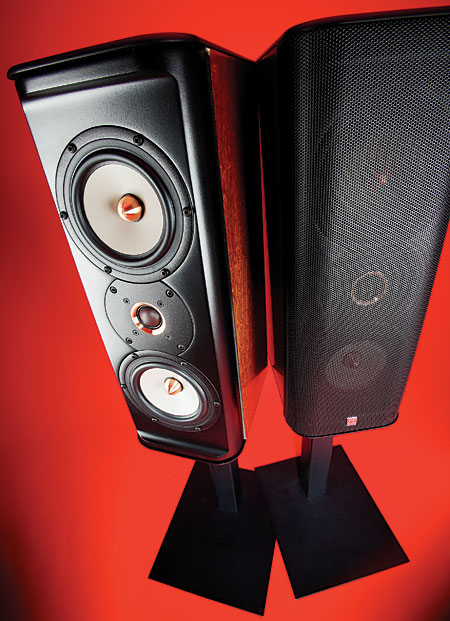 I took delivery of a pair of LCR7s, a fairly small two-way, sealed-box design that sells for $2000/pair (see sidebar, "The Standard LCR7"). This elegant speaker features two woofers and a tweeter closely spaced in a D'Appolito array—yes, the same "D'Appolito"—with the woofers top and bottom of a centrally placed tweeter (or to either side of it when the speaker is used for the center channel in a home theater system). But soon after I started my auditioning, Bryan informed me that, to celebrate the 30th anniversary of Snell Acoustics, Joe had designed a no-holds-barred version of the LCR7, the more expensive LCR7 XL. That, I decided, would be the speaker I would hang my Snell reviewing hat on.
Anniversary...
I took delivery of a pair of LCR7s, a fairly small two-way, sealed-box design that sells for $2000/pair (see sidebar, "The Standard LCR7"). This elegant speaker features two woofers and a tweeter closely spaced in a D'Appolito array—yes, the same "D'Appolito"—with the woofers top and bottom of a centrally placed tweeter (or to either side of it when the speaker is used for the center channel in a home theater system). But soon after I started my auditioning, Bryan informed me that, to celebrate the 30th anniversary of Snell Acoustics, Joe had designed a no-holds-barred version of the LCR7, the more expensive LCR7 XL. That, I decided, would be the speaker I would hang my Snell reviewing hat on.
Anniversary...
I well remember the first time I met Snell Acoustics founder Peter Snell. He was demonstrating his classic Type A loudspeaker at the 1979 Summer Consumer Electronics Show, in Chicago. "This'll clear the room," he winked at me, as he put on the Philips LP of Puccini's Tosca (6700 108), conducted by Sir Colin Davis and featuring Monserratt Caballé in the title role—unbeknownst to him, my favorite performance at that time. I listened all through the second half of Act I, which ends with police chief Scarpia (Ingvar Wixell) sending his thugs out to follow Tosca to find the escaped terrorist Cavaradossi (José Carreras) while the good citizens of Rome (the Covent Garden chorus) celebrate mass. Far from clearing the room, it was a seminal experience for quite a number of CESgoers!
The Type A was one of the best speakers of its era—full-range, low-coloration, and intended to be used adjacent to the wall behind it—and Peter Snell went on to design an entire range of loudspeakers before tragically dying of a heart attack in September 1984. Kevin Voecks was the company's chief engineer through the rest of the 1980s and the first half of the 1990s, and designed some excellent speakers, including my favorite, the Type E, before he left to cofound Revel. David Smith, ex-JBL, KEF, and McIntosh, replaced Kevin, and was responsible for the high-performance XA series before he moved to PSB in 2003.
...XL Edition
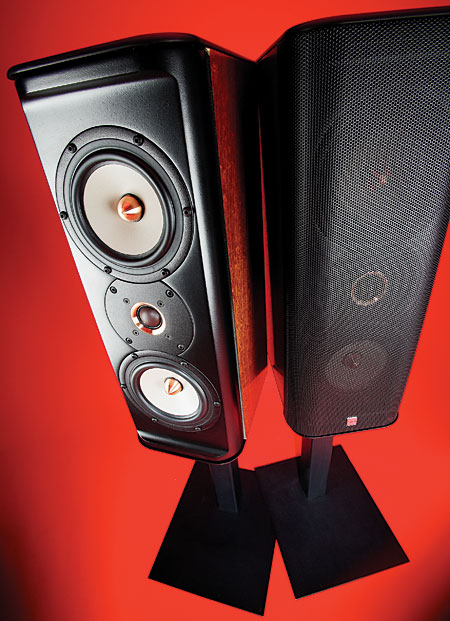
The LCR7 XL is the flagship of Joe D'Appolito's Series 7 speakers. Its twin 5.25" magnesium-cone woofers, with their copper-finished, stationary "phase plug" mounted on the end of the pole-piece and a low-profile cast basket, are sourced from Norwegian company SEAS, as is the Sonotex-dome tweeter. The Millennum-series tweeter has a neodymium magnet, a sealed back chamber, and more unusually, a silver-wire voice-coil. The short flare around the tweeter's dome is also finished in copper, and its faceplate is cut away to allow close mounting to the woofers. All three of the expensive SEAS "Excel" drive-units are magnetically shielded, and the response of each sample of the LCR7 is guaranteed to be within ±0.5dB of the target. The crossover is complex, with high-order slopes, and is mounted on the internal face of the terminal panel. Internal wiring is fairly small gauge, and press-on connectors are used to hook up the drive-units rather than solder joints. Electrical connection is via twin pairs of five-way binding posts on an inset panel on the speaker's rear. The only practical quibble I had with the Snells was these binding posts. They're spaced for double banana plugs, which in itself is not a problem, but the fact that they have knurled rather than hexagonal knobs is. A nut driver can't be used, but the close spacing makes it difficult for someone with stubby fingers like mine to fully tighten the connection.
Snell's Series 7 industrial design was done by Gerd Schmieta. The XL's elegant enclosure, made at Snell's cabinet shop in Haverhill, Massachusetts, is identical to that of the standard LCR7. Its vertical edges are rounded, the front baffle is painted black, and the sides and back are veneered. The cabinet is stiffened with aluminum top and bottom caps as well as a horizontal H-brace behind the tweeter, and is filled with acrylic foam. A metal-mesh wraparound grille runs the full height of the baffle and fits into slots between the profiled edges of the baffle and the end plates. The LCR7 XL's overall fit and finish are superb.
Sound
I set the XLs up on 24"-high, single-pillar Celestion stands damped and mass-loaded with sand and bird shot. The speakers were arranged with their drive-units vertically in-line; small pads of Blu-Tack provided resistive coupling to each stand's top plate. After the usual experimentation, I ended up with the speakers well away from the wall behind them, their rear-panel switches in the upward, Normal position. My first impressions were very favorable, especially after my experience with the standard LCR7s (see sidebar, "The Standard LCR7"). The tonal balance didn't seem quite as lightweight as with the less-expensive speaker. Playing the 1/3-octave warble tones on Editor's Choice (CD, Stereophile STPH016-2), the speaker was still putting out useful signal in the 50Hz band. Though the 40Hz, 25Hz, and 20Hz bands were inaudible, the lowest mode in my room did boost the left speaker's reproduction of the 32Hz band sufficiently to be just audible. As I've mentioned before in these pages, the advantage an optimal sealed-box woofer alignment offers over the almost ubiquitous reflex or ported design is that the ultimate rate of rolloff is only 12dB/octave—gentler than the 24dB/octave that results from the woofer and port outputs being in antiphase below the port resonance. So while a sealed-box design will have a higher nominal –3dB frequency than a comparable ported design, in all but large rooms it may well have more mid- and low bass, due to the usual "room gain" at low frequencies.
The LCR7 XL takes full benefit of this phenomenon. While its low frequencies were restricted in absolute terms—this Snell will never satisfy fans of classical pipe-organ recordings or devotees of bass-synth–heavy techno—it offered enough midbass in-room to provide musical satisfaction with many recordings.
I took delivery of a pair of LCR7s, a fairly small two-way, sealed-box design that sells for $2000/pair (see sidebar, "The Standard LCR7"). This elegant speaker features two woofers and a tweeter closely spaced in a D'Appolito array—yes, the same "D'Appolito"—with the woofers top and bottom of a centrally placed tweeter (or to either side of it when the speaker is used for the center channel in a home theater system). But soon after I started my auditioning, Bryan informed me that, to celebrate the 30th anniversary of Snell Acoustics, Joe had designed a no-holds-barred version of the LCR7, the more expensive LCR7 XL. That, I decided, would be the speaker I would hang my Snell reviewing hat on.
Anniversary...
I well remember the first time I met Snell Acoustics founder Peter Snell. He was demonstrating his classic Type A loudspeaker at the 1979 Summer Consumer Electronics Show, in Chicago. "This'll clear the room," he winked at me, as he put on the Philips LP of Puccini's Tosca (6700 108), conducted by Sir Colin Davis and featuring Monserratt Caballé in the title role—unbeknownst to him, my favorite performance at that time. I listened all through the second half of Act I, which ends with police chief Scarpia (Ingvar Wixell) sending his thugs out to follow Tosca to find the escaped terrorist Cavaradossi (José Carreras) while the good citizens of Rome (the Covent Garden chorus) celebrate mass. Far from clearing the room, it was a seminal experience for quite a number of CESgoers!
The LCR7 XL is the flagship of Joe D'Appolito's Series 7 speakers. Its twin 5.25" magnesium-cone woofers, with their copper-finished, stationary "phase plug" mounted on the end of the pole-piece and a low-profile cast basket, are sourced from Norwegian company SEAS, as is the Sonotex-dome tweeter. The Millennum-series tweeter has a neodymium magnet, a sealed back chamber, and more unusually, a silver-wire voice-coil. The short flare around the tweeter's dome is also finished in copper, and its faceplate is cut away to allow close mounting to the woofers. All three of the expensive SEAS "Excel" drive-units are magnetically shielded, and the response of each sample of the LCR7 is guaranteed to be within ±0.5dB of the target. The crossover is complex, with high-order slopes, and is mounted on the internal face of the terminal panel. Internal wiring is fairly small gauge, and press-on connectors are used to hook up the drive-units rather than solder joints. Electrical connection is via twin pairs of five-way binding posts on an inset panel on the speaker's rear. The only practical quibble I had with the Snells was these binding posts. They're spaced for double banana plugs, which in itself is not a problem, but the fact that they have knurled rather than hexagonal knobs is. A nut driver can't be used, but the close spacing makes it difficult for someone with stubby fingers like mine to fully tighten the connection.
I set the XLs up on 24"-high, single-pillar Celestion stands damped and mass-loaded with sand and bird shot. The speakers were arranged with their drive-units vertically in-line; small pads of Blu-Tack provided resistive coupling to each stand's top plate. After the usual experimentation, I ended up with the speakers well away from the wall behind them, their rear-panel switches in the upward, Normal position. My first impressions were very favorable, especially after my experience with the standard LCR7s (see sidebar, "The Standard LCR7"). The tonal balance didn't seem quite as lightweight as with the less-expensive speaker. Playing the 1/3-octave warble tones on Editor's Choice (CD, Stereophile STPH016-2), the speaker was still putting out useful signal in the 50Hz band. Though the 40Hz, 25Hz, and 20Hz bands were inaudible, the lowest mode in my room did boost the left speaker's reproduction of the 32Hz band sufficiently to be just audible. As I've mentioned before in these pages, the advantage an optimal sealed-box woofer alignment offers over the almost ubiquitous reflex or ported design is that the ultimate rate of rolloff is only 12dB/octave—gentler than the 24dB/octave that results from the woofer and port outputs being in antiphase below the port resonance. So while a sealed-box design will have a higher nominal –3dB frequency than a comparable ported design, in all but large rooms it may well have more mid- and low bass, due to the usual "room gain" at low frequencies.