When reviewing affordable speakers, it's critical to have benchmarks and comparisons for various price points. Inexpensive speaker designs are exercises in tradeoffs and compromises, especially for the least costly products. In all of my reviews, I try to compare the speaker in question with other designs close to the review sample's price, chosen from my list of previously reviewed speakers. From time to time, if a speaker particularly impresses me, I ask the manufacturer if I can keep the speakers around a while longer, so that it can serve as a comparison reference for a certain price point. That's not to say that any speaker I don't keep around is less desirable—there's just not enough room in my house to keep a sample of every speaker I like. An audio reviewer's wife puts up with enough as it is.
 On the other hand, you can rest assured that any speaker I do keep for a long time is still here because its design continues to impress me, even as speaker designers continually raise the bar with newer, more revealing, more cost-effective designs. And when a manufacturer informs me that a new design has replaced one of my benchmarks, I'm usually anxious to hear that attempt to supersede an excellent design.
One of those long-term references was NHT's SB3 ($600/pair), a bookshelf model that I reviewed in the November 2002 Stereophile (Vol.25 No.11) and have kept around for comparisons ever since. It has recently been superseded by NHT's Classic Three ($800/pair).
Innovating
On the other hand, you can rest assured that any speaker I do keep for a long time is still here because its design continues to impress me, even as speaker designers continually raise the bar with newer, more revealing, more cost-effective designs. And when a manufacturer informs me that a new design has replaced one of my benchmarks, I'm usually anxious to hear that attempt to supersede an excellent design.
One of those long-term references was NHT's SB3 ($600/pair), a bookshelf model that I reviewed in the November 2002 Stereophile (Vol.25 No.11) and have kept around for comparisons ever since. It has recently been superseded by NHT's Classic Three ($800/pair).
Innovating
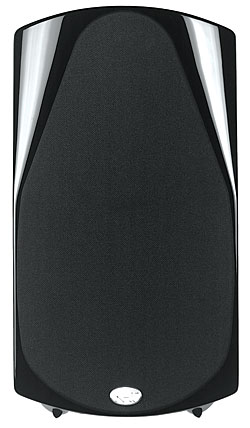
The Classic Three is somewhere in the middle of NHT's new Classic line of two-channel and home-theater speakers, which range in price from $400 to $1800/pair. The Three actually bears no resemblance to the two-way SB3, which it replaces. It's smaller, and while it is still a sealed-box, acoustic-suspension design, the Three is a three-way speaker with a ¾" aluminum-dome tweeter, a 2" aluminum midrange dome, and a 6.5" polypropylene-cone woofer. NHT believes that three-ways now play a greater role in their line because they provide broader dispersion and a higher dynamic range, which is more critical for the increasing popularity of multichannel systems.
All Classic speakers have baffles twice as thick as their predecessor models, designed to reduce cabinet vibrations and improve transient response. The parabolic curve of the baffle around the midrange and tweeter is intended to smooth out the mid- and high-frequency responses for all listening positions, especially those off the tweeter axis. Each of the Three's drivers is individually shielded using Bulk Molding Compound (BMC), which NHT developed for their more expensive XdS speaker. The midrange and tweeter are ferrofluid-cooled and in the Three are built with neodymium iron boron magnets, which are placed inside a steel can as part of the speaker motor's magnetic circuit. This results in very low stray flux field.
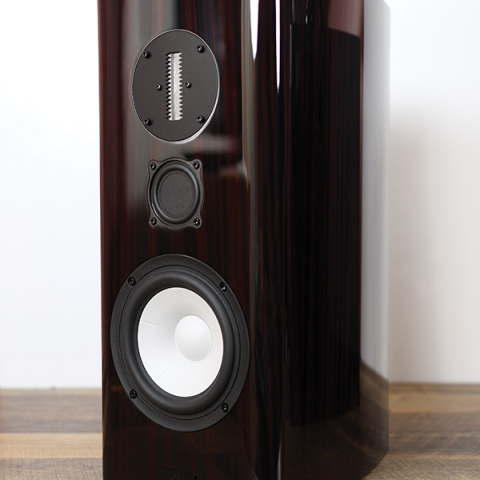
I was taken with the Classic Three's appearance. Smaller, more elegant, and less boxy-looking than the SB3, the Three has a slightly curved top and bottom. Two metal ridges screwed to the bottom of the speaker have a long, narrow rubber foot that resembles a windshield-wiper blade. The blades sat securely on my Celestion Si stands without the need to mess with any Blu-Tack. I heard a slightly more detailed sound with the Threes' grilles off, but no change in the tonal balance.
Listening
Usually, when I listen to an affordable speaker with a dead-neutral midrange, what I first notice is the speaker's ability to project vocal realism. The Classic Three, however, directed my initial attention elsewhere. The speaker's three greatest strengths—its ability to render subtle, organic gradations of low-level dynamic information; its resolution of detail and ability to "disappear" while throwing a wide, deep soundstage; and its extended, detailed, airy, and delicate high frequencies—combined to create a startling level of realism with well-recorded acoustic works, particularly classical. James Boyk's recording of Mussorgsky's Pictures at an Exhibition (CD, LP, Performance PR-7) revealed a solo-piano performance that sounded light, delicate, and detailed, with a low-level dynamic realism that rivaled that of a live piano.
On George Crumb's Quest (CD, Bridge 9069), the slightly warm string bass was otherwise natural, with the requisite thwack on attacks, and a strong sense of the instrument's wood. Listening to this recording, however, I was transfixed by the percussion. The cymbals had a long, natural decay and sense of air, and the level of pitch discrimination and subtleties of low-level dynamics were not what I'm used to hearing from speakers costing only $800/pair. The upper partials of the bell tree were delicate and seemed very extended. The articulation of the rain stick against the rear of the soundstage was such that it seemed as if I could hear every drip.
I was easily able to follow violinist Tom Chiu's phrasing and technique in David Chesky's Violin Concerto, from Area 31 (SACD, CD layer, Chesky SACD288), and the extended violin partials were realistic without sounding at all harsh. Moreover, the subtle timpani dynamics, transients, and pitch were transparent as the speakers disappeared into the soundstage.
The Threes loved to reproduce percussion. Drummer Mark Flynn's dynamic bass-drum technique and ride-cymbal textures on "Repose and Vertigo," from Attention Screen's La Tessitura (CD, Hojo HOJO110), had a bloom and immediacy like that of a live performance. I dredged out my original British pressing of King Crimson's Larks Tongues in Aspic (LP, Island ILPS 9230) and braced myself for the dynamic blast when percussionist Jamie Muir hits the deacon chime during the quiet midsection of "Easy Money." I felt as if Pert were hitting me right between the eyes with his mallet; the shimmering decay of that gorgeous burnished instrument lasted for many seconds.
Percussion seemed so realistic partly due to the NHT's dead-on-accurate articulation of transients. The interaction of Stevie Winwood's bass and Jim Capaldi's drums on Traffic's John Barleycorn Must Die (LP, Island 90058-1) locked into a rhythmic drive that reaffirmed why many years ago I placed this album on my list of the "Top 20 Rock Albums of All Time." It had been quite a while since I'd listened to it, however. From my notes: "I didn't realize how well recorded this album is!" I had never before noticed the delicate percussion fills along the rear wall of the soundstage.
The Three's lower-midrange naturalness and transparency made it an excellent match for jazz woodwind recordings. On "I'm an Old Cowhand," from Sonny Rollins' Way Out West (CD, JVC VICJ-60083), Rollins' tenor sax (I quote again from my notes) "bloomed subtly and silkily." Male vocals were equally spectacular. The male chorus in John Rutter's Requiem (CD, Reference RR-57CD) were layered holographically along the wide, deep stage without a hint of coloration. The Classic Threes "disappeared"; it was easy to discern the hall's acoustic.
The Rutter recording highlighted two aspects of the Three's bass. First, for such a small speaker with no reflex loading, the low-bass extension subjectively seemed to go fairly deep. (What's the frequency, Kenneth—er, I mean, John?) This recording's midbass, however, seemed slightly elevated—not a boomy resonant coloration, but throughout the midbass the clearly defined notes seemed a notch higher in volume. This elevated midbass also manifested itself as a slight warmth in the sound of the string bass on most jazz recordings I listened to, such as Victor Krauss's excellent string work on Bill Frisell's East/West (CD, Nonesuch 79863-2). However, in no case was this bothersome, nor did it call any particular attention to itself. In fact, Ray Brown's bass solo on "I'm an Old Cowhand" had a natural linearity, with excellent attack, definition, woodiness, and no trace of excess bloom. Nor was there any problem in the bass with rock recordings, even when I cranked up the volume. On "Man Machine," from Kraftwerk's Minimum/Maximum (CD, EMI ASW 60611), which I usually listen to at 105dB, the subtle bass-synth articulations were all there, with no hint of overhang, loss of definition, or lack of transient speed.
The recording that showed the NHT at its best was Tomiko Kohjiba's Transmigration of the Soul, from Festival (CD, Stereophile STPH007-2). The opening flute passage was airy and appropriately breathy; it was easy to follow flutist Carol Wincenc's phrasing technique. I could hear the rosin on the violin bows, the reediness in the clarinet, and the natural timbre, authority, decay, and air of the timpani. With all classical recordings, the Classic Three's overall sound was akin to what I would expect from much more expensive speakers in terms of the air surrounding the instruments and the replication of the recorded acoustic.
Comparing
I compared the NHT Classic Three ($800/pair) with its predecessor, NHT's SB3 ($600/pair), as well as the Epos M5 ($650/pair) and the Nola Mini ($695/pair). The NHT SB3's midrange was as seductive as the Classic Three's, but with much less detail. The SB3's highs sounded natural but were not as detailed, extended, or refined as the Three's. The SB3's midbass was also much less defined, and the Classic Three was superior in rendering low-level dynamic articulations.
The Epos M5's midrange was as delicate, refined, and detailed as the Classic Three's, and its highs were airy and extended. The M5's midbass was cleaner, tighter, and leaner than the Three's, but the latter's bass extension was superior, as was its high-level dynamic capability.
The Nola Mini had a natural midrange as well as extended and detailed highs. Midrange inner detail was more revealing through the Nola, however, and its bass extension and high-level dynamic capabilities were superior to those of the Classic Three.
Concluding
I applaud NHT, who have updated the already excellent SB3 to create a smaller, more elegant performer that exceeds the performance of the older speaker in every important parameter. That's real progress. At $800/pair, the Classic Three is a superb value, particularly for those listening rooms in which size and cosmetics are important but whose owners are reluctant to give up performance in bass definition and extension and in high-level dynamics. In every one of my listening sessions, the NHT Classic Three sounded like a larger, more expensive speaker. Keep up the good work, guys.
On the other hand, you can rest assured that any speaker I do keep for a long time is still here because its design continues to impress me, even as speaker designers continually raise the bar with newer, more revealing, more cost-effective designs. And when a manufacturer informs me that a new design has replaced one of my benchmarks, I'm usually anxious to hear that attempt to supersede an excellent design.
One of those long-term references was NHT's SB3 ($600/pair), a bookshelf model that I reviewed in the November 2002 Stereophile (Vol.25 No.11) and have kept around for comparisons ever since. It has recently been superseded by NHT's Classic Three ($800/pair).
Innovating
The Classic Three is somewhere in the middle of NHT's new Classic line of two-channel and home-theater speakers, which range in price from $400 to $1800/pair. The Three actually bears no resemblance to the two-way SB3, which it replaces. It's smaller, and while it is still a sealed-box, acoustic-suspension design, the Three is a three-way speaker with a ¾" aluminum-dome tweeter, a 2" aluminum midrange dome, and a 6.5" polypropylene-cone woofer. NHT believes that three-ways now play a greater role in their line because they provide broader dispersion and a higher dynamic range, which is more critical for the increasing popularity of multichannel systems.
Usually, when I listen to an affordable speaker with a dead-neutral midrange, what I first notice is the speaker's ability to project vocal realism. The Classic Three, however, directed my initial attention elsewhere. The speaker's three greatest strengths—its ability to render subtle, organic gradations of low-level dynamic information; its resolution of detail and ability to "disappear" while throwing a wide, deep soundstage; and its extended, detailed, airy, and delicate high frequencies—combined to create a startling level of realism with well-recorded acoustic works, particularly classical. James Boyk's recording of Mussorgsky's Pictures at an Exhibition (CD, LP, Performance PR-7) revealed a solo-piano performance that sounded light, delicate, and detailed, with a low-level dynamic realism that rivaled that of a live piano.
I compared the NHT Classic Three ($800/pair) with its predecessor, NHT's SB3 ($600/pair), as well as the Epos M5 ($650/pair) and the Nola Mini ($695/pair). The NHT SB3's midrange was as seductive as the Classic Three's, but with much less detail. The SB3's highs sounded natural but were not as detailed, extended, or refined as the Three's. The SB3's midbass was also much less defined, and the Classic Three was superior in rendering low-level dynamic articulations.
I applaud NHT, who have updated the already excellent SB3 to create a smaller, more elegant performer that exceeds the performance of the older speaker in every important parameter. That's real progress. At $800/pair, the Classic Three is a superb value, particularly for those listening rooms in which size and cosmetics are important but whose owners are reluctant to give up performance in bass definition and extension and in high-level dynamics. In every one of my listening sessions, the NHT Classic Three sounded like a larger, more expensive speaker. Keep up the good work, guys.