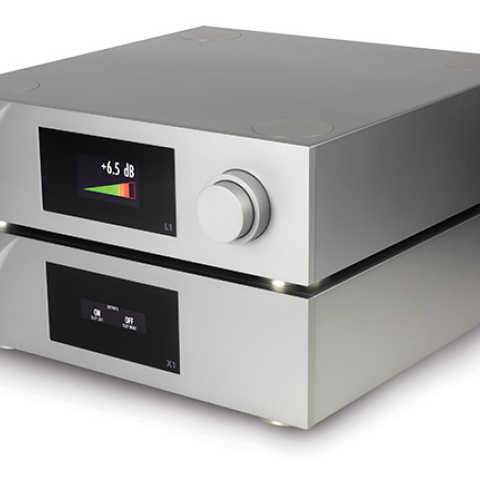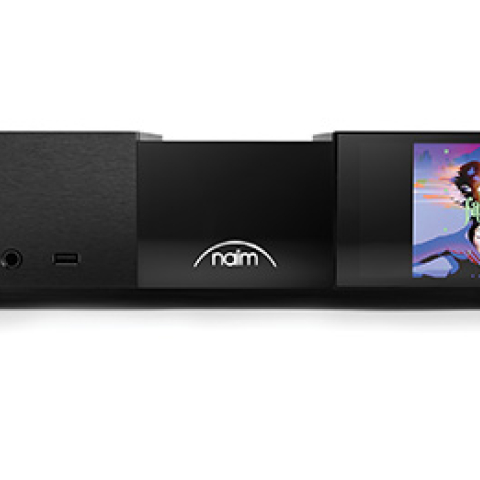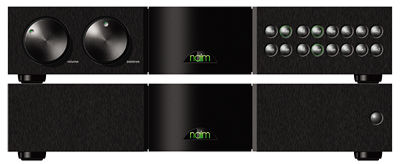
There's nothing groundbreaking about the technology included in Naim's new $22,400, two-box, remote-controllable, top-of-the-line NAC 552 preamplifier. Still, the inclusion of two sets of RCA input jacks is a departure from Naim's tradition of DIN jacks, and the NAC 552's programmability is unusual for a high-end two-channel audio product. And you can order RCA output jacks at no extra cost, which is how my review sample was configured.  Naim has always made a big issue of the quality of the power supplied to their electronics, and this preamplifier is no exception. The NAC 552PS power supply, built specifically for the NAC 552, has a noise-reducing "split-rail" (ie, separate positive and negative supplies) power supply based on an 800VA toroidal power transformer "big enough to supply a 300 or 400W amplifier," according to Naim. Three large capacitors and 16 regulators supply power to the NAC 552's various sections. The split-rail design is said to keep signal levels clean, quiet, and thermally stable. The supply feeds the preamp's analog section via a large-diameter cable with locking multi-pin Burndy connectors, while a separate five-pin DIN cable powers all control and digital functions. The preamplifier's audio output returns to the power-supply chassis via the main connecting cable, and drives the power amplifier via jacks on the power supply's rear panel—unusual, but common in Naim products.
The NAC 552's front-panel controls include volume and balance potentiometers and two rows of pushbuttons: one row for selecting the listening source, the other for directing signals to the Record Out facilities, though there is no "tape loop" as such. Both rows include Mute and Mono buttons, with which the user can fold down stereo mixes to mono at both playback and record outputs—and, more important, cancel out unwanted vertical modulations when recording mono LPs using a stereo cartridge. A very useful feature. Another useful feature is the Record selection's Lock function: by pushing the Source Mono button four times within six seconds, you can't accidentally change the selected Record Out source. Four more quick pushes and you can. The Input Mapping function lets you assign the input jacks to specific input source buttons. There are seven assignable DIN input jacks (one is powered and reserved for Naim's Stageline phono stage) and two RCA phono input jacks: nine inputs but only six input buttons. The source buttons are labeled CD, Tuner, Tape, AV, Aux 1, and Aux 2, which helps you decide which inputs to assign to which buttons—or you can connect your sources to conform to the default settings (eg, DIN input 2's default setting is the CD button).
Of the six main DIN connectors, only 3, 4, and 5 have input, output, and unity-gain capabilities. (Unity gain is a programmable pass-through function, bypassing the volume and balance controls, for integrating the 552 into a multichannel A/V system.) However, all sources are available for recording at each of the DINs with output capabilities, meaning you could have three recording devices connected to the 552 simultaneously. This feature is not made clear in the instruction manual. In fact, the manual is woefully inadequate. When I tried connecting the NAC 552 to the Alesis Masterlink ML-9600 hard-disk/CD-R recorder, I looked for the Naim's Record Out jacks and found none. The manual's diagram of the rear panel shows seven DINs and two sets of RCA jacks, labeled In 1, In 2, etc., but nowhere was there anything labeled Out. When I called Naim America's Chris Koster about this, he told me that inputs 3, 4, and 5 had both In and Out pins. I scoured the connection page, and there, in a small box labeled "Inputs 3, 4, 5," was a diagram of a five-pin DIN jack with two of the small holes labeled Out in very small print. Those tiny Outs were the only reference I could find in the manual to the Record Out connections. This is unfortunate for a product on which so much attention to recording facilities has been lavished.
Instruction manuals should tell a story and lead the consumer by the hand. This one does neither, though some sections are reasonably straightforward and descriptive. While Naim products are, for the most part, installed by dealers, they are also idiosyncratic. And while it's safe to assume that most buyers of NAC 552s will be stepping up from other Naim products, some will be first-time Naim buyers. This manual will give them a troubling and not particularly pleasant introduction to an accomplished line of products. One thing the manual does explain well is the input-assignment procedure, which is a relatively straightforward process. I won't go into the particulars, except to say that it includes watching a set of small, rear-panel LEDs mounted above each input. Naim should include a small dentist's mirror with each NAC 552.
Naim has always made a big issue of the quality of the power supplied to their electronics, and this preamplifier is no exception. The NAC 552PS power supply, built specifically for the NAC 552, has a noise-reducing "split-rail" (ie, separate positive and negative supplies) power supply based on an 800VA toroidal power transformer "big enough to supply a 300 or 400W amplifier," according to Naim. Three large capacitors and 16 regulators supply power to the NAC 552's various sections. The split-rail design is said to keep signal levels clean, quiet, and thermally stable. The supply feeds the preamp's analog section via a large-diameter cable with locking multi-pin Burndy connectors, while a separate five-pin DIN cable powers all control and digital functions. The preamplifier's audio output returns to the power-supply chassis via the main connecting cable, and drives the power amplifier via jacks on the power supply's rear panel—unusual, but common in Naim products.
The NAC 552's front-panel controls include volume and balance potentiometers and two rows of pushbuttons: one row for selecting the listening source, the other for directing signals to the Record Out facilities, though there is no "tape loop" as such. Both rows include Mute and Mono buttons, with which the user can fold down stereo mixes to mono at both playback and record outputs—and, more important, cancel out unwanted vertical modulations when recording mono LPs using a stereo cartridge. A very useful feature. Another useful feature is the Record selection's Lock function: by pushing the Source Mono button four times within six seconds, you can't accidentally change the selected Record Out source. Four more quick pushes and you can. The Input Mapping function lets you assign the input jacks to specific input source buttons. There are seven assignable DIN input jacks (one is powered and reserved for Naim's Stageline phono stage) and two RCA phono input jacks: nine inputs but only six input buttons. The source buttons are labeled CD, Tuner, Tape, AV, Aux 1, and Aux 2, which helps you decide which inputs to assign to which buttons—or you can connect your sources to conform to the default settings (eg, DIN input 2's default setting is the CD button).
Of the six main DIN connectors, only 3, 4, and 5 have input, output, and unity-gain capabilities. (Unity gain is a programmable pass-through function, bypassing the volume and balance controls, for integrating the 552 into a multichannel A/V system.) However, all sources are available for recording at each of the DINs with output capabilities, meaning you could have three recording devices connected to the 552 simultaneously. This feature is not made clear in the instruction manual. In fact, the manual is woefully inadequate. When I tried connecting the NAC 552 to the Alesis Masterlink ML-9600 hard-disk/CD-R recorder, I looked for the Naim's Record Out jacks and found none. The manual's diagram of the rear panel shows seven DINs and two sets of RCA jacks, labeled In 1, In 2, etc., but nowhere was there anything labeled Out. When I called Naim America's Chris Koster about this, he told me that inputs 3, 4, and 5 had both In and Out pins. I scoured the connection page, and there, in a small box labeled "Inputs 3, 4, 5," was a diagram of a five-pin DIN jack with two of the small holes labeled Out in very small print. Those tiny Outs were the only reference I could find in the manual to the Record Out connections. This is unfortunate for a product on which so much attention to recording facilities has been lavished.
Instruction manuals should tell a story and lead the consumer by the hand. This one does neither, though some sections are reasonably straightforward and descriptive. While Naim products are, for the most part, installed by dealers, they are also idiosyncratic. And while it's safe to assume that most buyers of NAC 552s will be stepping up from other Naim products, some will be first-time Naim buyers. This manual will give them a troubling and not particularly pleasant introduction to an accomplished line of products. One thing the manual does explain well is the input-assignment procedure, which is a relatively straightforward process. I won't go into the particulars, except to say that it includes watching a set of small, rear-panel LEDs mounted above each input. Naim should include a small dentist's mirror with each NAC 552.
Naim has always made a big issue of the quality of the power supplied to their electronics, and this preamplifier is no exception. The NAC 552PS power supply, built specifically for the NAC 552, has a noise-reducing "split-rail" (ie, separate positive and negative supplies) power supply based on an 800VA toroidal power transformer "big enough to supply a 300 or 400W amplifier," according to Naim. Three large capacitors and 16 regulators supply power to the NAC 552's various sections. The split-rail design is said to keep signal levels clean, quiet, and thermally stable. The supply feeds the preamp's analog section via a large-diameter cable with locking multi-pin Burndy connectors, while a separate five-pin DIN cable powers all control and digital functions. The preamplifier's audio output returns to the power-supply chassis via the main connecting cable, and drives the power amplifier via jacks on the power supply's rear panel—unusual, but common in Naim products.