Few topics will get audiophiles into an argument more readily than a discussion of the relative merits of tubed and solid-state equipment. A poll on the Stereophile website showed 53% of respondents choosing solid-state as their preferred amplifier design, while 38% indicated a preference for tubes—the remainder choosing "other," which presumably means digital amplifiers. (There has been no corresponding survey regarding preamplifier designs.) Opinions tend toward the dogmatic, with one respondent declaring "solid-state is more accurate," another stating unequivocally that "tubes sound closer to the real thing."  Although designers of audio equipment tend to be more evenhanded than consumers in their evaluations of the tube vs solid-state debate, most of them design with tubes or solid-state, not both. One of the few designers with a foot in each camp is Victor Khomenko of Balanced Audio Technology (BAT). BAT's first products were the VK-5 preamplifier and the VK-60 power amplifier, both of which use tubes, but I remember Khomenko telling me, when I reviewed these products for the December 1995 Stereophile (Vol.18 No.12), that he was just as comfortable designing with solid-state as with tubes, and that his plans for BAT included some solid-state offerings. Since then, he's made good on his promise: the BAT line now includes four solid-state amplifiers (including one multichannel) and three solid-state preamplifiers. On hand this time around was the VK-40, BAT's top-of-the-line solid-state preamplifier.
Although the subject of the review proper is the VK-40, I also had a chance to check out BAT's VK-75 tube amplifier, which replaces the original VK-60; and the VK-75SE, a Special Edition upscale version of the VK-75. To match the preamp and power amps, BAT sent along a sample of the VK-D5SE, the Special Edition version of the CD player reviewed by Jonathan Scull in the May 1998 issue (Vol.21 No.5). Description, Design, Setup
Although designers of audio equipment tend to be more evenhanded than consumers in their evaluations of the tube vs solid-state debate, most of them design with tubes or solid-state, not both. One of the few designers with a foot in each camp is Victor Khomenko of Balanced Audio Technology (BAT). BAT's first products were the VK-5 preamplifier and the VK-60 power amplifier, both of which use tubes, but I remember Khomenko telling me, when I reviewed these products for the December 1995 Stereophile (Vol.18 No.12), that he was just as comfortable designing with solid-state as with tubes, and that his plans for BAT included some solid-state offerings. Since then, he's made good on his promise: the BAT line now includes four solid-state amplifiers (including one multichannel) and three solid-state preamplifiers. On hand this time around was the VK-40, BAT's top-of-the-line solid-state preamplifier.
Although the subject of the review proper is the VK-40, I also had a chance to check out BAT's VK-75 tube amplifier, which replaces the original VK-60; and the VK-75SE, a Special Edition upscale version of the VK-75. To match the preamp and power amps, BAT sent along a sample of the VK-D5SE, the Special Edition version of the CD player reviewed by Jonathan Scull in the May 1998 issue (Vol.21 No.5). Description, Design, Setup
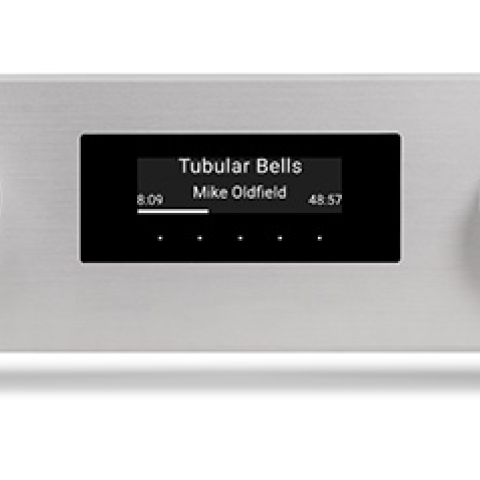
The appearance of the VK-40 strikes a nice...um...balance between functionality and style. Weighing in at 33 lbs, the VK-40 is obviously very substantially built, and its machined-alloy front panel—much thicker than the VK-5/5i's, as I remember—inspires confidence. The front panel is dominated by a large volume-control knob and a blue Vacuum Fluorescent Display (VFD). The VFD is large enough and bright enough that it can be easily seen from across the room, which is not always the case with displays of this sort. (It can also be turned off.) Small—but not too small—buttons provide input selection, mute, phase (polarity), and mono (L&R summed) output. There are five inputs: two single-ended RCA and three balanced XLR. Additional single-ended sources can be accommodated with the use of RCA/XLR adapters. The Volume knob serves multiple functions, depending on the VK-40's mode of operation; eg, it provides balance adjustment when the unit is in its Balance mode.
If, like the review sample, the VK-40 is equipped with the optional VK-P20 phono card, the Aux 2 input is automatically identified as PH1. The phono gain is factory-set at 58dB, which can be changed to 44dB with a switch on the phono board. (You have to remove the top cover to do this.) The standard phono load is factory-set at 47k ohms, but there are provisions for plug-in load resistors. If the phono board is installed, the unit comes equipped with RCA shorting plugs in the PH1 input, to minimize noise pickup if no phono cable is connected. The two main outputs are XLR only; driving single-ended amplifiers requires XLR/RCA adapters. Although purist in approach, the VK-40 has a comprehensive array of controls that can be accessed through the optional remote control, and that provide for exceptional ergonomics. While $500 for the remote option seems pretty steep, I'm told this reflects expenses incurred in manufacturing a sophisticated remote-control system that does not compromise sound quality. The display indicates volume control in 140 steps of 0.5dB; although the steps are discrete, they're small enough that, in normal use, the control feels continuous. Channel balance, phase, mono/stereo, and maximum volume can be programmed separately for each source, and differences in source output levels can be compensated for. The alphanumeric display can be programmed to give inputs unique names of up to four characters—using the Latin, Cyrillic, and Greek alphabets! According to Victor Khomenko, the VK-40's design is very similar to that of BAT's tube preamplifiers, including the top-of-the-line VK-5SE. Like all BAT preamplifiers, the VK-40 features a single gain stage, an electronic-shunt volume control, zero negative feedback, and no buffers, followers, or op-amps in the signal path. There are two custom 95VA toroidal power transformers for the audio circuits; a third toroidal transformer, with its own rectifiers and filters, provides the power for the digital control and display circuits. The gain stage is completely balanced in operation, but is claimed to work "exceedingly well" with single-ended signals.
Although designers of audio equipment tend to be more evenhanded than consumers in their evaluations of the tube vs solid-state debate, most of them design with tubes or solid-state, not both. One of the few designers with a foot in each camp is Victor Khomenko of Balanced Audio Technology (BAT). BAT's first products were the VK-5 preamplifier and the VK-60 power amplifier, both of which use tubes, but I remember Khomenko telling me, when I reviewed these products for the December 1995 Stereophile (Vol.18 No.12), that he was just as comfortable designing with solid-state as with tubes, and that his plans for BAT included some solid-state offerings. Since then, he's made good on his promise: the BAT line now includes four solid-state amplifiers (including one multichannel) and three solid-state preamplifiers. On hand this time around was the VK-40, BAT's top-of-the-line solid-state preamplifier. The appearance of the VK-40 strikes a nice...um...balance between functionality and style. Weighing in at 33 lbs, the VK-40 is obviously very substantially built, and its machined-alloy front panel—much thicker than the VK-5/5i's, as I remember—inspires confidence. The front panel is dominated by a large volume-control knob and a blue Vacuum Fluorescent Display (VFD). The VFD is large enough and bright enough that it can be easily seen from across the room, which is not always the case with displays of this sort. (It can also be turned off.) Small—but not too small—buttons provide input selection, mute, phase (polarity), and mono (L&R summed) output. There are five inputs: two single-ended RCA and three balanced XLR. Additional single-ended sources can be accommodated with the use of RCA/XLR adapters. The Volume knob serves multiple functions, depending on the VK-40's mode of operation; eg, it provides balance adjustment when the unit is in its Balance mode.