One of the differences between mass-market and high-end audio is in product model longevity. By this I don't mean that high-end products necessarily last longer—although I think they generally do—but that models remain in a manufacturer's product line longer, perhaps being refined in an evolutionary manner. This helps products retain their value, and, when new models are introduced, these involve more than a cosmetic upgrade and some additional bells'n'whistles. 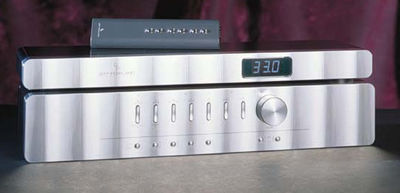 Take, for example, the products from the Jeff Rowland Design Group. The Consonance and Consummate preamplifiers were reviewed in Stereophile back in 1991 and 1992 (Consonance, Vol.14 No.3; Consummate, Vol.15 No.1), and only recently has Rowland replaced these models with the top-of-the-line Coherence ($12,800) and the more affordable Synergy. Although the new preamps share operational similarities with their predecessors (such as remote control and numerical readout of volume level), they're actually brand-new designs. Design issues
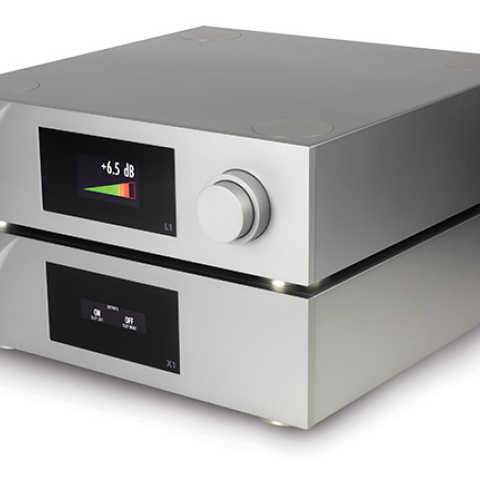
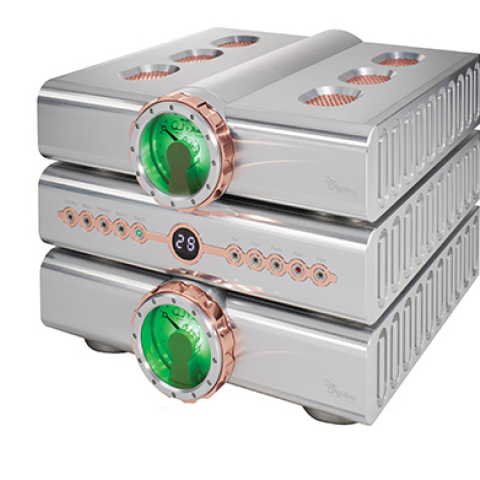
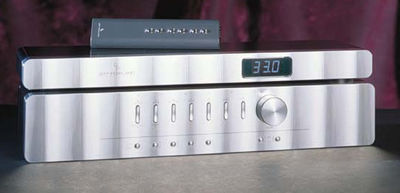
The Synergy is a two-box affair, the power supply normally installed atop the preamplifier proper. (Compliant interface supports are provided.) As well as providing DC power, the power supply contains infrared receiver circuitry and a numerical display of volume level. Connected to the preamplifier with a detachable cable made by Cardas, the power supply has two outputs, the second output to accommodate the forthcoming separate phono stage. There is no power switch; the Synergy is designed to be plugged in all the time. Fit'n'finish are like...well, something from Rowland. The chassis is machined anodized aluminum, with a ¾"-thick front plate and dimensional tolerances held to 0.005".
Like all Rowland products, the Synergy is fully balanced, with six balanced XLR inputs (one labeled Bypass, which has unity gain and is not affected by any of the Synergy's control settings) and two outputs (Main and Record). Rowland uses the "Pin-3 positive" rather than the more common AES/IEC "Pin-2 positive" standard, so if you mix'n'match with products that assume "Pin-2 positive" and you want to maintain correct absolute phase (polarity), you may have to reverse the speaker cables or use the Synergy's phase switch. The Synergy has no single-ended RCA inputs or outputs, but XLR/RCA adaptors are provided. The Synergy's front plate is dominated by a substantial round volume-control knob. Although continuous in feel, this is not a conventional potentiometer, but part of a system of digital control over volume, varying volume by 0.5dB steps over a 63.5dB range. The volume level selected is shown on the numerical readout that's part of the power-supply unit, the display turning off automatically after a few seconds. A rocker switch allows you to increase or decrease the gain for each input by ±20dB in 0.5dB steps. This is meant to allow equalization of volume levels among different sources, although I can't imagine any situation where source outputs differ by as much as 20dB, let alone 40dB. However, as we'll see later (no skipping ahead!), increasing the source gain has other effects as well. Each input (other than Bypass) can be independently adjusted for left/right balance, mono/stereo, phase, and input impedance, as well as gain. Settings are memorized and recalled when returning to that input, but revert to baseline if the AC supply is interrupted. Input impedance is normally set at 36k ohms; pressing the upper section of the Input Term rocker switch connects a 600 ohm terminating resistor across each leg of the input connector. This would be needed when using Rowland's phono stage, which is designed to have a 600 ohm termination. Each input (again, except for Bypass) can be set for Listen or Record. Another rocker switch engages Mute. All functions are microprocessor-controlled, the microprocessor reverting to a nonclocking "sleep" mode five milliseconds after a function is selected, thus preventing possible contamination of analog circuits by digital noise. Input switching, volume, balance, and mute are available on the remote control.
The Synergy features Jensen 10-KB-D input-coupling transformers, Analog Devices AD-811 audio op-amps, and a Crystal Semiconductor CS-3310 digital attenuator. Shannon Dickson's forthcoming review of the Coherence in September 1999 (Vol.22 No.9) will provide a thorough discussion of the technology behind the Rowland Design Group's new preamplifiers; for now, let's just note that the Jensen transformer is a low-distortion, ultra-wide-bandwidth device said to work particularly well with the Crystal digital attenuator, and that the AD-811 is viewed by many audio engineers as the best IC audio line drive available. Ergonomics
One of editor Larry Ullman's directives to Stereophile Guide to Home Theater writers is that a product's convenience and ease of use be given significant weighting in evaluation. Now, you say, that may be fine for couch-potato home theater types, but this is audio. True-blue audiophiles couldn't care less about convenience; performance is all.
Take, for example, the products from the Jeff Rowland Design Group. The Consonance and Consummate preamplifiers were reviewed in Stereophile back in 1991 and 1992 (Consonance, Vol.14 No.3; Consummate, Vol.15 No.1), and only recently has Rowland replaced these models with the top-of-the-line Coherence ($12,800) and the more affordable Synergy. Although the new preamps share operational similarities with their predecessors (such as remote control and numerical readout of volume level), they're actually brand-new designs. Design issues The Synergy is a two-box affair, the power supply normally installed atop the preamplifier proper. (Compliant interface supports are provided.) As well as providing DC power, the power supply contains infrared receiver circuitry and a numerical display of volume level. Connected to the preamplifier with a detachable cable made by Cardas, the power supply has two outputs, the second output to accommodate the forthcoming separate phono stage. There is no power switch; the Synergy is designed to be plugged in all the time. Fit'n'finish are like...well, something from Rowland. The chassis is machined anodized aluminum, with a ¾"-thick front plate and dimensional tolerances held to 0.005".
One of editor Larry Ullman's directives to Stereophile Guide to Home Theater writers is that a product's convenience and ease of use be given significant weighting in evaluation. Now, you say, that may be fine for couch-potato home theater types, but this is audio. True-blue audiophiles couldn't care less about convenience; performance is all.