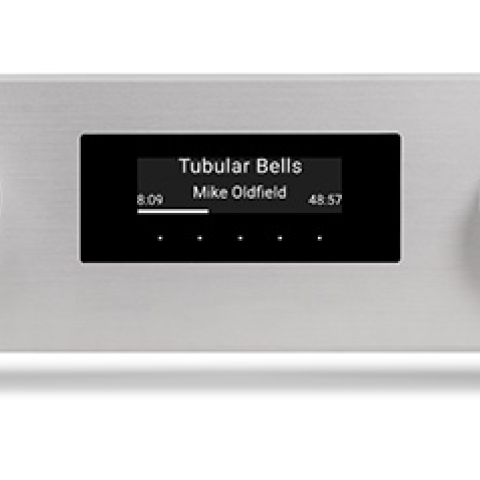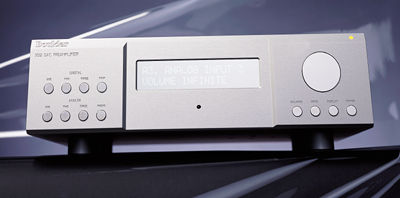
The Boulder 1012's is a line-level preamplifier and DAC in one box. Its design and build qualities are icons to elegant engineering know-how. No screws show on the rectangular box of large but not massive proportions, for example, which is all done up in matte aluminum and set off with a few highly polished stainless-steel buttons. The chassis construction uses tongue-and-groove techniques. The sides of the 1012 benefit from styling cues found on Boulder's newer amplifiers. As you can see from the photograph, the look is both elegant and hi-tech in a way very few other manufacturers manage.  Off came the top. The interior build quality was indeed impressive, but the amount of empty real estate inside a unit this heavy gave me a shock. "Surface-mount technology, Jonathan," Boulder's Bruce van Allen explained. "Couldn't even do it that way five years ago." A recessed area in the middle third of the faceplate houses a display that gives information in a two-line, easy-to-read fluorescent matrix of bright blue. To the left are two rows of four mirror-gloss stainless-steel buttons. To the right of these, four more buttons sit under a flat, highly polished stainless-steel disc that's flush with the faceplate. Touch to turn! Very modern-looking indeed. Of those two rows of buttons, the upper four select among digital inputs 1-4, the lower four among analog inputs 1-3 and Phono.
You heard me right, citizen—Boulder's got you covered. Analog signals are not digitized, but sent directly through the 1012's line stage. But that requires XLR connectors, as do all inputs on the 1012, and nothin' but RCA connectors sit at the outputs of my lovely ol' Forsell Air Force One turntable, still sweetly spinning as the years go by. (I'll cover the Boulder 1012's variable-gain RIAA phono stage—included as part of the package—in a Follow-Up sometime soon.) To the right of the 1012's electric-blue display and under that highly polished spinner are four more brightly polished stainless-steel buttons: a balance control, numerically indicated on the display; the Mute button, which activates a huge MUTE indicator on the display, as well as total silence; a Display button to lower the rather bright display; and the Power button. The neatly laid-out back panel is chock full of balanced inputs. Leftmost are three AES/EBU digital inputs, with a TosLink connector as well. A high-quality XLR-RCA adapter is supplied for the digital inputs, but this is no normal adapter. It's got a resistor network inside to impedance-match the load, and the 1012's AES/EBU data inputs will sense and accept 500mV S/PDIF datastreams. A few Master Slave switches might give you momentary pause (Dirk Bogarde, Berlin; night has fallen; in slinks Charlotte Rampling...nah). Next to that is a medium-sized heatsink with a couple of fuses below, and below that a standard mains-in socket.
Then the outputs: one set of connectors for recording, in and out, and another main left and right output pair. Next to them are five analog input pairs, again all XLR balanced connectors; and last, those balanced phono inputs already mentioned. The remote control is cute as hell, very Philippe Starck-like, and shaped like Gumby in a coma, With its nicely ergonomic pushbuttons you can choose the input, power, balance, volume, mute the preamp, or reverse the polarity. Soft footers are provided to apply to its bottom, if desired. And when replacing the batteries, you're warned to leave the remote upside down on a flat surface lest you suffer the indignity of a room full of bouncing BB-sized pellets, which make up the remote's pushbutton interface. Technical Tips
Off came the top. The interior build quality was indeed impressive, but the amount of empty real estate inside a unit this heavy gave me a shock. "Surface-mount technology, Jonathan," Boulder's Bruce van Allen explained. "Couldn't even do it that way five years ago." A recessed area in the middle third of the faceplate houses a display that gives information in a two-line, easy-to-read fluorescent matrix of bright blue. To the left are two rows of four mirror-gloss stainless-steel buttons. To the right of these, four more buttons sit under a flat, highly polished stainless-steel disc that's flush with the faceplate. Touch to turn! Very modern-looking indeed. Of those two rows of buttons, the upper four select among digital inputs 1-4, the lower four among analog inputs 1-3 and Phono.
You heard me right, citizen—Boulder's got you covered. Analog signals are not digitized, but sent directly through the 1012's line stage. But that requires XLR connectors, as do all inputs on the 1012, and nothin' but RCA connectors sit at the outputs of my lovely ol' Forsell Air Force One turntable, still sweetly spinning as the years go by. (I'll cover the Boulder 1012's variable-gain RIAA phono stage—included as part of the package—in a Follow-Up sometime soon.) To the right of the 1012's electric-blue display and under that highly polished spinner are four more brightly polished stainless-steel buttons: a balance control, numerically indicated on the display; the Mute button, which activates a huge MUTE indicator on the display, as well as total silence; a Display button to lower the rather bright display; and the Power button. The neatly laid-out back panel is chock full of balanced inputs. Leftmost are three AES/EBU digital inputs, with a TosLink connector as well. A high-quality XLR-RCA adapter is supplied for the digital inputs, but this is no normal adapter. It's got a resistor network inside to impedance-match the load, and the 1012's AES/EBU data inputs will sense and accept 500mV S/PDIF datastreams. A few Master Slave switches might give you momentary pause (Dirk Bogarde, Berlin; night has fallen; in slinks Charlotte Rampling...nah). Next to that is a medium-sized heatsink with a couple of fuses below, and below that a standard mains-in socket.
Then the outputs: one set of connectors for recording, in and out, and another main left and right output pair. Next to them are five analog input pairs, again all XLR balanced connectors; and last, those balanced phono inputs already mentioned. The remote control is cute as hell, very Philippe Starck-like, and shaped like Gumby in a coma, With its nicely ergonomic pushbuttons you can choose the input, power, balance, volume, mute the preamp, or reverse the polarity. Soft footers are provided to apply to its bottom, if desired. And when replacing the batteries, you're warned to leave the remote upside down on a flat surface lest you suffer the indignity of a room full of bouncing BB-sized pellets, which make up the remote's pushbutton interface. Technical Tips
Boulder's build philosophy is one of modularity. For instance, there's a plug-in, programmable digital receiver card to accommodate future formats. A plug-in DSP card permits updating of algorithms for SACD and DVD-Audio, among other possibilities. There's also a plug-in D/A board for future DACs. And last, from a list of features proudly presented: exchangeable input boards for ST glass optical or (more significant, I think) FireWire IEEE 1394 connections.
Bruce van Allen, who e-mailed me the technical details, was very clear: "These features eliminate digital obsolescence." Like many other manufacturers these days, Boulder is trying to understand where the rapidly accelerating digital juggernaut is headed. This more or less forces them to debut platforms that will take plug-in cards for whatever formats might come down the line. It's just the way things are.
Off came the top. The interior build quality was indeed impressive, but the amount of empty real estate inside a unit this heavy gave me a shock. "Surface-mount technology, Jonathan," Boulder's Bruce van Allen explained. "Couldn't even do it that way five years ago." A recessed area in the middle third of the faceplate houses a display that gives information in a two-line, easy-to-read fluorescent matrix of bright blue. To the left are two rows of four mirror-gloss stainless-steel buttons. To the right of these, four more buttons sit under a flat, highly polished stainless-steel disc that's flush with the faceplate. Touch to turn! Very modern-looking indeed. Of those two rows of buttons, the upper four select among digital inputs 1-4, the lower four among analog inputs 1-3 and Phono. Boulder's build philosophy is one of modularity. For instance, there's a plug-in, programmable digital receiver card to accommodate future formats. A plug-in DSP card permits updating of algorithms for SACD and DVD-Audio, among other possibilities. There's also a plug-in D/A board for future DACs. And last, from a list of features proudly presented: exchangeable input boards for ST glass optical or (more significant, I think) FireWire IEEE 1394 connections.