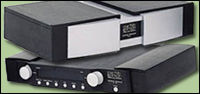
I've always wanted to review one of Madrigal's Mark Levinson products, and finally my prayers have been answered. The chosen victim? The No.32 Reference preamplifier. Note that "Reference" moniker. The No.32 is the first Mark Levinson preamplifier to carry such appellation. They're not kidding. 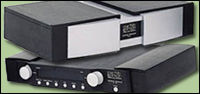 Power supply matters
When phono was the primary source and all circuits were single-ended, a separate power supply was the most obvious characteristic of a high-end preamplifier design. Even today, many low-gain line stages use an external power supply, despite the fact that, as Madrigal points out, balanced circuitry is generally less sensitive to noise. In fact, Madrigal feels the cost of the additional chassis far outweighs the benefit. They prefer reaching their technical and performance goals with properly implemented balanced circuitry, relay switching, and microprocessor control. The No.32 takes an evolutionary step forward by packaging the power supply, control circuitry, and display together in one chassis: the "dirty box" Reference Controller. The audio circuitry, more sensitive to noise, comes in a separate chassis: the "clean box" preamp itself. AC power supplies, microprocessors, LED displays—anything that generates noise—is thus physically separated from low-level audio signals. The only element the audio circuits are exposed to is quiet, regulated DC power and the audio signal itself. Two master supplies are located in the center section of the sleek-looking Controller. One supply is dedicated to control and communications, the other to the audio circuits. A combination of inductors and capacitors prefilters the AC line and isolates the two master supplies from each other. The supplies use custom-designed transformers with multiple secondary windings to improve isolation between circuit blocks. Separate rectification, filtering, and regulation circuits supply DC to the control/communications circuits, to a Levinson No.25 phono preamp, for the optional phono modules installed in this unit, and to the 400Hz oscillator circuits used in power-supply regeneration. An external ground terminal is provided for systems in which the AC mains receptacle lacks a separate ground pin.
AC power regeneration refers to the DC supply feeding the voltage gain stages. This supply is derived from an AC source generated within the device itself. This technique is expensive but very effective, according to Madrigal. In the No.32's Controller, a 400Hz oscillator generates the AC source for the preamplifier's audio power supplies, replacing the 50/60Hz reference provided by your local utility. One advantage to operating at 400Hz as opposed to 60Hz is that the transformers operate more efficiently and thus generate less heat. Another advantage is that the filter capacitors are charged more quickly, yielding a smoother DC supply from the filter caps. Equivalent filtering from a 60Hz supply requires larger capacitors, and thus higher ESR (Effective Series Resistance) at high frequencies. Because 400Hz oscillators and power-supply components are commonly used in aircraft electronics, high-quality parts are readily available.
Power supply matters When phono was the primary source and all circuits were single-ended, a separate power supply was the most obvious characteristic of a high-end preamplifier design. Even today, many low-gain line stages use an external power supply, despite the fact that, as Madrigal points out, balanced circuitry is generally less sensitive to noise. In fact, Madrigal feels the cost of the additional chassis far outweighs the benefit. They prefer reaching their technical and performance goals with properly implemented balanced circuitry, relay switching, and microprocessor control. The No.32 takes an evolutionary step forward by packaging the power supply, control circuitry, and display together in one chassis: the "dirty box" Reference Controller. The audio circuitry, more sensitive to noise, comes in a separate chassis: the "clean box" preamp itself. AC power supplies, microprocessors, LED displays—anything that generates noise—is thus physically separated from low-level audio signals. The only element the audio circuits are exposed to is quiet, regulated DC power and the audio signal itself. Two master supplies are located in the center section of the sleek-looking Controller. One supply is dedicated to control and communications, the other to the audio circuits. A combination of inductors and capacitors prefilters the AC line and isolates the two master supplies from each other. The supplies use custom-designed transformers with multiple secondary windings to improve isolation between circuit blocks. Separate rectification, filtering, and regulation circuits supply DC to the control/communications circuits, to a Levinson No.25 phono preamp, for the optional phono modules installed in this unit, and to the 400Hz oscillator circuits used in power-supply regeneration. An external ground terminal is provided for systems in which the AC mains receptacle lacks a separate ground pin.