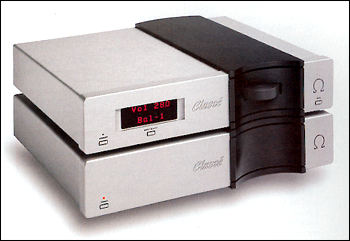
One room at the 1999 CES in Las Vegas that knocked me for a loop was the Avalon/Classé installation mentioned in my April show report. Classé had just debuted the Omega preamp, the companion piece to the Omega amplifier I reviewed in March. It proved a very suave, musical, and high-performance marriage. 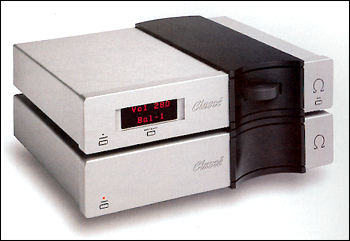 Returning from CES, I thought about some of the trends I'd noticed. With the ca $150k Boulder system, the pricey Burmester electronics, and the slew of new X-series components from Pass Labs, there are suddenly a number of no-holds-barred solid-state super rack systems available. In my experience of them so far, the synergy between the bespoke components of such systems is real, and makes for an appreciable difference in sound quality and overall refinement. Thus, the filaments of the tiny 2A3 over my head began to glow, and I determined to audition the Omega pre- and -amp together. Tech briefing
The Omega's technical specifications are of a very high order. Its power supply is housed in a separate chassis, in which two toroidal transformers handle the left and right channels, and a third the digital micro-controllers. There are four high-voltage (±40VDC from ±50VDC), high-current (4A) regulators for the analog section, and more than 12,000uF of main storage capacitance. High-performance Deutsch connectors terminate the umbilical running between the control unit and the power supply. The control unit is dual-mono, fully balanced, fully symmetrical, and fully remote-controlled. Its own power supply, pulling DC from the companion chassis, is made up of four sections of discrete, stable, high-current, high-precision regulators, which power the amplifiers within the control unit with more than 50,000uF of filter capacitance. Tantalum bypass capacitors ride each output transistor.
The volume control is a special beast billed as a logic-controlled 12-bit relay-resistive network. It's based on two pairs per side of discrete R2R networks comprising 12 "high-sensitivity" mechanical relays. The contacts are heavily gold-plated for low-noise operation and near-zero contact resistance. The 48 resistors are handpicked, proprietary, high-precision (0.1%), low-noise, low-distortion, metal-film types offering fully 120 gain steps in 0.5dB increments. Bottom line: At any volume setting, the signal travels through a maximum of four resistors and four relay contacts. With 100% passive attenuation, and balanced operation's inherent common-mode noise rejection (provided the "hot" and "cold" halves of the circuit are optimally matched), tracking error is said to be vanishing low. The output stage of the fully differential Omega preamp comprises four identical, totally discrete, fully symmetrical circuits. All small-signal transistors are tested and matched for each unit. The input transistors are matched pairs of low-noise, low-distortion JFET devices followed by low-noise, low-distortion bipolar transistors for the voltage gain-stage, and high-power MOSFET devices in the output stage. All circuitry is fully potted and shielded. Sounds a bit like a power amp, doesn't it?
Returning from CES, I thought about some of the trends I'd noticed. With the ca $150k Boulder system, the pricey Burmester electronics, and the slew of new X-series components from Pass Labs, there are suddenly a number of no-holds-barred solid-state super rack systems available. In my experience of them so far, the synergy between the bespoke components of such systems is real, and makes for an appreciable difference in sound quality and overall refinement. Thus, the filaments of the tiny 2A3 over my head began to glow, and I determined to audition the Omega pre- and -amp together. Tech briefing The Omega's technical specifications are of a very high order. Its power supply is housed in a separate chassis, in which two toroidal transformers handle the left and right channels, and a third the digital micro-controllers. There are four high-voltage (±40VDC from ±50VDC), high-current (4A) regulators for the analog section, and more than 12,000uF of main storage capacitance. High-performance Deutsch connectors terminate the umbilical running between the control unit and the power supply. The control unit is dual-mono, fully balanced, fully symmetrical, and fully remote-controlled. Its own power supply, pulling DC from the companion chassis, is made up of four sections of discrete, stable, high-current, high-precision regulators, which power the amplifiers within the control unit with more than 50,000uF of filter capacitance. Tantalum bypass capacitors ride each output transistor.