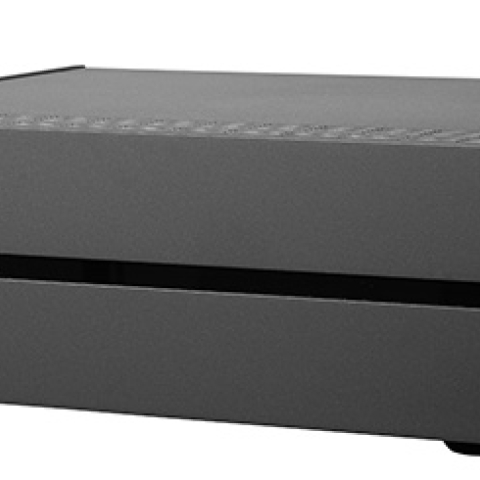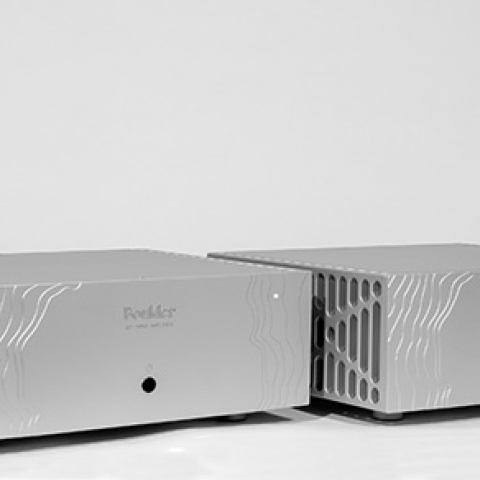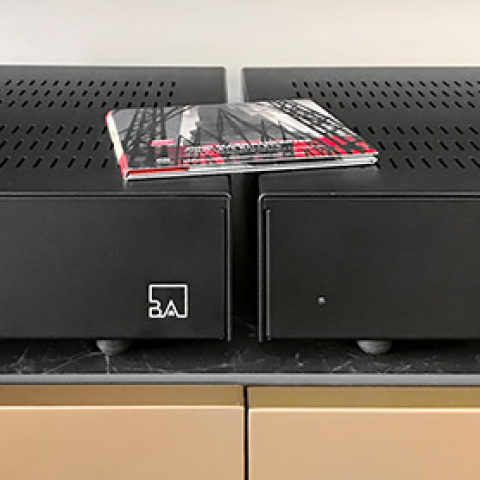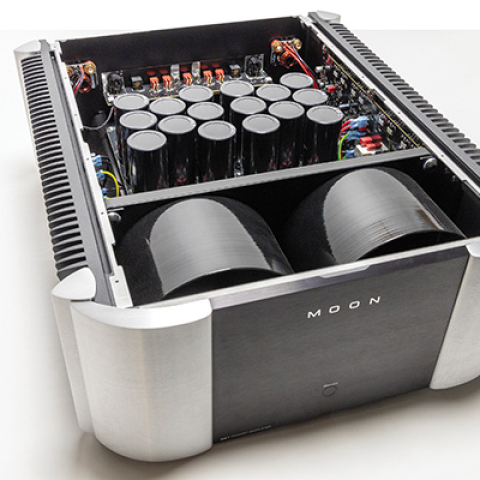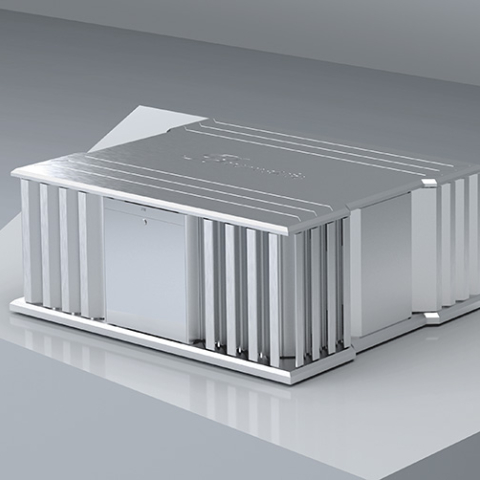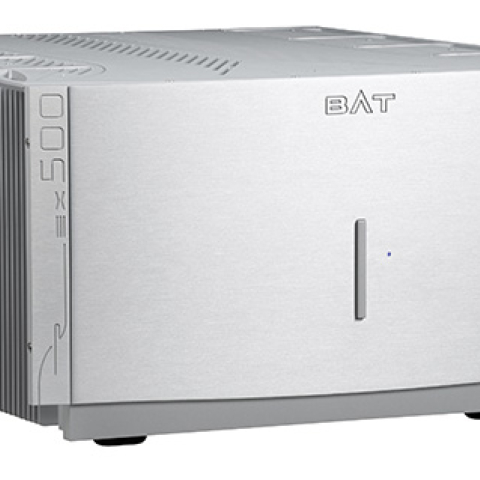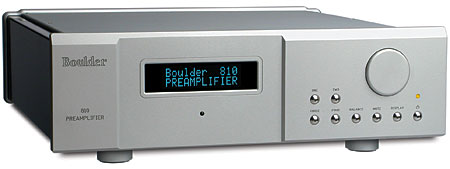
Boulder Amplifiers, named after the Colorado town where the company has resided since its founding 23 years ago, makes some of the most elegant-looking solid-state amps around. Chassis are anodized, aircraft-grade aluminum with rounded edges, machined and finished in-house. The two models reviewed here, the 810 line preamplifier and the 860 power amplifier, each have a sleek, compact build—stacked atop each other, the two stand just over a foot high—owing to extremely efficient packing of the circuitry inside. These are the company's "entry-level" electronics, but there's nothing cheap about them—the preamp retails for $6900, the amp for $8500—and for all their economical size, they look like luxury goods as well.
 Description and Design
The 810 line-stage preamp is a dual-mono design with two circuit boards horizontally attached to the rear panel, one for each channel. The volume controls, though also dual-mono, are integrated into a single, elegant volume knob with a proprietary, 200-step ladder network in 0.5dB increments. If you've ever wondered what a half-decibel volume adjustment sounds like, now you can hear it. The network also lets you set and re-set volume levels with very fine precision. Boulder's chief engineer, Jeff Nelson, has a thing about keeping noise to a dead minimum. The 810's signal paths are kept short, wires are few in number and length, circuits are surface-mounted to the degree possible, power supplies are regulated and shielded, and there are two toroidal transformers: one for the audio signal, the other for the display's digital logic control. (The two toroids are kept separate so that the latter's noise doesn't leak into the former.) Even the feet comprise four layers of damping material, each with a different resonance that cancels out the resonances of the others. It works, I think. Let's put it this way: I put three spikes or cones under most amps and preamps, and they almost always improve the sound. With the Boulder 810 and 860, they made no difference whatever.
 The 810 also includes a microprocessor that lets you program the display (to read, for instance, "CD" instead of "Input 1") and set default volume levels for each input, if you wish. In a strictly stylish bit, the display is made of mirrored glass, and the input-selection buttons are stainless-steel ball bearings—just because (as Boulder's sales manager, Richard Maez, put it to me) there shouldn't be any plastic on a $6900 preamp. As proper a philosophy as any.
The 860 power amp has a chassis of the same material, the same four-layer damped feet, and the same emphasis on short signal paths, low noise, and isolation of components. It has a large, magnetically shielded toroidal transformer and 16 bipolar output transistors. Output devices are clamped to the heatsinks on a machined bar, with a proprietary damping material separating them to avoid ringing. The input and gain sections are balanced; the output stage is not. As with the 810, all inputs are three-pin XLR. The binding posts for speaker cable are custom-made, with very large (ie, very visible, very easy to grasp) thumbscrew adjustments.
Boulder's watchword seems to be quiet. Nothing should be heard except the unadulterated audio signal: the music. How did that sound?
Setup & System
The 810 also includes a microprocessor that lets you program the display (to read, for instance, "CD" instead of "Input 1") and set default volume levels for each input, if you wish. In a strictly stylish bit, the display is made of mirrored glass, and the input-selection buttons are stainless-steel ball bearings—just because (as Boulder's sales manager, Richard Maez, put it to me) there shouldn't be any plastic on a $6900 preamp. As proper a philosophy as any.
The 860 power amp has a chassis of the same material, the same four-layer damped feet, and the same emphasis on short signal paths, low noise, and isolation of components. It has a large, magnetically shielded toroidal transformer and 16 bipolar output transistors. Output devices are clamped to the heatsinks on a machined bar, with a proprietary damping material separating them to avoid ringing. The input and gain sections are balanced; the output stage is not. As with the 810, all inputs are three-pin XLR. The binding posts for speaker cable are custom-made, with very large (ie, very visible, very easy to grasp) thumbscrew adjustments.
Boulder's watchword seems to be quiet. Nothing should be heard except the unadulterated audio signal: the music. How did that sound?
Setup & System
I did most of my listening to the 860 and 810 together, as that's how they're generally sold, or at least marketed. Then I listened to the 860 hooked up to a different preamp and the 810 hooked up to a different power amp. In both of the latter cases I used the Krell FBI Fully Balanced Integrated amp, which can be configured as a preamp only and as a power amp only. I chose the Krell for three reasons. First, it was handy—I'd reviewed it for the July 2007 Stereophile and still had it around (though not for much longer). Second, its sound is exceptionally neutral. Third, the FBI's preamp and amp sections have nearly identical sonic signatures, so any colorations or distortions it might add would be the same in both sets of comparisons. I used balanced cables throughout (Boulder products have only balanced inputs), except when the FBI was serving as a preamp; then, I also used its CAST inputs. Sound
There's one sonic category in which the Boulders beat maybe every other amp—and certainly every solid-state amp—I've ever heard in my system: the ability to throw precise images of an instrument, a singer, or the sections of an ensemble onto a very wide, deep soundstage. On a few of the tracks of her gorgeous Poetica (CD, Anzic 1301), clarinetist Anat Cohen plays with a string quartet as well as a standard jazz quartet. When I'd heard these tracks—most notably, her cover of John Coltrane's "Lonnie's Lament"—through other amps, the string quartet, though lovely, sounded like massed strings. Through the Boulders—especially the 860 power amp—each of the four instruments was buzzing and being bowed from a particular spot, and the four players were spread across the soundstage, each of them distinct, several feet behind Cohen's clarinet.
About halfway through the first movement of David Zinman's recording of Górecki's Symphony 3 (CD, Nonesuch 79282-2), when a fair number of the London Sinfonietta's musicians sit out and the remaining members take on the sound of a chamber orchestra, I got a clear sense not only of the hall's natural reverberations but also of the semicircle in which the musicians were sitting. This effect wasn't an audiophile gimmick—it lent the music an eerie palpability. I felt, for a moment, that it was going on right before not only my ears but my eyes. Similarly, in the opening moments of Michael Tilson Thomas and the San Francisco Symphony Orchestra's wondrous performance of Mahler's Symphony 9 (SACD/CD, SFSO 821936-0007-2), the horn blasts from the back row sounded as if they were coming from way back there—in my case, from across the street. The Boulders, especially the 860, rendered a sense of depth—and continuous layers of it—as convincingly as a superb tube amp. I got a sense of peering through the soundstage, as if lights were switched on, from front to back, left to right, floor to ceiling, and all places in between.
An amplifier's transparency and knack for picking up spatial cues are usually matched by its fidelity to harmonic overtones, and the Boulder 860 followed this pattern. When trumpeter Dave Douglas and violinist Mark Feldman play in unison on Douglas' Charms of the Night Sky (CD, Winter & Winter 910015-2), I had no problem telling the two apart, tonally and spatially, because their distinguishing overtones—the trumpet's bell and the violin's bowing—were so clear. On Duke Ellington's Masterpieces by Ellington (CD, Columbia/Legacy CK 87043), about five minutes into "Mood Indigo," I heard a flute fluttering under a loud trumpet passage; it hadn't jumped out at me so dramatically in the several dozen times I'd played this wonderful disc before.
 The 860 was also a champ at capturing fine dynamic contrasts—the subtle shifts of loudness or softness caused by the quivering of a bow, the flexing of vocal cords, the pressure of a foot on a piano pedal, a slight accent on a snare drum. One of my favorite tests of this quality is "Resting on the Road," the penultimate track of Don Pullen's Sacred Common Ground (CD, Blue Note CDP 8 32800 2). Pullen was a master of dynamic shadings and rubato, and if an amp does its job right in this realm, his bittersweet hesitations in this song bring a tear to my eye. The Boulder did its job. It also passed the Blink Test with k.d. lang's "Constant Craving," the last track of Ingénue (CD, Sire 26840-2): At the start of this song, the hard guitar strums and drum thwacks should make you blink on each beat. With many amps, even otherwise beefy ones, they don't; with the Boulder, they did.
In other respects, though, the 860—much more than the 810—had some problems. Most troubling, the upper midrange was at once dark and a bit glaring. Pianos sounded a bit hooded—not quite as if the lid were shut, but as if it had been lowered more than it should have been. Voices had a veiled quality, as if the singers were cupping one side of the mouth with one hand (or as if the loudspeakers were covered with a grille). This went for a great variety of voices: Dawn Upshaw, Donald Fagen, Lorraine Hunt Lieberson, Joni Mitchell, Bob Dylan, Leonard Cohen, k.d. lang, Bonnie Raitt, Sarah Vaughan, Ella Fitzgerald.
The same was true for strings, though less so for massed violin sections than for solo violins. For instance, Andrew Manze and Rachel Podger's recording of J.S. Bach's solo and double violin concertos with the Academy of Ancient Music (SACD/CD, Harmonia Mundi HMU 807155) is one of the most glorious-sounding digital albums I own. The violins are (as I noted in my review of the Krell FBI amp in July) shiveringly silky. Yet, played through the Boulders, the violins had a steely edge. High-pitched crescendos—such as those in Górecki's Third and Mahler's Ninth, or even when k.d. lang sings loud—sounded downright harsh. I reached for the remote to turn down the volume.
Another problem was deep bass, which sounded a bit woolly. At first, I thought the 860 was rolling off the lowest notes. On further listening, it seemed more that the percussive edge of those lowest notes was softened. For instance, in "Mood Indigo," the rhythm of Wendell Marshall's bass was captured perfectly (he strolls a hair behind the beat), but his deepest notes were barely audible; the tone was there, vaguely; what was missing was the pluck. In Górecki's Symphony 3, the deep bass lines—which dominate the work's first few minutes and continue to rumble throughout the first movement—sounded boomy, even bloated.
I singled out the 860 because, when I plugged the 810 into the Krell FBI's power-amp stage, these flaws were much less noticeable, and some disappeared. The 810, in other words, seemed to do very well what a line-stage amp is supposed to do: pass the audio signal from a source to the power amp with minimal distortion along the way. With the 810 plugged into the Krell FBI's amp inputs, violins weren't the slightest bit steely; they were silky, if not quite as sweet as with the FBI operating as an integrated amp. The bass was not at all bloated, though neither was it quite the last word in tightness. The 810+FBI combo also sounded warmer all around, and it matched—but did not exceed—the 810+860 system in dynamic contrasts. And the 810+FBI wasn't as impressive as the all-Boulder amp-preamp setup in imaging and soundstaging.
Conclusion
The 860 was also a champ at capturing fine dynamic contrasts—the subtle shifts of loudness or softness caused by the quivering of a bow, the flexing of vocal cords, the pressure of a foot on a piano pedal, a slight accent on a snare drum. One of my favorite tests of this quality is "Resting on the Road," the penultimate track of Don Pullen's Sacred Common Ground (CD, Blue Note CDP 8 32800 2). Pullen was a master of dynamic shadings and rubato, and if an amp does its job right in this realm, his bittersweet hesitations in this song bring a tear to my eye. The Boulder did its job. It also passed the Blink Test with k.d. lang's "Constant Craving," the last track of Ingénue (CD, Sire 26840-2): At the start of this song, the hard guitar strums and drum thwacks should make you blink on each beat. With many amps, even otherwise beefy ones, they don't; with the Boulder, they did.
In other respects, though, the 860—much more than the 810—had some problems. Most troubling, the upper midrange was at once dark and a bit glaring. Pianos sounded a bit hooded—not quite as if the lid were shut, but as if it had been lowered more than it should have been. Voices had a veiled quality, as if the singers were cupping one side of the mouth with one hand (or as if the loudspeakers were covered with a grille). This went for a great variety of voices: Dawn Upshaw, Donald Fagen, Lorraine Hunt Lieberson, Joni Mitchell, Bob Dylan, Leonard Cohen, k.d. lang, Bonnie Raitt, Sarah Vaughan, Ella Fitzgerald.
The same was true for strings, though less so for massed violin sections than for solo violins. For instance, Andrew Manze and Rachel Podger's recording of J.S. Bach's solo and double violin concertos with the Academy of Ancient Music (SACD/CD, Harmonia Mundi HMU 807155) is one of the most glorious-sounding digital albums I own. The violins are (as I noted in my review of the Krell FBI amp in July) shiveringly silky. Yet, played through the Boulders, the violins had a steely edge. High-pitched crescendos—such as those in Górecki's Third and Mahler's Ninth, or even when k.d. lang sings loud—sounded downright harsh. I reached for the remote to turn down the volume.
Another problem was deep bass, which sounded a bit woolly. At first, I thought the 860 was rolling off the lowest notes. On further listening, it seemed more that the percussive edge of those lowest notes was softened. For instance, in "Mood Indigo," the rhythm of Wendell Marshall's bass was captured perfectly (he strolls a hair behind the beat), but his deepest notes were barely audible; the tone was there, vaguely; what was missing was the pluck. In Górecki's Symphony 3, the deep bass lines—which dominate the work's first few minutes and continue to rumble throughout the first movement—sounded boomy, even bloated.
I singled out the 860 because, when I plugged the 810 into the Krell FBI's power-amp stage, these flaws were much less noticeable, and some disappeared. The 810, in other words, seemed to do very well what a line-stage amp is supposed to do: pass the audio signal from a source to the power amp with minimal distortion along the way. With the 810 plugged into the Krell FBI's amp inputs, violins weren't the slightest bit steely; they were silky, if not quite as sweet as with the FBI operating as an integrated amp. The bass was not at all bloated, though neither was it quite the last word in tightness. The 810+FBI combo also sounded warmer all around, and it matched—but did not exceed—the 810+860 system in dynamic contrasts. And the 810+FBI wasn't as impressive as the all-Boulder amp-preamp setup in imaging and soundstaging.
Conclusion
The Boulders are handsome pieces of gear, inside and out. The 810 preamp sounded very neutral, with only a slight softening in the bass and an even slighter rolloff in the upper octaves. The 860 power amp was superb at capturing harmonic overtones and dynamic contrasts, at placing images precisely on a soundstage, and at illuminating that soundstage—at letting the listener peer all the way into the stage, from left to right, from front to back, from floor to ceiling. However, the glare and darkness in the upper midrange, as well as the fuzziness in the deep bass, were, in my mind, out of character for an $8500 amplifier. Overall, I was left admiring the music, but rarely fully engaged.
Description and Design
The 810 line-stage preamp is a dual-mono design with two circuit boards horizontally attached to the rear panel, one for each channel. The volume controls, though also dual-mono, are integrated into a single, elegant volume knob with a proprietary, 200-step ladder network in 0.5dB increments. If you've ever wondered what a half-decibel volume adjustment sounds like, now you can hear it. The network also lets you set and re-set volume levels with very fine precision. Boulder's chief engineer, Jeff Nelson, has a thing about keeping noise to a dead minimum. The 810's signal paths are kept short, wires are few in number and length, circuits are surface-mounted to the degree possible, power supplies are regulated and shielded, and there are two toroidal transformers: one for the audio signal, the other for the display's digital logic control. (The two toroids are kept separate so that the latter's noise doesn't leak into the former.) Even the feet comprise four layers of damping material, each with a different resonance that cancels out the resonances of the others. It works, I think. Let's put it this way: I put three spikes or cones under most amps and preamps, and they almost always improve the sound. With the Boulder 810 and 860, they made no difference whatever.
The 810 also includes a microprocessor that lets you program the display (to read, for instance, "CD" instead of "Input 1") and set default volume levels for each input, if you wish. In a strictly stylish bit, the display is made of mirrored glass, and the input-selection buttons are stainless-steel ball bearings—just because (as Boulder's sales manager, Richard Maez, put it to me) there shouldn't be any plastic on a $6900 preamp. As proper a philosophy as any.
The 860 power amp has a chassis of the same material, the same four-layer damped feet, and the same emphasis on short signal paths, low noise, and isolation of components. It has a large, magnetically shielded toroidal transformer and 16 bipolar output transistors. Output devices are clamped to the heatsinks on a machined bar, with a proprietary damping material separating them to avoid ringing. The input and gain sections are balanced; the output stage is not. As with the 810, all inputs are three-pin XLR. The binding posts for speaker cable are custom-made, with very large (ie, very visible, very easy to grasp) thumbscrew adjustments.
Boulder's watchword seems to be quiet. Nothing should be heard except the unadulterated audio signal: the music. How did that sound?
I did most of my listening to the 860 and 810 together, as that's how they're generally sold, or at least marketed. Then I listened to the 860 hooked up to a different preamp and the 810 hooked up to a different power amp. In both of the latter cases I used the Krell FBI Fully Balanced Integrated amp, which can be configured as a preamp only and as a power amp only. I chose the Krell for three reasons. First, it was handy—I'd reviewed it for the July 2007 Stereophile and still had it around (though not for much longer). Second, its sound is exceptionally neutral. Third, the FBI's preamp and amp sections have nearly identical sonic signatures, so any colorations or distortions it might add would be the same in both sets of comparisons. I used balanced cables throughout (Boulder products have only balanced inputs), except when the FBI was serving as a preamp; then, I also used its CAST inputs. Sound
There's one sonic category in which the Boulders beat maybe every other amp—and certainly every solid-state amp—I've ever heard in my system: the ability to throw precise images of an instrument, a singer, or the sections of an ensemble onto a very wide, deep soundstage. On a few of the tracks of her gorgeous Poetica (CD, Anzic 1301), clarinetist Anat Cohen plays with a string quartet as well as a standard jazz quartet. When I'd heard these tracks—most notably, her cover of John Coltrane's "Lonnie's Lament"—through other amps, the string quartet, though lovely, sounded like massed strings. Through the Boulders—especially the 860 power amp—each of the four instruments was buzzing and being bowed from a particular spot, and the four players were spread across the soundstage, each of them distinct, several feet behind Cohen's clarinet.
The 860 was also a champ at capturing fine dynamic contrasts—the subtle shifts of loudness or softness caused by the quivering of a bow, the flexing of vocal cords, the pressure of a foot on a piano pedal, a slight accent on a snare drum. One of my favorite tests of this quality is "Resting on the Road," the penultimate track of Don Pullen's Sacred Common Ground (CD, Blue Note CDP 8 32800 2). Pullen was a master of dynamic shadings and rubato, and if an amp does its job right in this realm, his bittersweet hesitations in this song bring a tear to my eye. The Boulder did its job. It also passed the Blink Test with k.d. lang's "Constant Craving," the last track of Ingénue (CD, Sire 26840-2): At the start of this song, the hard guitar strums and drum thwacks should make you blink on each beat. With many amps, even otherwise beefy ones, they don't; with the Boulder, they did.
The Boulders are handsome pieces of gear, inside and out. The 810 preamp sounded very neutral, with only a slight softening in the bass and an even slighter rolloff in the upper octaves. The 860 power amp was superb at capturing harmonic overtones and dynamic contrasts, at placing images precisely on a soundstage, and at illuminating that soundstage—at letting the listener peer all the way into the stage, from left to right, from front to back, from floor to ceiling. However, the glare and darkness in the upper midrange, as well as the fuzziness in the deep bass, were, in my mind, out of character for an $8500 amplifier. Overall, I was left admiring the music, but rarely fully engaged.