Conceptually, the preamplifier is the bottleneck in an audio system. All sources pass through it, and it influences every sound you hear. A system comprising great speakers and gutsy amplification will sound uninspired if that's the character of the preamplifier. Conversely, a great preamplifier will allow through so much information, so much of the music, that the listener can forgive the shortcomings of lesser speakers and amplifiers.
 Since I reviewed it in November 1997 (Stereophile, Vol.20 No.11), the Mark Levinson No.380S has been my preferred preamplifier. The '380S cost $6495 when it was last available; I bought the review sample because its combination of remote control, balanced operation, a volume control with accurate 0.1dB steps, an input volume-offset capability (to match source levels for comparisons), sonic transparency, an enveloping soundstage, and a musically convincing if rather fulsome tonality, was all that I desired.
 However, Harman's Madrigal subsidiary, which had been responsible for the design, manufacture, and marketing of the Mark Levinson brand since the mid-1980s, ran afoul of business problems at the beginning of this century. In 2003, Harman transferred Mark Levinson production to their Lexicon facility in Massachusetts, combining both brands with Revel Loudspeakers under the umbrella of the newly formed Harman Specialty Group. Coincident with this change, the No.380S was discontinued and two new preamplifiers were announced, the No.320 ($8000) and the No.326S ($10,000). The latter, which became available in spring 2005, is the subject of this review.
Technology
However, Harman's Madrigal subsidiary, which had been responsible for the design, manufacture, and marketing of the Mark Levinson brand since the mid-1980s, ran afoul of business problems at the beginning of this century. In 2003, Harman transferred Mark Levinson production to their Lexicon facility in Massachusetts, combining both brands with Revel Loudspeakers under the umbrella of the newly formed Harman Specialty Group. Coincident with this change, the No.380S was discontinued and two new preamplifiers were announced, the No.320 ($8000) and the No.326S ($10,000). The latter, which became available in spring 2005, is the subject of this review.
Technology
As might be expected from the new preamplifiers' names, they are descended from Mark Levinson's state-of-the-art, two-chassis, full-function No.32 preamplifier, one of the last designs to come from the Madrigal era. The '32 was very much an ultimate statement in preamp design. It separated the preamp's components into two boxes—one "clean," with all the signal-handling circuits, the other "dirty," with the power supply and all the control circuits—a topology that has since been echoed in other manufacturers' offerings. The No.32 even regenerated its own AC. Jonathan Scull enthusiastically reviewed the '32 for Stereophile in January 2000, commenting on "the enormous amount of unforced information passing through its circuits." The No.326S and No.320 appear identical. Each looks like a less-wide version of the No.32's control chassis, with gray rotary controls flanking a red alphanumeric LED display panel set into the black-anodized front panel. They differ in the '326S's use of Arlon 25 for its main circuit board, which occupies almost the entire interior of the preamp. This expensive material offers very low dielectric loss, and was featured in the No.32 and other ML Reference products. The '326S's left-hand rotary control selects inputs, the right-hand one controls volume. Four front-panel buttons control Display Intensity, Channel Balance, (programmable) Mute, and Standby, while two others, Set-Up and Enter, allow each input's operating parameters to be set in conjunction with the source select knob. All these functions are duplicated on the small cast-metal remote, which also has Mono and Polarity buttons.
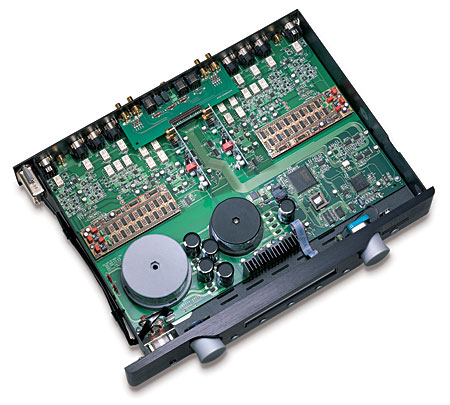 Whereas the circuitry for the No.380S's two channels was separated by a central shielded section running from front to back and containing the power supply and its transformers, in the No.326S all that "dirty" circuitry is enclosed in a full-width, steel-shielded box behind the front panel. Separate toroidal transformers are used for the signal and control circuitry, and a large heatsink behind the display panel supports the first stage of voltage regulation. Local regulation, using Linear Technology ICs, is then provided for each channel's gain, volume-control, and output stages, these based on high-quality op-amps, mainly Analog Devices AD797s and AD810s. There are also some 8-pin ICs with their markings painted over. Both surface-mount and through-hole devices are used, but the passive components are almost all surface-mount types.
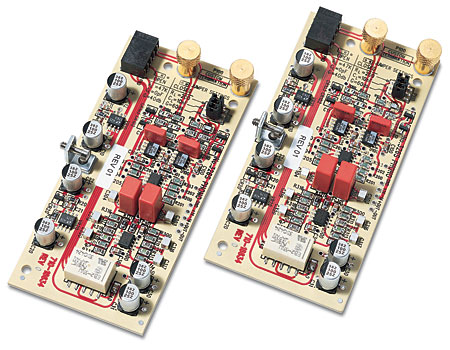
The No.326S has three pairs of balanced inputs on XLRs and four single-ended inputs on RCAs. Signals passed through the latter are internally converted to balanced operation before being fed to the two volume-control daughterboards (one for each channel), these also made of Arlon 25. Precision surface-mount resistors, controlled by a front-panel shaft encoder, are used to provide 1dB steps for the bottom 23dB of the volume control's 80dB range, and 0.1dB steps for the top 57dB. The volume control can be bypassed for each input for home-theater use, and the maximum gain for each input can be set from 0dB to 18dB, in three 6dB steps.
The left- and right-channel audio circuits are physically separated, and there are balanced and an unbalanced output jacks at each end of the rear panel. The input jacks are mirror-imaged (ie, input 1 is on the outside and input 7 on the inside for each channel), and in the center of the rear panel are the control, communication, and tape output jacks and a ground terminal. If the optional phono boards are installed, these take the place of the single-ended line input 7.
Overall, the No.326S's quality of construction is superb, as you'd expect from a preamp of this heritage and price.
Sound
Whereas the circuitry for the No.380S's two channels was separated by a central shielded section running from front to back and containing the power supply and its transformers, in the No.326S all that "dirty" circuitry is enclosed in a full-width, steel-shielded box behind the front panel. Separate toroidal transformers are used for the signal and control circuitry, and a large heatsink behind the display panel supports the first stage of voltage regulation. Local regulation, using Linear Technology ICs, is then provided for each channel's gain, volume-control, and output stages, these based on high-quality op-amps, mainly Analog Devices AD797s and AD810s. There are also some 8-pin ICs with their markings painted over. Both surface-mount and through-hole devices are used, but the passive components are almost all surface-mount types.
The No.326S has three pairs of balanced inputs on XLRs and four single-ended inputs on RCAs. Signals passed through the latter are internally converted to balanced operation before being fed to the two volume-control daughterboards (one for each channel), these also made of Arlon 25. Precision surface-mount resistors, controlled by a front-panel shaft encoder, are used to provide 1dB steps for the bottom 23dB of the volume control's 80dB range, and 0.1dB steps for the top 57dB. The volume control can be bypassed for each input for home-theater use, and the maximum gain for each input can be set from 0dB to 18dB, in three 6dB steps.
The left- and right-channel audio circuits are physically separated, and there are balanced and an unbalanced output jacks at each end of the rear panel. The input jacks are mirror-imaged (ie, input 1 is on the outside and input 7 on the inside for each channel), and in the center of the rear panel are the control, communication, and tape output jacks and a ground terminal. If the optional phono boards are installed, these take the place of the single-ended line input 7.
Overall, the No.326S's quality of construction is superb, as you'd expect from a preamp of this heritage and price.
Sound
If there is one sin we audio reviewers are guilty of, it is our tendency to get excited. We can't resist dramatizing both the descriptions and the degrees of the sonic differences we describe. I plead guilty. It's hard not to get dramatic when you experience sound quality better than you had expected from an audio product. Drama, however, is not a quality associated with a supposedly neutral component: surely a preamplifier, more than any other component, should be able to approximate the late Peter Walker's "straight wire with gain." In any case, dramatic changes are not the kind that prove to be of lasting value. What I did become increasingly aware of during my time with the Levinson No.326S was the fact that "neutrality" is not merely an absence of aberration but a positive virtue. I could hear more deeply into the mix, but without detail being spotlit or unnaturally thrown forward. Subtle details were presented with greater contrast against a quieter ground in all of these recordings: the reverberation tails that follow Joe Morello's kick-drum highlights in his drum solo in "Take 5," from Dave Brubeck's Time Out (SACD, Sony 7464-65122-6); the differences in the Cantus choir's reverb signature in Goshen College's Sauder Hall, depending on whether we had the drapes around the hall's perimeter open or closed when I recorded Comfort and Joy Volumes One and Two (CDs, Cantus CTS-1204, CTS-1205); the differences in tonality between Jack Bruce's fretted Gibson EB1 and his fretless Warwick bass on Cream's Royal Albert Hall CD (Reprise 49416-2); the dome of space surrounding Rachel Podger's violin on La Stravaganza, her wonderfully recorded collection of Vivaldi violin concertos (SACD, Channel Classics CCS SA19503); and Al Kooper's deeply buried but still audible piano on "Long Hot Summer," from Jimi Hendrix's Electric Ladyland (CD, Reprise 6307-2).
 Going back to my longtime companion, the No.380S, was illuminating. The soundstage still had great depth, but recorded detail merged more into the mixes, and while the bottom end warmed up, it became just too plummy-sounding. The No.32, which I'd used briefly following Jonathan's review, offered a greater degree of transparency and control than the '380S, but stayed within the same rather fat tonal family. Paul Bolin didn't like this when he compared it with the VTL TL-7.5 in October 2003, but it can prove perfect in a complementary system. However, I should do more than refer to my six-year-old listening notes—I will do some direct comparisons with the No.32 for a future Follow-Up.
Returning to the No.326S, the bass leaned out, the detail lifted up away from the floor, and the highs became better defined. The character of this preamplifier came from a direction dramatically different from that of the '380S, and overall, I think I prefer it.
The acid test of a preamplifier, of course, is to compare it with no preamplifier at all. For this, I fed the balanced outputs of either the Ayre C-5xe universal player or the Levinson No.30.6 processor to the Levinson No.33H monoblocks, using a balanced NHT Passive Volume Control to set levels. I acknowledge both that the level matching was more approximate than the 0.1dB I feel necessary for formal comparisons, and that I had to use additional Canare adapter cables because the NHT has ¼" TRS outputs rather than XLRs. However, there were losses in bass weight and dynamics when I compared the sound of the system run direct with my immediate memory of its character with the No.326S in-circuit. Perhaps there was a small gain in high-frequency transparency without the active preamp, perhaps not. What I was not expecting was a flattening of image depth and an increase in overall grain that made me less tolerant of recorded imperfections.
I persevered with the comparisons, using different recordings, but going back to the No.326S full-time came as a relief: the overall presentation acquired more of the bloom I find necessary.
Mercury retrograde
Going back to my longtime companion, the No.380S, was illuminating. The soundstage still had great depth, but recorded detail merged more into the mixes, and while the bottom end warmed up, it became just too plummy-sounding. The No.32, which I'd used briefly following Jonathan's review, offered a greater degree of transparency and control than the '380S, but stayed within the same rather fat tonal family. Paul Bolin didn't like this when he compared it with the VTL TL-7.5 in October 2003, but it can prove perfect in a complementary system. However, I should do more than refer to my six-year-old listening notes—I will do some direct comparisons with the No.32 for a future Follow-Up.
Returning to the No.326S, the bass leaned out, the detail lifted up away from the floor, and the highs became better defined. The character of this preamplifier came from a direction dramatically different from that of the '380S, and overall, I think I prefer it.
The acid test of a preamplifier, of course, is to compare it with no preamplifier at all. For this, I fed the balanced outputs of either the Ayre C-5xe universal player or the Levinson No.30.6 processor to the Levinson No.33H monoblocks, using a balanced NHT Passive Volume Control to set levels. I acknowledge both that the level matching was more approximate than the 0.1dB I feel necessary for formal comparisons, and that I had to use additional Canare adapter cables because the NHT has ¼" TRS outputs rather than XLRs. However, there were losses in bass weight and dynamics when I compared the sound of the system run direct with my immediate memory of its character with the No.326S in-circuit. Perhaps there was a small gain in high-frequency transparency without the active preamp, perhaps not. What I was not expecting was a flattening of image depth and an increase in overall grain that made me less tolerant of recorded imperfections.
I persevered with the comparisons, using different recordings, but going back to the No.326S full-time came as a relief: the overall presentation acquired more of the bloom I find necessary.
Mercury retrograde
I have had no end of equipment failures this past year, and the No.326S was no exception. Halfway through the auditioning, the front-panel volume control stopped working. This was more a minor annoyance than a catastrophe, as I almost always used the remote control to adjust level, but it should be noted nonetheless. Summing up
There has been a veritable explosion in the number of high-performance preamps on the market in the past few years. At $10,000, the Mark Levinson No.326S comes under strong competition from the $7100 McIntosh C200 (reviewed by Paul Bolin in December 2004), the $9995 EAR 912 (reviewed by Art Dudley in December 2005), the $11,995 Musical Fidelity Tri-Vista kWP (reviewed by Michael Fremer in January 2004), and the $12,500 VTL TL-7.5 (reviewed by PB in October 2003). Mark Levinson's own No.32 Reference is not that much more expensive at $15,950, and neither are the $13,500 Conrad-Johnson ACT2 (reviewed by Wes Phillips in March 2005), the $15,990 Halcro dm10 (reviewed by PB in April 2004), the $15,999 Burmester 011 (reviewed by Brian Damkroger in July 2005), and the $16,000 Viola Cadenza (reviewed by WP in December 2005).
Having auditioned almost all of these preamps in my system or in one of my reviewers' systems, there isn't one of them that I couldn't spend the rest of my days with, at least in terms of sound quality. (Aesthetics and ergonomics are different matters.) But having lived with the No.326S for the past six months, I don't feel I've been missing out, though I have yet to perform a direct comparison with Levinson's own awesome No.32. For now, the No.326S offers all I want from a preamplifier. Recommended.
Since I reviewed it in November 1997 (Stereophile, Vol.20 No.11), the Mark Levinson No.380S has been my preferred preamplifier. The '380S cost $6495 when it was last available; I bought the review sample because its combination of remote control, balanced operation, a volume control with accurate 0.1dB steps, an input volume-offset capability (to match source levels for comparisons), sonic transparency, an enveloping soundstage, and a musically convincing if rather fulsome tonality, was all that I desired.
However, Harman's Madrigal subsidiary, which had been responsible for the design, manufacture, and marketing of the Mark Levinson brand since the mid-1980s, ran afoul of business problems at the beginning of this century. In 2003, Harman transferred Mark Levinson production to their Lexicon facility in Massachusetts, combining both brands with Revel Loudspeakers under the umbrella of the newly formed Harman Specialty Group. Coincident with this change, the No.380S was discontinued and two new preamplifiers were announced, the No.320 ($8000) and the No.326S ($10,000). The latter, which became available in spring 2005, is the subject of this review.
As might be expected from the new preamplifiers' names, they are descended from Mark Levinson's state-of-the-art, two-chassis, full-function No.32 preamplifier, one of the last designs to come from the Madrigal era. The '32 was very much an ultimate statement in preamp design. It separated the preamp's components into two boxes—one "clean," with all the signal-handling circuits, the other "dirty," with the power supply and all the control circuits—a topology that has since been echoed in other manufacturers' offerings. The No.32 even regenerated its own AC. Jonathan Scull enthusiastically reviewed the '32 for Stereophile in January 2000, commenting on "the enormous amount of unforced information passing through its circuits." The No.326S and No.320 appear identical. Each looks like a less-wide version of the No.32's control chassis, with gray rotary controls flanking a red alphanumeric LED display panel set into the black-anodized front panel. They differ in the '326S's use of Arlon 25 for its main circuit board, which occupies almost the entire interior of the preamp. This expensive material offers very low dielectric loss, and was featured in the No.32 and other ML Reference products. The '326S's left-hand rotary control selects inputs, the right-hand one controls volume. Four front-panel buttons control Display Intensity, Channel Balance, (programmable) Mute, and Standby, while two others, Set-Up and Enter, allow each input's operating parameters to be set in conjunction with the source select knob. All these functions are duplicated on the small cast-metal remote, which also has Mono and Polarity buttons.
Whereas the circuitry for the No.380S's two channels was separated by a central shielded section running from front to back and containing the power supply and its transformers, in the No.326S all that "dirty" circuitry is enclosed in a full-width, steel-shielded box behind the front panel. Separate toroidal transformers are used for the signal and control circuitry, and a large heatsink behind the display panel supports the first stage of voltage regulation. Local regulation, using Linear Technology ICs, is then provided for each channel's gain, volume-control, and output stages, these based on high-quality op-amps, mainly Analog Devices AD797s and AD810s. There are also some 8-pin ICs with their markings painted over. Both surface-mount and through-hole devices are used, but the passive components are almost all surface-mount types.
The No.326S has three pairs of balanced inputs on XLRs and four single-ended inputs on RCAs. Signals passed through the latter are internally converted to balanced operation before being fed to the two volume-control daughterboards (one for each channel), these also made of Arlon 25. Precision surface-mount resistors, controlled by a front-panel shaft encoder, are used to provide 1dB steps for the bottom 23dB of the volume control's 80dB range, and 0.1dB steps for the top 57dB. The volume control can be bypassed for each input for home-theater use, and the maximum gain for each input can be set from 0dB to 18dB, in three 6dB steps.
The left- and right-channel audio circuits are physically separated, and there are balanced and an unbalanced output jacks at each end of the rear panel. The input jacks are mirror-imaged (ie, input 1 is on the outside and input 7 on the inside for each channel), and in the center of the rear panel are the control, communication, and tape output jacks and a ground terminal. If the optional phono boards are installed, these take the place of the single-ended line input 7.
If there is one sin we audio reviewers are guilty of, it is our tendency to get excited. We can't resist dramatizing both the descriptions and the degrees of the sonic differences we describe. I plead guilty. It's hard not to get dramatic when you experience sound quality better than you had expected from an audio product. Drama, however, is not a quality associated with a supposedly neutral component: surely a preamplifier, more than any other component, should be able to approximate the late Peter Walker's "straight wire with gain." In any case, dramatic changes are not the kind that prove to be of lasting value. What I did become increasingly aware of during my time with the Levinson No.326S was the fact that "neutrality" is not merely an absence of aberration but a positive virtue. I could hear more deeply into the mix, but without detail being spotlit or unnaturally thrown forward. Subtle details were presented with greater contrast against a quieter ground in all of these recordings: the reverberation tails that follow Joe Morello's kick-drum highlights in his drum solo in "Take 5," from Dave Brubeck's Time Out (SACD, Sony 7464-65122-6); the differences in the Cantus choir's reverb signature in Goshen College's Sauder Hall, depending on whether we had the drapes around the hall's perimeter open or closed when I recorded Comfort and Joy Volumes One and Two (CDs, Cantus CTS-1204, CTS-1205); the differences in tonality between Jack Bruce's fretted Gibson EB1 and his fretless Warwick bass on Cream's Royal Albert Hall CD (Reprise 49416-2); the dome of space surrounding Rachel Podger's violin on La Stravaganza, her wonderfully recorded collection of Vivaldi violin concertos (SACD, Channel Classics CCS SA19503); and Al Kooper's deeply buried but still audible piano on "Long Hot Summer," from Jimi Hendrix's Electric Ladyland (CD, Reprise 6307-2).
Going back to my longtime companion, the No.380S, was illuminating. The soundstage still had great depth, but recorded detail merged more into the mixes, and while the bottom end warmed up, it became just too plummy-sounding. The No.32, which I'd used briefly following Jonathan's review, offered a greater degree of transparency and control than the '380S, but stayed within the same rather fat tonal family. Paul Bolin didn't like this when he compared it with the VTL TL-7.5 in October 2003, but it can prove perfect in a complementary system. However, I should do more than refer to my six-year-old listening notes—I will do some direct comparisons with the No.32 for a future Follow-Up.
Returning to the No.326S, the bass leaned out, the detail lifted up away from the floor, and the highs became better defined. The character of this preamplifier came from a direction dramatically different from that of the '380S, and overall, I think I prefer it.
The acid test of a preamplifier, of course, is to compare it with no preamplifier at all. For this, I fed the balanced outputs of either the Ayre C-5xe universal player or the Levinson No.30.6 processor to the Levinson No.33H monoblocks, using a balanced NHT Passive Volume Control to set levels. I acknowledge both that the level matching was more approximate than the 0.1dB I feel necessary for formal comparisons, and that I had to use additional Canare adapter cables because the NHT has ¼" TRS outputs rather than XLRs. However, there were losses in bass weight and dynamics when I compared the sound of the system run direct with my immediate memory of its character with the No.326S in-circuit. Perhaps there was a small gain in high-frequency transparency without the active preamp, perhaps not. What I was not expecting was a flattening of image depth and an increase in overall grain that made me less tolerant of recorded imperfections.
I have had no end of equipment failures this past year, and the No.326S was no exception. Halfway through the auditioning, the front-panel volume control stopped working. This was more a minor annoyance than a catastrophe, as I almost always used the remote control to adjust level, but it should be noted nonetheless. Summing up
There has been a veritable explosion in the number of high-performance preamps on the market in the past few years. At $10,000, the Mark Levinson No.326S comes under strong competition from the $7100 McIntosh C200 (reviewed by Paul Bolin in December 2004), the $9995 EAR 912 (reviewed by Art Dudley in December 2005), the $11,995 Musical Fidelity Tri-Vista kWP (reviewed by Michael Fremer in January 2004), and the $12,500 VTL TL-7.5 (reviewed by PB in October 2003). Mark Levinson's own No.32 Reference is not that much more expensive at $15,950, and neither are the $13,500 Conrad-Johnson ACT2 (reviewed by Wes Phillips in March 2005), the $15,990 Halcro dm10 (reviewed by PB in April 2004), the $15,999 Burmester 011 (reviewed by Brian Damkroger in July 2005), and the $16,000 Viola Cadenza (reviewed by WP in December 2005).