It seems as if I came of audiophile age in the George Kaye era. The first truly high-end system I ever heard contained a pair of Julius Futterman OTL monoblocks that Kaye had "finished" after Futterman's death in 1979 (footnote 1). In the mid-1980s, I owned both an New York Audio Labs (NYAL) Superit phono section and a Moscode 300 amplifier—two lovely examples of high-value high-end. Both components were far from perfect, but they were fun—and, unlike most of the other components that were then highly regarded by magazines and listeners, I could afford them.
 To Kaye—and his original partner, the late Harvey "Gizmo" Rosenberg of NYAL—fun is the whole point of hi-fi. Kaye's last amplifier, the $4995 Moscode 401HR, which I reviewed in the June 2006 Stereophile, was cosmetically similar to the new 402Au ($6495) and also offered 200Wpc output. However, Kaye tells me, the 402Au is almost completely different on the inside. That's where the fun—and the magic—starts.
If you obey all the rules, you miss all the fun
To Kaye—and his original partner, the late Harvey "Gizmo" Rosenberg of NYAL—fun is the whole point of hi-fi. Kaye's last amplifier, the $4995 Moscode 401HR, which I reviewed in the June 2006 Stereophile, was cosmetically similar to the new 402Au ($6495) and also offered 200Wpc output. However, Kaye tells me, the 402Au is almost completely different on the inside. That's where the fun—and the magic—starts.
If you obey all the rules, you miss all the fun
One big difference from the 401HR is that, as the 402Au's name implies, the traces on its circuit board are gold-plated. Another example of (pardon the expression) gilding the audiophilic lily? No, insists Kaye. He speculates that gold's superior conductive qualities—compared to the universally used tin-based solder—improve low-level detail. "It was a gamble, because I couldn't order sample qualities, only production quantities, but it paid off."
In addition, the audio signal path is hand-wired with Cardas cable comprising just four wires: two hot, two ground. It has double-regulated power supplies. There is no off-board speaker wiring; each channel's circuit board is soldered directly to the Edison Price Music Posts. Oh yeah, those boards are mounted on elastomer suspensions to reduce microphony. (For a complete rundown of the 402Au's innards and construction, go here.)
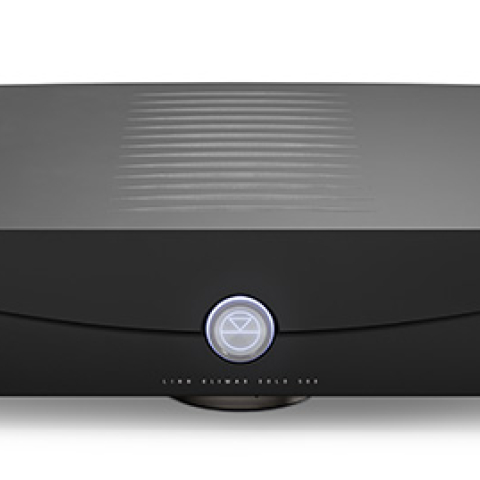
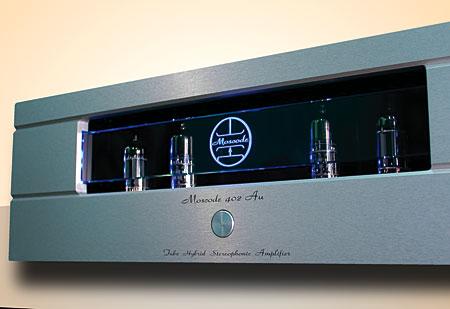
The front panel includes the same blue-illuminated glass window as the 401HR. This drops down to grant easy access to the input tubes, which use an auto filament switcher, which recognizes center-tapped tubes (12AU7, for example) and switches from a two-pin, 6V to a three-pin, 12V filament circuit. This makes tube rolling a snap.
 Opening the tube compartment automatically powers the amp off. If you decide to roll tubes, Kaye suggests starting with the two inner voltage-gain tubes. The 402Au accepts 6H30Pi, 6GU7, 6DJ8, 6922, 6FQ7, 5814, 7730, or 12AU7. Pairs of 6H30Pi and 6GU7 tubes come stock. Close the tube compartment and the amp automatically powers back on.
Kaye loves the sound of tubes, but he's not wild about tubed output sections. Tubed output requires output transformers in the signal path, which, he says, require thousands of feet of wire and lots of iron in the core. And that iron, Kaye says, is subject to saturation and hysteresis. In fact, Kaye calls transformers tone filters. Kaye grants that big transformers are probably what give tube amplifiers their glorious midrange, but it comes at a cost at both frequency extremes.
MOSFETs, he contends, aren't perfect either, but their shortcomings tend to be more those of power (harmonic distortion) than of frequency or phase shift. Total harmonic distortion (THD), he shrugs, can be controlled with a judicious application of feedback. The 402Au employs six output MOSFETs per channel.
The 402Au's rear panel is pretty simple. It accepts only single-ended signals via a pair of Cardas input connectors; next to them, however, is a three-way switch for stereo, null, and running both channels in parallel for vertical biamping. Other than the Edison Price posts for the right and left channels and an IEC AC socket, that's it.
Fun is a good thing, but only when it spoils nothing better
Opening the tube compartment automatically powers the amp off. If you decide to roll tubes, Kaye suggests starting with the two inner voltage-gain tubes. The 402Au accepts 6H30Pi, 6GU7, 6DJ8, 6922, 6FQ7, 5814, 7730, or 12AU7. Pairs of 6H30Pi and 6GU7 tubes come stock. Close the tube compartment and the amp automatically powers back on.
Kaye loves the sound of tubes, but he's not wild about tubed output sections. Tubed output requires output transformers in the signal path, which, he says, require thousands of feet of wire and lots of iron in the core. And that iron, Kaye says, is subject to saturation and hysteresis. In fact, Kaye calls transformers tone filters. Kaye grants that big transformers are probably what give tube amplifiers their glorious midrange, but it comes at a cost at both frequency extremes.
MOSFETs, he contends, aren't perfect either, but their shortcomings tend to be more those of power (harmonic distortion) than of frequency or phase shift. Total harmonic distortion (THD), he shrugs, can be controlled with a judicious application of feedback. The 402Au employs six output MOSFETs per channel.
The 402Au's rear panel is pretty simple. It accepts only single-ended signals via a pair of Cardas input connectors; next to them, however, is a three-way switch for stereo, null, and running both channels in parallel for vertical biamping. Other than the Edison Price posts for the right and left channels and an IEC AC socket, that's it.
Fun is a good thing, but only when it spoils nothing better
It isn't difficult to set up or place the 402Au, since it runs relatively cool—except that wrestling around its 52 lbs is a real chore. "You need a lot of iron for that power supply," Kaye commented, "and then you need a lot of aluminum to cool it off." By aluminum, of course, he's referring to the amp's heatsinks, which are inside the 402Au's ventilated chassis of 14-gauge steel. No sharp edges, but also no handles or rack mounts—placing the 402Au on my open amp stand wasn't that hard, but if you're putting it in an enclosed equipment rack, it's probably a two-audiophile job.
Footnote 1: See http://en.wikipedia.org/wiki/Julius_Futterman.
To Kaye—and his original partner, the late Harvey "Gizmo" Rosenberg of NYAL—fun is the whole point of hi-fi. Kaye's last amplifier, the $4995 Moscode 401HR, which I reviewed in the June 2006 Stereophile, was cosmetically similar to the new 402Au ($6495) and also offered 200Wpc output. However, Kaye tells me, the 402Au is almost completely different on the inside. That's where the fun—and the magic—starts.
If you obey all the rules, you miss all the fun
One big difference from the 401HR is that, as the 402Au's name implies, the traces on its circuit board are gold-plated. Another example of (pardon the expression) gilding the audiophilic lily? No, insists Kaye. He speculates that gold's superior conductive qualities—compared to the universally used tin-based solder—improve low-level detail. "It was a gamble, because I couldn't order sample qualities, only production quantities, but it paid off."
Opening the tube compartment automatically powers the amp off. If you decide to roll tubes, Kaye suggests starting with the two inner voltage-gain tubes. The 402Au accepts 6H30Pi, 6GU7, 6DJ8, 6922, 6FQ7, 5814, 7730, or 12AU7. Pairs of 6H30Pi and 6GU7 tubes come stock. Close the tube compartment and the amp automatically powers back on.
It isn't difficult to set up or place the 402Au, since it runs relatively cool—except that wrestling around its 52 lbs is a real chore. "You need a lot of iron for that power supply," Kaye commented, "and then you need a lot of aluminum to cool it off." By aluminum, of course, he's referring to the amp's heatsinks, which are inside the 402Au's ventilated chassis of 14-gauge steel. No sharp edges, but also no handles or rack mounts—placing the 402Au on my open amp stand wasn't that hard, but if you're putting it in an enclosed equipment rack, it's probably a two-audiophile job.
Footnote 1: See http://en.wikipedia.org/wiki/Julius_Futterman.