"Everybody's gotta get into the act!" Jimmy Durante used to say. That's what's happening with phono preamplifiers—they just keep being built, and I keep getting them for review. Up for evaluation in next month's column are new models from Perreaux, Musical Fidelity, Graham Slee, and a Chinese one, Ming Da. You can bet there'll be more.
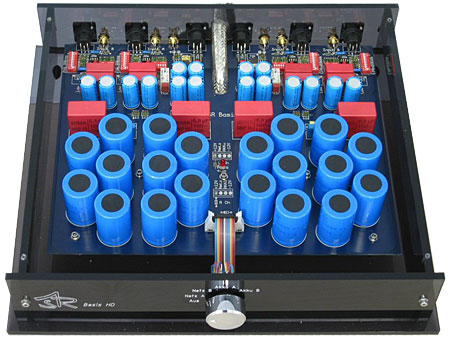
 This month, I concentrate on one: from German designer Friedrich Schäfer, the unique and exceptionally fine-sounding ASR Basis Exclusive ($4950), built in Germany and imported by Fanfare International. This two-piece, battery-operated design is connected to the power supply via a large-diameter umbilical cord hardwired to the main section and terminated in a massive multi-pin connector. The battery supply—larger and heavier than the amplification and equalization section—is housed in a metal chassis with a thick acrylic front panel. The main unit consists of a single, unusually large double-sided circuit board in a plain-looking acrylic chassis that will win no points for industrial design—unless you like acrylic.
Unusually, the Exclusive is actually two complete, fully balanced stereo phono preamplifiers on a single chassis, entirely independent except for a shared, switchable output. You can have two turntables connected simultaneously, or have two tonearms on a single 'table (as I do), and easily switch between them. The fully balanced input stages feature both single-ended RCA and balanced XLR inputs, as does the shared output.
Each preamplifier is independently configurable via a series of DIP switches that control gain, capacitance, and resistance. An additional DIP switch acts as a "rumble filter" to allow you to limit low-frequency response to 2Hz or 20Hz. 10 more DIP switches allow loading to be adjusted from 5 ohms to 1k ohm for moving-coil (MC) cartridges; and, for moving-magnet (MM) types, 50k ohms in balanced mode and 36k ohms in unbalanced. There are switch positions for values of 5, 7, 10, 15, 22, 47, 64, 100, 220, 360, 470, 1k, and 50k ohms; other values are possible by choosing different combinations of switch positions.
Capacitance adjustment for MMs is more limited: 100pF or 320pF. A six-switch DIP-switch array offers gains of 0dB, +4dB, +8dB, +12dB, +18dB, +24dB, and +34dB. The quoted figure refers to additional gain above the preamp's MM gain; the Exclusive provides enormous amounts of gain for even the lowest-output MC cartridge, and +34dB gain by itself simply wouldn't be enough. The instruction manual's specifications page doesn't clarify things: it lists the Exclusive's maximum gain as "+32dB"! The manual, while informative and pretty comprehensive, needs some organization and a better translation.
The heart of the Basis Exclusive is a super-quiet Analog Devices microphone preamp based, believe it or not, on op-amps. According to the manual, after the adjustable linear gain stage, the signal passes through a passive low-pass RIAA filter and the low-frequency cutoff switch, followed by active RIAA equalization. The low-impedance unbalanced signal can then be output directly. An additional driver circuit is used for the balanced output signal. Only polypropylene and polystyrene capacitors are used in the signal path.
Battery charging is controlled by an optical digital logic circuit. A 72VA Philbert-Mantelschnitt transformer is used during charging but is automatically disconnected via relays during battery operation. There are six 6V, 12 amp-hour accumulators, and 400,000µF of buffering capacitance; when the voltage goes below 16.5V, switching is accomplished via a MOSFET-controlled circuit.
Charging begins automatically when the Exclusive is switched off. Fully charged, the battery can power the preamp for about 60 hours of continuous use. Should the batteries discharge, the Exclusive automatically switches to line voltage power and begins to recharge the batteries, if I interpret the poorly translated instructions correctly.
I'll spare you a complete description, but if you can follow the instructions, you'll know in great detail what is occurring with the charge circuitry at all times. At the push of a button on the back of the battery pack, a series of 10 LEDs lets you know the charge condition of the battery. You get about three hours of playback from an hour of charging. Basically, the charging and use of the battery system were transparent: during the entire time I used the Exclusive, I never ran out of battery juice. But if you leave it on accidentally for a few days, you probably will!
Connections, Configuring the DIP Switches, and Sound!
This month, I concentrate on one: from German designer Friedrich Schäfer, the unique and exceptionally fine-sounding ASR Basis Exclusive ($4950), built in Germany and imported by Fanfare International. This two-piece, battery-operated design is connected to the power supply via a large-diameter umbilical cord hardwired to the main section and terminated in a massive multi-pin connector. The battery supply—larger and heavier than the amplification and equalization section—is housed in a metal chassis with a thick acrylic front panel. The main unit consists of a single, unusually large double-sided circuit board in a plain-looking acrylic chassis that will win no points for industrial design—unless you like acrylic.
Unusually, the Exclusive is actually two complete, fully balanced stereo phono preamplifiers on a single chassis, entirely independent except for a shared, switchable output. You can have two turntables connected simultaneously, or have two tonearms on a single 'table (as I do), and easily switch between them. The fully balanced input stages feature both single-ended RCA and balanced XLR inputs, as does the shared output.
Each preamplifier is independently configurable via a series of DIP switches that control gain, capacitance, and resistance. An additional DIP switch acts as a "rumble filter" to allow you to limit low-frequency response to 2Hz or 20Hz. 10 more DIP switches allow loading to be adjusted from 5 ohms to 1k ohm for moving-coil (MC) cartridges; and, for moving-magnet (MM) types, 50k ohms in balanced mode and 36k ohms in unbalanced. There are switch positions for values of 5, 7, 10, 15, 22, 47, 64, 100, 220, 360, 470, 1k, and 50k ohms; other values are possible by choosing different combinations of switch positions.
Capacitance adjustment for MMs is more limited: 100pF or 320pF. A six-switch DIP-switch array offers gains of 0dB, +4dB, +8dB, +12dB, +18dB, +24dB, and +34dB. The quoted figure refers to additional gain above the preamp's MM gain; the Exclusive provides enormous amounts of gain for even the lowest-output MC cartridge, and +34dB gain by itself simply wouldn't be enough. The instruction manual's specifications page doesn't clarify things: it lists the Exclusive's maximum gain as "+32dB"! The manual, while informative and pretty comprehensive, needs some organization and a better translation.
The heart of the Basis Exclusive is a super-quiet Analog Devices microphone preamp based, believe it or not, on op-amps. According to the manual, after the adjustable linear gain stage, the signal passes through a passive low-pass RIAA filter and the low-frequency cutoff switch, followed by active RIAA equalization. The low-impedance unbalanced signal can then be output directly. An additional driver circuit is used for the balanced output signal. Only polypropylene and polystyrene capacitors are used in the signal path.
Battery charging is controlled by an optical digital logic circuit. A 72VA Philbert-Mantelschnitt transformer is used during charging but is automatically disconnected via relays during battery operation. There are six 6V, 12 amp-hour accumulators, and 400,000µF of buffering capacitance; when the voltage goes below 16.5V, switching is accomplished via a MOSFET-controlled circuit.
Charging begins automatically when the Exclusive is switched off. Fully charged, the battery can power the preamp for about 60 hours of continuous use. Should the batteries discharge, the Exclusive automatically switches to line voltage power and begins to recharge the batteries, if I interpret the poorly translated instructions correctly.
I'll spare you a complete description, but if you can follow the instructions, you'll know in great detail what is occurring with the charge circuitry at all times. At the push of a button on the back of the battery pack, a series of 10 LEDs lets you know the charge condition of the battery. You get about three hours of playback from an hour of charging. Basically, the charging and use of the battery system were transparent: during the entire time I used the Exclusive, I never ran out of battery juice. But if you leave it on accidentally for a few days, you probably will!
Connections, Configuring the DIP Switches, and Sound!
For audiophiles with more than one turntable or with two tonearms mounted on a single 'table, instantly switchable dual phono sections is a major convenience. I had the Lyra Titan cartridge on the Graham 2.2 arm and the Transfiguration Temper W on the Immedia RPM. A setting of +12dB of additional gain was more than sufficient for these MC cartridges, which are both of moderately low output. I preferred running the Titan at 1k ohm, but found the Temper W sounded best loaded down to 37 ohms, very close to the recommended 30 ohms. I left the Exclusive's rumble filter off, but made sure to mute the system before raising or lowering the arms. I ran the system single-ended at first, using Graham's excellent new IC-70 DIN-to-RCA phono cable on the 2.2, and Hovland Music Groove II on the Immedia arm. Harmonic Technology Magic interconnect ran to the preamp. Once the ASR Basis Exclusive was configured, using it was simple: a single chrome rotary switch mounted on the front panel chooses between Off and either of the two phono sections, using either the battery or line power. I ran the Exclusive in battery mode at all times. If you have a negative opinion of op-amps, listening to this phono preamp will change your mind. Whether it was the battery supply, the op-amps, the combination, or whatever, the ASR Basis Exclusive was easily the quietest phono preamp I have ever reviewed, with the exception of the $29,000 Boulder 2008 (which is equally quiet but is otherwise in a class of its own). Music didn't just emerge from the most jet-"black" backgrounds I've ever experienced with vinyl—it seemed to leap in stark relief from that silent backdrop. When I ran the Exclusive fully balanced (into the Halcro dm10 preamplifier) using Cardas Neutral Reference DIN-to-XLR and Shunyata Research balanced interconnect, the effect was only intensified. The Exclusive seemed to suppress surface noise to unusually low levels, making records I'd thought were noisy sound quiet, while allowing ultra-low-level detail to appear out of the vacuum-like blackness.
This month, I concentrate on one: from German designer Friedrich Schäfer, the unique and exceptionally fine-sounding ASR Basis Exclusive ($4950), built in Germany and imported by Fanfare International. This two-piece, battery-operated design is connected to the power supply via a large-diameter umbilical cord hardwired to the main section and terminated in a massive multi-pin connector. The battery supply—larger and heavier than the amplification and equalization section—is housed in a metal chassis with a thick acrylic front panel. The main unit consists of a single, unusually large double-sided circuit board in a plain-looking acrylic chassis that will win no points for industrial design—unless you like acrylic.
Unusually, the Exclusive is actually two complete, fully balanced stereo phono preamplifiers on a single chassis, entirely independent except for a shared, switchable output. You can have two turntables connected simultaneously, or have two tonearms on a single 'table (as I do), and easily switch between them. The fully balanced input stages feature both single-ended RCA and balanced XLR inputs, as does the shared output.
For audiophiles with more than one turntable or with two tonearms mounted on a single 'table, instantly switchable dual phono sections is a major convenience. I had the Lyra Titan cartridge on the Graham 2.2 arm and the Transfiguration Temper W on the Immedia RPM. A setting of +12dB of additional gain was more than sufficient for these MC cartridges, which are both of moderately low output. I preferred running the Titan at 1k ohm, but found the Temper W sounded best loaded down to 37 ohms, very close to the recommended 30 ohms. I left the Exclusive's rumble filter off, but made sure to mute the system before raising or lowering the arms. I ran the system single-ended at first, using Graham's excellent new IC-70 DIN-to-RCA phono cable on the 2.2, and Hovland Music Groove II on the Immedia arm. Harmonic Technology Magic interconnect ran to the preamp. Once the ASR Basis Exclusive was configured, using it was simple: a single chrome rotary switch mounted on the front panel chooses between Off and either of the two phono sections, using either the battery or line power. I ran the Exclusive in battery mode at all times. If you have a negative opinion of op-amps, listening to this phono preamp will change your mind. Whether it was the battery supply, the op-amps, the combination, or whatever, the ASR Basis Exclusive was easily the quietest phono preamp I have ever reviewed, with the exception of the $29,000 Boulder 2008 (which is equally quiet but is otherwise in a class of its own). Music didn't just emerge from the most jet-"black" backgrounds I've ever experienced with vinyl—it seemed to leap in stark relief from that silent backdrop. When I ran the Exclusive fully balanced (into the Halcro dm10 preamplifier) using Cardas Neutral Reference DIN-to-XLR and Shunyata Research balanced interconnect, the effect was only intensified. The Exclusive seemed to suppress surface noise to unusually low levels, making records I'd thought were noisy sound quiet, while allowing ultra-low-level detail to appear out of the vacuum-like blackness.