In 1962, when tennis rackets were made of wood, newspeople were known for challenging the government, and the off-Broadway musical The Fantasticks was in its second year (the show closed in 2002), Nippon Columbia's Denki Onkyo (or Den-On) division introduced to the professional audio world a brand-new moving-coil phono cartridge. Developed in cooperation with the Japan Broadcasting Corporation, the DL-103 was one of the first attempts at making a truly wide-bandwidth stereo cartridge that nonetheless could withstand the rigors of back-cueing. The DL-103 was a nearly instant success with broadcasters, and its popularity spilled over into the world of domestic audio.
 In 2007, you can still buy a brand-new Denon DL-103—for the almost jarringly small sum of $229. It has outlived The Fantasticks by five years. I'm sure that no one at the Denon of 1962 could have foreseen such a thing, and I'm doubly sure that no one at the Denon of 1982, which introduced the world's first pro-audio CD player, could have seen it coming either.
But here we are: The DL-103 is almost as old as I am, and continues to attract a great deal more attention. Record collectors love the DL-103 because it's cheap and it has gobs of real musical tone. Internet retailers love it because it's consistent—damn consistent—and rugged. And OEMs love it because, like the Garrard 301, the Quad ESL, and the Rega RB300, the Denon DL-103 is one of those products that cries out to be maximized.
Description
In 2007, you can still buy a brand-new Denon DL-103—for the almost jarringly small sum of $229. It has outlived The Fantasticks by five years. I'm sure that no one at the Denon of 1962 could have foreseen such a thing, and I'm doubly sure that no one at the Denon of 1982, which introduced the world's first pro-audio CD player, could have seen it coming either.
But here we are: The DL-103 is almost as old as I am, and continues to attract a great deal more attention. Record collectors love the DL-103 because it's cheap and it has gobs of real musical tone. Internet retailers love it because it's consistent—damn consistent—and rugged. And OEMs love it because, like the Garrard 301, the Quad ESL, and the Rega RB300, the Denon DL-103 is one of those products that cries out to be maximized.
Description
Enter Zu Audio, a seven-year-old company that specializes in the design and manufacture of cables and loudspeakers. Founded in Ogden, Utah, by a pair of ex-Kimber, ex-Talon, ex-Wasatch engineers named Sean Casey and Adam Decaria, Zu has already impressed a number of reviewers with its clean-slate designs and clear emphasis on affordability. Zu's marketing sensibilities are also unmistakably fresh: I can't help liking a company that would name one line of cables Mother and another Saint Julian. Zu's founders are also younger than the Denon DL-103—which may be significant. Far from an exercise in nostalgia, Casey's and Decaria's interest in the DL-103 came only recently, when they learned of the cartridge from friend and phono maven Phil Ressler. "Phil told me about this amazing cartridge, how it had more tone than anything else for the money," Casey says. "We checked it out, and he was right—and we saw some areas that needed improvement. . . " Before going further, let's have a closer look at the stock Denon DL-103. It's a resolutely old-fashioned pickup in which a two-piece aluminum cantilever drives a cross-shaped armature wound with several turns of exceptionally fine-gauge copper magnet wire. The armature rests against a sky-blue rubber damper, under tension from a taut length of the sort of piano wire once used by spies to strangle each other. The magnet is oblong and apparently of no exotic composition, and its flux lines are channeled by a pole piece of the usual shape. While Denon has offered the DL-103 with various stylus profiles over the years, the square-shank nude diamond of the stock cartridge is ground to a spherical tip—the version that Zu and I both prefer, for its dependably musical, unfussy sound. And while thousands of words can be written on the subject—Is a spherical tip less susceptible to interchannel phase distortion than an elliptical tip? Should a stylus endeavor to ride on the very bottom of the groove, where damage is supposedly less pronounced? All else being equal, will there be an appreciable difference in record wear when a user switches from a 2gm downforce to one of 2.5gm? —I propose to leave it alone for the time being.
I am, however, interested in the manner in which the DL-103's stylus is fastened to its aluminum tube. While this is normally done in a single machine operation in which the end of the tube is crimped flat and the shank is punched through it from the top, examining the DL-103 under a microscope shows that the business end of its cantilever is machined away—surprisingly neatly—leaving a sort of an inverted scoop in which an opening for the diamond shank is then punched or milled. In terms of shank alignment alone, the Zu DL-103, my own stock DL-103, and every other Denon I've examined under a microscope have had the most accurately and cleanly made stylus assemblies I've ever seen.
In common with its early broadcasting contemporary, the EMT, specifications for the stock DL-103 show a highish source impedance (40 ohms). The two brands also exhibit similarly low compliance and high downforce (5x 10⁻⁶ cm/dyne and 2.5gm, respectively, for the Denon). The comparison falters from there, in light of the DL-103's comparatively low output (0.3mV) and low overall mass, the latter owing to its two-piece plastic body.
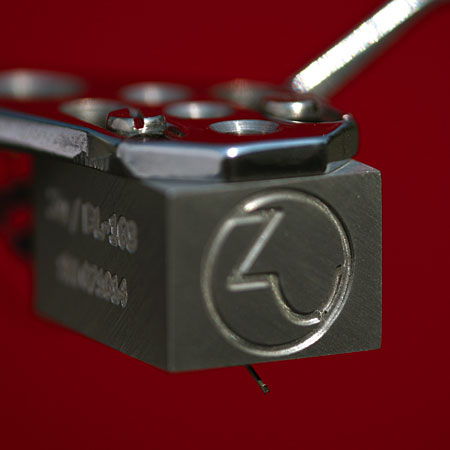
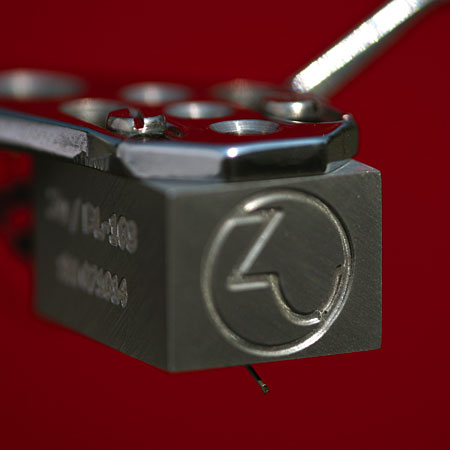
Back to 2007: For a variety of reasons, Casey and company decided to dispense with most of the Denon's plastic body. The most common complaint about the DL-103 is also the truest: Its good motor is compromised by a too-flimsy mounting arrangement, with open-edge bolt channels that prevent the cartridge from being rigidly fastened to a headshell. Additionally, according to Sean Casey, "The plastic body is a drag on the frequency extremes."
Casey also determined the need to minimize mechanical impedance differences among three major parts of the system: the magnet, the pole piece, and the base that holds them all together. Knowing that, and knowing that the cartridge will almost always be mounted in an aluminum headshell, the decision was made to create a new body for the DL-103 out of 6061 "aircraft" aluminum—CNC-machined right there in Ogden, Utah—and to tie those major components together using a ferrous-based epoxy. That the low-compliance DL-103 is thus made significantly heavier is an advantage, according to Casey, who also recommends using his cartridge with the heaviest accessory counterweight available, preferably with a rigid mounting.
Finally, a very different, slow-set epoxy is used to encapsulate the DL-103's motor, damping its structure and further tying the sides of the aluminum body to the stock Denon cradle.
Setup
One stock spec I neglected to mention: The distance between the DL-103's stylus tip and the center line of its mounting holes is 7.5mm—a standard to which Linn and various other companies have adhered in making their own MC cartridges.
In 2007, you can still buy a brand-new Denon DL-103—for the almost jarringly small sum of $229. It has outlived The Fantasticks by five years. I'm sure that no one at the Denon of 1962 could have foreseen such a thing, and I'm doubly sure that no one at the Denon of 1982, which introduced the world's first pro-audio CD player, could have seen it coming either.
But here we are: The DL-103 is almost as old as I am, and continues to attract a great deal more attention. Record collectors love the DL-103 because it's cheap and it has gobs of real musical tone. Internet retailers love it because it's consistent—damn consistent—and rugged. And OEMs love it because, like the Garrard 301, the Quad ESL, and the Rega RB300, the Denon DL-103 is one of those products that cries out to be maximized.
Enter Zu Audio, a seven-year-old company that specializes in the design and manufacture of cables and loudspeakers. Founded in Ogden, Utah, by a pair of ex-Kimber, ex-Talon, ex-Wasatch engineers named Sean Casey and Adam Decaria, Zu has already impressed a number of reviewers with its clean-slate designs and clear emphasis on affordability. Zu's marketing sensibilities are also unmistakably fresh: I can't help liking a company that would name one line of cables Mother and another Saint Julian. Zu's founders are also younger than the Denon DL-103—which may be significant. Far from an exercise in nostalgia, Casey's and Decaria's interest in the DL-103 came only recently, when they learned of the cartridge from friend and phono maven Phil Ressler. "Phil told me about this amazing cartridge, how it had more tone than anything else for the money," Casey says. "We checked it out, and he was right—and we saw some areas that needed improvement. . . " Before going further, let's have a closer look at the stock Denon DL-103. It's a resolutely old-fashioned pickup in which a two-piece aluminum cantilever drives a cross-shaped armature wound with several turns of exceptionally fine-gauge copper magnet wire. The armature rests against a sky-blue rubber damper, under tension from a taut length of the sort of piano wire once used by spies to strangle each other. The magnet is oblong and apparently of no exotic composition, and its flux lines are channeled by a pole piece of the usual shape. While Denon has offered the DL-103 with various stylus profiles over the years, the square-shank nude diamond of the stock cartridge is ground to a spherical tip—the version that Zu and I both prefer, for its dependably musical, unfussy sound. And while thousands of words can be written on the subject—Is a spherical tip less susceptible to interchannel phase distortion than an elliptical tip? Should a stylus endeavor to ride on the very bottom of the groove, where damage is supposedly less pronounced? All else being equal, will there be an appreciable difference in record wear when a user switches from a 2gm downforce to one of 2.5gm? —I propose to leave it alone for the time being.
One stock spec I neglected to mention: The distance between the DL-103's stylus tip and the center line of its mounting holes is 7.5mm—a standard to which Linn and various other companies have adhered in making their own MC cartridges.