It was John Atkinson, that legendary ornithologist, who first pointed it out: "Have you noticed how frequently you see women using the iPod?" I hadn't. I'd been so darn happy striding about the streets of New York listening to Tom Russell and Carla Bley that I hadn't been paying attention. Gimlet-eyed, I now began examining my fellow pedestrians for the telltale flash of the distinctive white-and-chrome player and the giveaway white headphone cable that announced the iPod's earbuds.  What an astoundingly acute observer of the human condition Stereophile's editor proved to be! Of course, there were guys walking around with 'em (many wearing "Think Different!" T-shirts), but the streets were filled with fashionably dressed young women brandishing iPods as though they were this season's trendiest little Manolo Blahnik sling-back. Holy cow! I'm running with the fashionistas! Can I still be an audiophile, too? What did you see when you were there?
Apple's third-generation iPods are smaller, sleeker, more capacious than earlier models. The G3 is available with a 10GB, 15GB, or 30GB hard drive. [A 40GB drive is now available.—Ed.] The 30GB version is slightly larger and heavier than the other two, at 4.1" H by 2.4" W by 0.73" D and 6.2oz (compared to 0.62" D and 5.6oz). Our review sample was the 30GB model, which includes several accessories that buyers of the 10GB version have to buy separately: a docking cradle, a wired remote, and a carrying case of elastic and leather. A FireWire connecting cable is standard (it sports an extremely thin "dock connector" on the end that attaches to the iPod, since the iPod itself is too thin to accommodate a standard IEEE1394 plug.) The iPod can connect to a PC through a special 32-pin-to-USB-2.0+FireWire cable. The bifurcated cable has a 32-pin plug on one end, then splits into two cables: one with a USB plug for connection to the computer, the other terminating in a FireWire connector, which plugs into the iPod's power adapter so you can charge the battery.
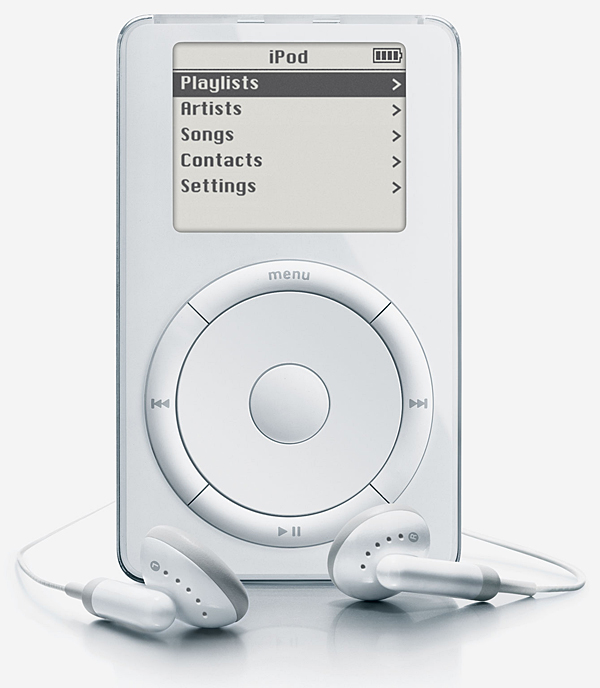
The iPod is a product of Apple's industrial design department, headed by Jonathan Ives, which means it is very clean and contemporary. The back of the iPod is shiny stainless steel, while the front is bright white plastic. ("White's this year's black," a fashionista of my acquaintance assures me.) The face is dominated by three features: a 1 5/8" by 1¼" (2" diagonal, in TVspeak) backlit LCD display sits above a row of four touch-sensitive control "buttons" (Previous Track, Menu, Play/Pause, Skip Forward), which, in turn, lies above a large touch-sensitive "wheel" that is actually a multifunction control: the outer ring controls volume and navigates through menu choices, while the inner "button" serves as an Enter key. What's surprising is how flexible and intuitive this seemingly rudimentary control array is in operation. Press Play and the iPod powers on, playing where it left off. Tap Menu and you're given several programming choices. The navigation wheel lets you highlight your choice, and a tap on the enter key takes you to that menu. Use the wheel to choose the option you want, tap enter, and you're there: a new playlist or a new song. All of this can be accomplished one-handed, while running. The iPod's thin top edge has a 1/8" stereo headphone jack with an adjacent oval slot for anchoring the wired remote (added because users of Gen 1 and 2 iPods complained that the remote disconnected from the chassis too readily), and a sliding panel that activates the hold function for the controls. I found the touch-sensitive control extremely sensitive, so disabling it with the hold function proved a lifesaver.
The thin bottom edge contains the jack for the 32-pin dock connector (interestingly, FireWire uses only six pins—this may represent some sort of future-proofing on Apple's part). In addition to carrying data at 400Mbps, this cable also recharges the iPod's internal lithium-ion battery. Assuming you turn off all "frivolous" functions such as backlighting and EQ, don't skip forward and back much, and use the iPod only in moderate temperatures (50-95 degrees F), the battery will last eight hours. Otherwise, reckon on about six hours. That cable dock in the iPod's base will fit either the cable or the docking cradle. The iPod slips into the docking cradle, fitting over the cradle's male 32-pin connector, leaning back at a 30 degrees angle (so you can read its display when it's sitting on your desktop). The FireWire-to-iPod cable connects to the back of the docking cradle, but that's not the cradle's only connection. Next to the 32-pin jack is a line-out stereo miniplug jack, an important option for audiophiles since it bypasses the iPod's volume control. The FireWire-to-32-pin cable can be plugged either directly into an Apple computer (for data transfer and recharging) or to the iPod's power adapter (recharge only). All iPods ship with a pair of earbud-type headphones with 18mm neodymium-powered drivers. These have surprisingly good sound—at least compared to the phones included with most portable players. A pair of low-impedance Etymotic ER-4Ps ($330) offered much better sound and isolation from environmental noise, but that's a subject for another review.
The person who said "Beauty is only skin deep" certainly never popped the cover off an iPod. The design is just as jewel-like inside as out—packed, but definitely a gem of space conservation.
What an astoundingly acute observer of the human condition Stereophile's editor proved to be! Of course, there were guys walking around with 'em (many wearing "Think Different!" T-shirts), but the streets were filled with fashionably dressed young women brandishing iPods as though they were this season's trendiest little Manolo Blahnik sling-back. Holy cow! I'm running with the fashionistas! Can I still be an audiophile, too? What did you see when you were there? Apple's third-generation iPods are smaller, sleeker, more capacious than earlier models. The G3 is available with a 10GB, 15GB, or 30GB hard drive. [A 40GB drive is now available.—Ed.] The 30GB version is slightly larger and heavier than the other two, at 4.1" H by 2.4" W by 0.73" D and 6.2oz (compared to 0.62" D and 5.6oz). Our review sample was the 30GB model, which includes several accessories that buyers of the 10GB version have to buy separately: a docking cradle, a wired remote, and a carrying case of elastic and leather. A FireWire connecting cable is standard (it sports an extremely thin "dock connector" on the end that attaches to the iPod, since the iPod itself is too thin to accommodate a standard IEEE1394 plug.) The iPod can connect to a PC through a special 32-pin-to-USB-2.0+FireWire cable. The bifurcated cable has a 32-pin plug on one end, then splits into two cables: one with a USB plug for connection to the computer, the other terminating in a FireWire connector, which plugs into the iPod's power adapter so you can charge the battery.