The Rega Couple interconnect ($150/1m pair) comes in a plastic pouch rather like a Ziploc veggie bag—just the pouch and a printed card. How much could the packaging cost? Ten cents?
This, in a nutshell, is why I like Rega: They spend the money on the product, not the packaging. No hype. Rega products have no frills or frivolous features. There's no over-designing in order to overcharge. Simpler is better—better sound, greater reliability.
 I like Rega for another reason. While some British companies—Meridian, Linn, Naim—have marched steadily upmarket, Rega has remained steadfastly in the middle. While never the cheapest, Rega products are hard to top in terms of value for money.
Veggie bag notwithstanding, the Rega Couple is an excellent interconnect made with Klotz low-capacitance wire and Neutrik connectors (both from Germany). I keep wanting to call it the Klutz cable.
A bit of history: Rega began in 1973, producing the Planet turntable. The Planar 3 'table was introduced in 1977, followed by the Planar 2. A quarter century and several updates later, both 'tables are still in production.
In 1989, Rega began making speakers, and in 1991 introduced their first integrated amplifier. Among major British hi-fi manufacturers, Rega was the last to recognize the CD, introducing their original Planet CD player (same name as their first turntable) in 1997...
At $950, the Rega Mira integrated amplifier matches Rega's Planet 2000 in size, styling, and price. Same Swiss case—smooth as a fine watch. Rega really has improved the fit and finish of their electronics: outstanding without being ostentatious. Good taste, dammit!
The Mira is small and weighs only about 14 lbs, but it looks, feels, and sounds very solidly made—it's a little brick. It's remote-controlled, of course—almost all integrateds are nowadays. Couch potatoes (like me), rejoice. Four line-level inputs, a tape loop, and a moving-magnet phono stage are standard equipment. (The phono input can also accommodate a high-output moving-coil cartridge.)
There are two pair of RCA jacks for preamp out and power amp in, in case you go for biamping later on. Rega says the Mira's preamp section can drive at least five power amplifiers. Not in my house, it won't! Gad, I want to simplify. An internal switch links the preamp and power-amp sections.
This is a purist integrated: no tone controls, no balance control, no speaker selector switch (there are outputs for only one pair of speakers), and no headphone output.
Two quirks: When you use the remote to adjust volume, the volume changes very fast—a tad too fast, I thought. For fine volume adjustments, Rega suggests you use the volume-control knob on the unit itself, which adjusts the volume very slowly. Another peculiarity is that the volume-control knob doubles as a source-selector switch. Push in the knob to changes sources, push it again to adjust volume. Odd, yes, but easy to get the hang of.
Power output is specified as 61Wpc into 8 ohms and 91Wpc into 4 ohms, but Rega's Phil Freeman says that's conservative. I quote from the owner's manual: "The Mira amplifier is capable of driving all normal hi-fi loudspeakers. (Most loudspeakers have a nominal impedance of 8 ohms.)"
In the UK, maybe. Phil Freeman told me the Mira should have no problem driving most nominal 4-ohm speakers. The only thing you might notice, he said, is that the amplifier might run a little warmer because it has to work harder. (In case you hadn't noticed, all amplifiers run warmer into lower impedances.)
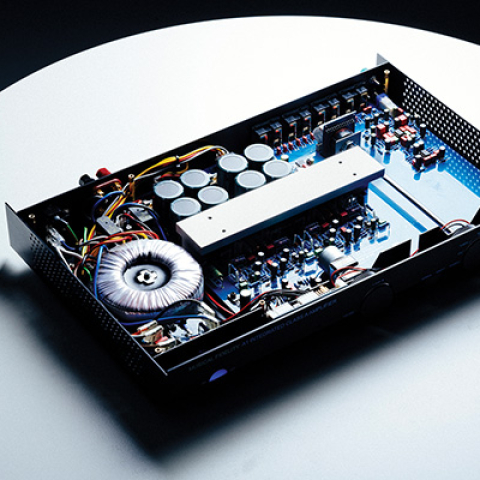
The Mira uses parts not normally found in modestly priced gear, including Evox polypropylene caps, a large toroidal power-supply transformer, and a high-quality Alps volume pot. The output transistors (one pair per channel) are Sanken. Rega feels these Japanese bipolars are the best they can buy.
I played around a lot with the Mira, mostly using it with the Planet, but also with the Denon DCD-1650 into my MSB Link DAC III with upsampling and Power Base option. [Then importer] Steve Lauerman wanted me to review the entire Rega system, but mixing and matching was much more fun and allowed me to more fully appreciate the Mira, which is aptly named: it's something of a small miracle.
Sorry to be repetitive, but the Mira was warm, rich, full-bodied, with lots of dynamic drive, and very smooth and sweet through the midrange, with no grain. Gad, I loved it. I think I'd buy this in a flash if I heard it in a dealer's showroom—unless the dealer also demoed the Creek 5350SE (reviewed in March 2001 by Bob Reina), in which case I'd be in a quandary. And the phono stage was killer, considering the price of the amp: excellent detail, great dynamics. No, it's not the best you can buy. You could get an even bigger soundstage, more resolution, blah blah blah—but you'd probably have to pay more for the phono stage than you would for the entire Mira amp.
Up the Creek
I like Rega for another reason. While some British companies—Meridian, Linn, Naim—have marched steadily upmarket, Rega has remained steadfastly in the middle. While never the cheapest, Rega products are hard to top in terms of value for money.
Veggie bag notwithstanding, the Rega Couple is an excellent interconnect made with Klotz low-capacitance wire and Neutrik connectors (both from Germany). I keep wanting to call it the Klutz cable.
A bit of history: Rega began in 1973, producing the Planet turntable. The Planar 3 'table was introduced in 1977, followed by the Planar 2. A quarter century and several updates later, both 'tables are still in production.
In 1989, Rega began making speakers, and in 1991 introduced their first integrated amplifier. Among major British hi-fi manufacturers, Rega was the last to recognize the CD, introducing their original Planet CD player (same name as their first turntable) in 1997...
At $950, the Rega Mira integrated amplifier matches Rega's Planet 2000 in size, styling, and price. Same Swiss case—smooth as a fine watch. Rega really has improved the fit and finish of their electronics: outstanding without being ostentatious. Good taste, dammit!
The Mira is small and weighs only about 14 lbs, but it looks, feels, and sounds very solidly made—it's a little brick. It's remote-controlled, of course—almost all integrateds are nowadays. Couch potatoes (like me), rejoice. Four line-level inputs, a tape loop, and a moving-magnet phono stage are standard equipment. (The phono input can also accommodate a high-output moving-coil cartridge.)
There are two pair of RCA jacks for preamp out and power amp in, in case you go for biamping later on. Rega says the Mira's preamp section can drive at least five power amplifiers. Not in my house, it won't! Gad, I want to simplify. An internal switch links the preamp and power-amp sections.
This is a purist integrated: no tone controls, no balance control, no speaker selector switch (there are outputs for only one pair of speakers), and no headphone output.
Two quirks: When you use the remote to adjust volume, the volume changes very fast—a tad too fast, I thought. For fine volume adjustments, Rega suggests you use the volume-control knob on the unit itself, which adjusts the volume very slowly. Another peculiarity is that the volume-control knob doubles as a source-selector switch. Push in the knob to changes sources, push it again to adjust volume. Odd, yes, but easy to get the hang of.
Power output is specified as 61Wpc into 8 ohms and 91Wpc into 4 ohms, but Rega's Phil Freeman says that's conservative. I quote from the owner's manual: "The Mira amplifier is capable of driving all normal hi-fi loudspeakers. (Most loudspeakers have a nominal impedance of 8 ohms.)"
In the UK, maybe. Phil Freeman told me the Mira should have no problem driving most nominal 4-ohm speakers. The only thing you might notice, he said, is that the amplifier might run a little warmer because it has to work harder. (In case you hadn't noticed, all amplifiers run warmer into lower impedances.)
The Mira uses parts not normally found in modestly priced gear, including Evox polypropylene caps, a large toroidal power-supply transformer, and a high-quality Alps volume pot. The output transistors (one pair per channel) are Sanken. Rega feels these Japanese bipolars are the best they can buy.
I played around a lot with the Mira, mostly using it with the Planet, but also with the Denon DCD-1650 into my MSB Link DAC III with upsampling and Power Base option. [Then importer] Steve Lauerman wanted me to review the entire Rega system, but mixing and matching was much more fun and allowed me to more fully appreciate the Mira, which is aptly named: it's something of a small miracle.
Sorry to be repetitive, but the Mira was warm, rich, full-bodied, with lots of dynamic drive, and very smooth and sweet through the midrange, with no grain. Gad, I loved it. I think I'd buy this in a flash if I heard it in a dealer's showroom—unless the dealer also demoed the Creek 5350SE (reviewed in March 2001 by Bob Reina), in which case I'd be in a quandary. And the phono stage was killer, considering the price of the amp: excellent detail, great dynamics. No, it's not the best you can buy. You could get an even bigger soundstage, more resolution, blah blah blah—but you'd probably have to pay more for the phono stage than you would for the entire Mira amp.
Up the Creek
Roy Hall finally delivered the Creek 5350SE—after giving Bob Reina an "exclusive" head start over his "friend" Sam! So the first thing I did was compare the Rega and the Creek integrateds, using the Triangle Antal XS, B&W CDM9, and Rega Jura speakers. The Mira was richer, riper, warmer, with good resolution of low-level detail. No solid-state sterility here! The Creek 5350SE struck me as even more transparent—also more open-sounding, with a leaner presentation overall. Both amps got a tight grip on the bass. (I love bottom ends. Ask Marina!)
I could live happily with the Rega or the Creek; much would depend on my choice of speakers and my sonic priorities—and my finances. The Creek 5350SE costs $1495, plus $95 for the optional moving-magnet phono stage.
Of course, I got my revenge on Roy Hall for giving Reina the first 5350SE—I called Hall and went on at length about how much I was enjoying the Mira. Boy, was he riled. It's a wonder I have any friends at all.
While I ended up buying the Creek in order to practice what I preach (simplify!), you might prefer the Mira. I could, and did, adjust my ears happily to both integrateds.
The Mira is a great integrated amp—one of the finest I've auditioned to date. Do you need more than a Rega Mira or a Creek 5350SE to enjoy your music? I'm not sure I do; the Creek will be my reference amp in our living room.
Affordable gear has never been as good as it is now.
I like Rega for another reason. While some British companies—Meridian, Linn, Naim—have marched steadily upmarket, Rega has remained steadfastly in the middle. While never the cheapest, Rega products are hard to top in terms of value for money.
Roy Hall finally delivered the Creek 5350SE—after giving Bob Reina an "exclusive" head start over his "friend" Sam! So the first thing I did was compare the Rega and the Creek integrateds, using the Triangle Antal XS, B&W CDM9, and Rega Jura speakers. The Mira was richer, riper, warmer, with good resolution of low-level detail. No solid-state sterility here! The Creek 5350SE struck me as even more transparent—also more open-sounding, with a leaner presentation overall. Both amps got a tight grip on the bass. (I love bottom ends. Ask Marina!)