You'd think I'd be used to Charlie Hansen by now. After all, I've been speaking to Ayre Acoustics' renaissance man for a decade, having first encountered him when I was trying to arrange the review of Ayre's 100Wpc V-3 power amplifier that was published in the August 1996 Stereophile (Vol.19 No.8). I thought the V-3 was impressive.
 Then I met Hansen. In person, Hansen resembles nothing so much as Mr. Mxyztplk, the mischievous imp from the fifth dimension in the Superman comics—and, like that little pixie, Hansen tends to chortle maniacally as he throws out his barbed observations.
The trick to dealing with Charlie Hansen, however, is to never assume that he's kidding. When he says something that really seems too silly to be true, he's almost certainly not fooling around.
Like when he told me, the day before the 2005 Consumer Electronics Show, that Ayre's new C-5xe universal disc player ($5995) was the best thing I'd hear at the show. That wasn't brag, it was true. But the C-5xe was a typical Hansen product in that it ignored conventional wisdom—in this case, that universal means multichannel.
"That's just marketing BS," Hansen said. "If you're a high-end company and you make a high-resolution player, it has to offer better sound—and that means better two-channel sound. Who cares about what's happening behind you?"
The purpose of genius...is to ask new questions
Then I met Hansen. In person, Hansen resembles nothing so much as Mr. Mxyztplk, the mischievous imp from the fifth dimension in the Superman comics—and, like that little pixie, Hansen tends to chortle maniacally as he throws out his barbed observations.
The trick to dealing with Charlie Hansen, however, is to never assume that he's kidding. When he says something that really seems too silly to be true, he's almost certainly not fooling around.
Like when he told me, the day before the 2005 Consumer Electronics Show, that Ayre's new C-5xe universal disc player ($5995) was the best thing I'd hear at the show. That wasn't brag, it was true. But the C-5xe was a typical Hansen product in that it ignored conventional wisdom—in this case, that universal means multichannel.
"That's just marketing BS," Hansen said. "If you're a high-end company and you make a high-resolution player, it has to offer better sound—and that means better two-channel sound. Who cares about what's happening behind you?"
The purpose of genius...is to ask new questions
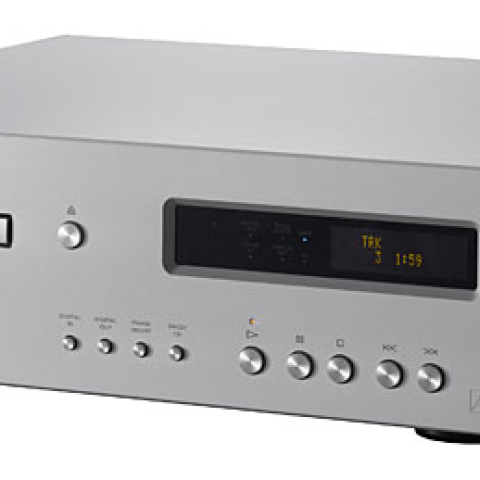
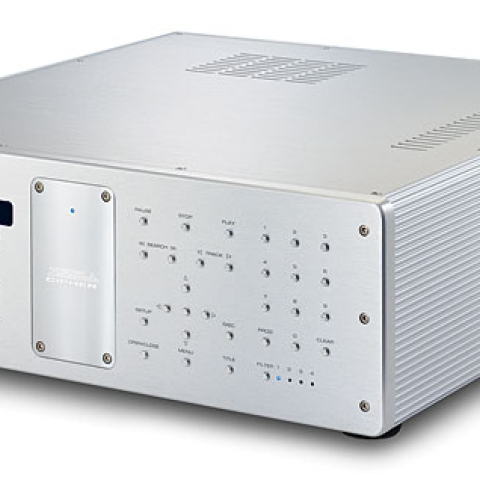
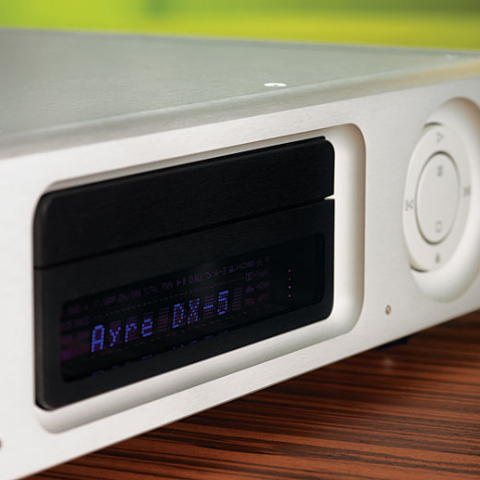
The C-5xe is an impressive hunk of audio jewelry. It sports a 5/8" aluminum front panel, and the rest of it isn't much less substantial. A large, centrally located display is housed, along with the disc drawer, in the center of the faceplate, while an inset control wheel sits to its right—an outer ring accesses play, skip forward and back, and open/close; the inner button controls stop and pause. (In DVD mode, the skip forward and back commands allow you to navigate the menu options without resorting to an external display—sort of.)
The front-panel display is impressive and conveys a lot of information, such as whether the C-5xe is playing a track with 44.1kHz, 48kHz, 88.2kHz, 96kHz, 176.4kHz, 192kHz, DSD, DTS, or Dolby Digital data. Additional lights indicate DVD-Video chapter numbers, DVD-Audio group numbers, or CD, SACD, or DVD-V track numbers. An indicator labeled V-Part lights up when you play tracks with video content. There are also indicators for Play, Pause, and other disc information—and my favorite, Display Off.
The rear panel is a much simpler affair, boasting an AES-EBU digital audio out (Ayre can supply an adapter if you require an S/PDIF connection), single-ended RCA outputs, balanced XLR connectors (pin 2 hot), a control port, and an IEC AC input plug.
There are, however, two nonstandard switches on the rear panel. One switches between the IR remote control and command port inputs, such as Creston or AMX systems. Actually, this also controls the digital filters, allowing consumers to choose between two algorithms—one labeled DF Measure, which Ayre says produces greater accuracy in the frequency domain, and the other, labeled DF Listen, which Ayre says is more accurate in the time domain. (I used both, but settled on DF Listen for my auditioning.) The other switch turns off the digital output when the analog outs are being used.
The owner's manual doesn't list much in the way of specifications, other than maximum output levels for balanced and single-ended in PCM and DSD modes (there's a 6dB difference between PCM and DSD), XLR output polarity, output impedance (balanced and SE), power consumption, dimensions, and weight. It does list various "frequency responses" that are tied to sampling rates, but these are given without reference limits. They do all go down to DC, for what that's worth.
So I called Hansen for elucidation and a technical description of the C-5xe. He cackled. "Specs? I don't know what the hell they are...let me look in the owner's manual. Oh! I can tell you what its dimension are, so you can figure out whether or not it will fit on your shelf. We don't do much with specs, because specs have very little to do with how the thing sounds."
Actually, Charlie, I just want the audio porn. Tell me about the C-5xe's naughty bits.
That's when he got down to business and gave me the facts, Jack—faster than I could transcribe them. Fortunately, my Panasonic microcassette recorder was on.
"We're using a Pioneer universal transport and a Burr-Brown DSD1792 DAC chip, which has outstanding performance specifications, as well as a current output, which allows us to use our own discrete current-to-voltage converter for better sound quality. The SACD decoder is the Sony CXD2753R.
"We use only linear [nonswitching] power supplies. There are two separate transformers: one for the transport and decoder, which has four separate windings feeding eight separate regulators; the other is for the DAC and audio circuitry, featuring two separate windings and 14 separate regulators. As usual with Ayre, the clock, DAC, and audio-circuitry regulators are all fully discrete, zero-feedback, custom components.
"The DSD1792 DAC chip processes each format in its native state, whether PCM or DSD. The output of the DAC chip feeds the same analog circuitry for all formats. And you may have noticed that the maximum output level is different in PCM and DSD."
That, at least, is in the owner's manual.
"Well, the reason for the output difference is that the DSD1792 DAC has more than one built-in filter. For example, on DSD, it actually has four different filters. We listened to them all, and the best-sounding one has a lower output level than PCM. [cackles] We were torn: Should we use the best-sounding one and have people carp at us about having lower output level on DSD, or should we try to keep it all the same?"
I bet that was a hard decision. [snort]
"Well, you'd be surprised. People call us up and complain about the weirdest things.
"Basically, there's the two operating modes. There's the PCM mode and there's SACD. When you play an SACD, it works in the native DSD, it doesn't convert the signal. There's nothing happening there, except your basic purity approach. The only thing unusual happening there is the clock, because one of the problems with the universal players is that you have two clocks you have to deal with, one for the 44.1kHz sample rate and one for the 48kHz sample rate.
"We designed our own clocks, which are as low-jitter as we can make 'em—we don't use any canned modules or off-the-shelf solutions, we make our own from scratch. Then we turn off the unused clock, so you don't get any interference, modulation, or crosstalk from the clock that's not being used. We just shut it off completely.
"I suppose, if we're talking about audio porn, I should explain why we use the Pioneer transport. You don't have a lot of choices when it comes to universal transports—there are exactly four: Pioneer, Denon, Yamaha, and Linn. We chose the Pioneer because it's really a native universal transport, it works really well, and it has an acceptable user interface. Also, Pioneer does a great job of supporting its transports with replacement parts.
"That is not an insignificant consideration. If you design a product that is built around that part, you might have to mortgage your company to buy enough of the part to keep making the product, and to take care of your customers who trusted you enough to buy it in the first place. Do you buy 5000 transports and stick 'em in the warehouse so you can keep that product going for five years?"
Is that what you did?
"Well, we're putting that off for as long as we conscionably can! But that is what we did with the D-1X—we had to go to the bank, and what I did was put my house on the line to secure the loan.
"Right now, the C-5xe's transport is still in production, but you just can't get a straight answer on how much longer that will be the case. I think it's important to be able to keep a product going, to be able to upgrade it, to be able to support it. If you don't want to do all that, make mass-market disposable stuff—just don't charge a lot for it and pretend it's high-end, because that's not what the High End is supposed to be about."
Genius is an infinite capacity for taking pains
Usually, when it comes to discussing system setup, there's not a lot to say, but with the Ayre C-5xe, little things meant a lot. First, Ayre insisted on sending an entire Ayre-approved system, including an Ayre K-5xe preamp, Ayre V-5xe power amp (which I had previously reviewed elsewhere), and Cardas cables and AC cords. I also had on hand the Conrad-Johnson ACT2, the Coda S5, and the Shunyata cables I've been using in my reference system, as well as the Canton Vento 802DC, Dynaudio Special 25, and Thiel CS1.6 loudspeakers I've used successfully in systems past. Late in the review cycle, John Atkinson dropped by the Linn Unidisk SC Art Dudley had reviewed in June, so I could have another universal player for comparison.
Then I met Hansen. In person, Hansen resembles nothing so much as Mr. Mxyztplk, the mischievous imp from the fifth dimension in the Superman comics—and, like that little pixie, Hansen tends to chortle maniacally as he throws out his barbed observations.
The trick to dealing with Charlie Hansen, however, is to never assume that he's kidding. When he says something that really seems too silly to be true, he's almost certainly not fooling around.
The C-5xe is an impressive hunk of audio jewelry. It sports a 5/8" aluminum front panel, and the rest of it isn't much less substantial. A large, centrally located display is housed, along with the disc drawer, in the center of the faceplate, while an inset control wheel sits to its right—an outer ring accesses play, skip forward and back, and open/close; the inner button controls stop and pause. (In DVD mode, the skip forward and back commands allow you to navigate the menu options without resorting to an external display—sort of.)
Usually, when it comes to discussing system setup, there's not a lot to say, but with the Ayre C-5xe, little things meant a lot. First, Ayre insisted on sending an entire Ayre-approved system, including an Ayre K-5xe preamp, Ayre V-5xe power amp (which I had previously reviewed elsewhere), and Cardas cables and AC cords. I also had on hand the Conrad-Johnson ACT2, the Coda S5, and the Shunyata cables I've been using in my reference system, as well as the Canton Vento 802DC, Dynaudio Special 25, and Thiel CS1.6 loudspeakers I've used successfully in systems past. Late in the review cycle, John Atkinson dropped by the Linn Unidisk SC Art Dudley had reviewed in June, so I could have another universal player for comparison.