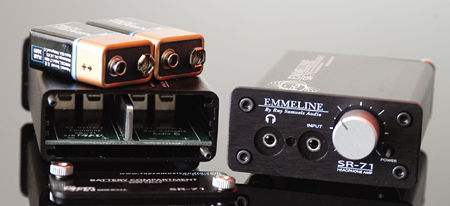
The Emmeline SR-71 portable headphone amplifier ($395) is small but not light. Housed in an extruded-aluminum chassis with a bolt-on faceplate and a rear panel and battery cover that attaches with a thumb-screw, it measures 3.5" by 2.5" by 1.5" and weighs 11oz. That sounds light, especially compared to some of the headphone amps I've carted around in the past—not to mention their four–D-cell extended power supplies—but in the iPod era, it's the portable equivalent of a class-A power amp. So why would anybody be willing to lug it around?
Because the SR-71 is the portable equivalent of a class-A power amp. Besides, the darn thing is addictive.
I'm confessing a confession
If you're not familiar with Ray Samuels Audio's naming strategy, it can be a tad confusing—every RSA product is called the Emmeline something or other. "That's because all of my products have to be good enough to bear the name of my beautiful daughter," Ray Samuels explained. "And then I name each of them after an airplane, because I worked in the aviation industry for so many years." Hence, this portable amp is the Emmeline SR-71, in a nod to the US Air Force's iconic, blisteringly fast reconnaissance plane.
 The Emmeline SR-71 is a dual-mono design that uses op-amps for its 6dB gain stage and has a buffered output stage that delivers, Samuels says, 250mA, which pretty much drives any headphone you might consider wearing in public. Because the SR-71 is tiny, its signal paths are short—always a good thing. Parts quality is high: double-sided FR4 mil-spec PC boards with oxygen-free copper traces, 1% Vishay surface-mount resistors, and tantalum and film capacitors in the power supply. What's that? You want to know which op-amp Samuels is using? He isn't saying—and he's erased the parts ID and painted the chip red to keep it a secret.
The rear panel unscrews with thumb wheels, to allow you to drop in two 9V batteries. The faceplate sports two 1/8" stereo minijacks (signal input and headphone, of course), a volume knob (connected to a sweet-sounding pot), and a power switch. Battery life is around 40 hours for conventional cells, 60 for alkaline-plus batteries. Late in the review process I found a source of inexpensive 9V lithium cells, which cost more or less the same as the alkaline pluses but offer about 200 hours of use (or so I'm told—I have only about 100 hours on them and they're still going strong).
My heart's in a pickle, it's constantly fickle
The Emmeline SR-71 is a dual-mono design that uses op-amps for its 6dB gain stage and has a buffered output stage that delivers, Samuels says, 250mA, which pretty much drives any headphone you might consider wearing in public. Because the SR-71 is tiny, its signal paths are short—always a good thing. Parts quality is high: double-sided FR4 mil-spec PC boards with oxygen-free copper traces, 1% Vishay surface-mount resistors, and tantalum and film capacitors in the power supply. What's that? You want to know which op-amp Samuels is using? He isn't saying—and he's erased the parts ID and painted the chip red to keep it a secret.
The rear panel unscrews with thumb wheels, to allow you to drop in two 9V batteries. The faceplate sports two 1/8" stereo minijacks (signal input and headphone, of course), a volume knob (connected to a sweet-sounding pot), and a power switch. Battery life is around 40 hours for conventional cells, 60 for alkaline-plus batteries. Late in the review process I found a source of inexpensive 9V lithium cells, which cost more or less the same as the alkaline pluses but offer about 200 hours of use (or so I'm told—I have only about 100 hours on them and they're still going strong).
My heart's in a pickle, it's constantly fickle
If you want a portable headphone amplifier to take to the gym, slip into your cycling jersey, or tote along on your 10km runs, the SR-71 probably isn't what you're looking for—it's a bit too bulky to easily slip into your running shorts. No, it's "portable" in the sense that it can fit into your briefcase or travel bag along with your iPod, sunglasses, and PDA. In fact, think of your PDA as your litmus test—if you're traveling too light to take your Palm Pilot, you won't want to carry your SR-71.
On the other hand, the '71 turned out to be good enough to use with my big rig, so I've used it around the house, both in my main review system and in the bedroom, when I've needed to listen to music and audiobooks after my wife has fallen asleep. I've never established a bedside headphone station before, but when a headphone amp weighs only 11oz and doesn't require an AC cord, you can improvise as needed.
There's another reason I was willing to invent new uses for the SR-71: It sounded good—really good. A $400 headphone amp ought to sound good, of course, but I fell into the trap of thinking of the SR-71 as a portable audio product and was delighted to discover that it's just plain great. Still, the first question remains: How good is it as a portable?
Mighty darn fine—grin-like-an-idiot fine, not to put too fine a point on it. I connected it to my iPod Mini with a Cardas 6" mini-to-mini connector, plugged in my beloved Etymotic ER-6S headphones, with their 48 ohm imopedance, and fell completely into the pixilated world of Gong's You (CD, EMI 66552-2). I was plunged into the tale of Zero the hero as he journeyed through Planet Gong to the other side of the sky and . . . well, I guess you had to be there. But whether or not I can take you there, the SR-71 took me there, plunging me deep into Gong's swirling, trippy world, complete with synth washes, pixie voices, Mike Howlett's bass guitar, and Steve Hillage's incisive guitar histrionics. Ohhh yeahhhh.
If you think that iPods and other portables have to have tinny, disembodied sounds, you haven't heard uncompressed AIFF files played through a big rig—or the SR-71. With the Emmeline portable amp and relatively flat headphones, such as the Etymotics or the AKG K-501s, music took on body and a detailed individuality that the portable player palpably lacked on its own. The SR-71 revealed just how good bass response can be with headphones. Music regained much of the bloom and physical impressiveness that it has when reproduced through full-range loudspeakers.
The SR-71 also enchanted me with its unhyped midrange. Taut bass lines sucked me in initially, but the amp had a way with voices that kept me listening, hour after hour. Take Grey De Lisle's The Graceful Ghost (CD, Sugar Hill SUG-CD 3985), which has an analog warmth that enhances De Lisle's crystalline soprano. Without the SR-71, my Mini delivered the uncompressed AIFF vocal files with clarity but without incisive detail; the Ray Samuels amp restored De Lisle's breathy, silvery luster.
I then pulled out my trusty old HeadRoom Supreme (discontinued but still available from www.headphone.com for $359), which in 1993 represented the state of the art of portable headphone amplification. The Supreme didn't have quite the SR-71's bottom-end warmth and punch, but the big shock was how much brighter and grainier the Supreme sounded. What a difference a dozen years can make—and the '71 is smaller and lighter to boot. It'll be interesting to try the same comparison with HeadRoom's new Micro (stay tuned).
When I can't fondle the hand I'm fond of, I fondle the hand at hand
Although Ray Samuels designed the SR-71 to work as a portable, he insists that its performance puts it in the same league as dedicated home headphone amps, such as his own Emmeline HR-2 ($875). Encouraged by him, I connected the SR-71 to a Musical Fidelity combo of X-3V3 CD player and X-DACV3 D/A converter, with an Audience Au24 mini-phone-plug-to-stereo-RCA cable. The first disc I auditioned was Keith Jarrett's Radiance (CD, ECM 1960/61), which was, in many ways, a revelation. The piano sound was clear and crisp, with superb attack and richly delineated decay trailing each note. Once again, I was drawn completely into the performance. Then I heard a raspy noise—a discharging capacitor? a momentary short? It repeated—and again. No, I suddenly realized, it wasn't the SR-71, it was Jarrett, quietly (well, not that quietly) moaning and grunting along with his playing. It's been a long time since Jarrett last recorded a solo-piano disc; I'd fallen out of the habit of ignoring his vocal accompaniment.
Perhaps you'd rather not listen to Jarrett vocalize, but it is on the recording, and the SR-71 delivered it as distinctly separate from the sound of the piano. In other words, the amp got the details right, which is its job.
Ray Samuels was right to insist that I connect the SR-71 to high-end separates. The same qualities that make it a great portable amp served it well in my house—including its dual-mono nature, which gave it great channel separation, and its independence from the AC grid, which rendered it as quiet as a tomb.
And it sure wasn't wimpy. Connected to the Musical Fidelity player-DAC combo, it delivered Jarrett's muscular abstractions with all the power and punch that he has in concert—and that's saying a lot.
Against the X-Can
As I already had the SR-71 connected to the Musical Fidelity components, it seemed a good idea to compare it to MF's X-CanV3 headphone amp, which Sam Tellig reviewed in the December 2004 issue and which has become my in-home reference. At $449, the X-Can is only slightly more expensive than the SR-71, and boasts both a ¼" headphone jack and RCA inputs and feed-through. On the Jarrett disc, the X-CanV3 matched the SR-71's taut bass impact and crystalline attacks. Actually, the X-CanV3 had a bit more bass extension, but the biggest difference was that the MF allowed me to hear more of the way the piano notes leapt into the hall's ambience. It wasn't simply that there was more ambience, but that the hall sound and the sound of the notes within that hall sound were more intertwined with one another. That's likely just a convoluted way of saying that the SR-71 probably lost some of that complex detail—edited it out, you might say. Another difference between the two amps was that the Musical Fidelity was more comfortable driving my combo of Sennheiser HD-600 headphones and Stefan Audio Arts Equinox cable. The SR-71 could drive the HD-600s, but not to the highest levels I wished, whereas the X-CanV3 achieved volumes that were far greater than was good for my hearing. It's not that I want to deafen myself, but there are times when you need that little bit extra, whether you're monitoring a recording project or just getting stupid with Steve Hillage's Strat-strangling.
As with most things in life, which headphone amp is best almost certainly depends on what you need it to do. If you're going to be listening through Sennheiser HD-600s or HD-650s (or AKG-1000s, for that matter) and you're going to be listening at home, the X-CanV3 remains hard to beat.
When I'm not facing the face that I fancy, I fancy the face I face
However, while I do listen at home, and do listen a lot through HD-series Sennheisers, I frequently find myself listening on the road, or in other rooms of my house. Having a headphone amplifier of extremely high quality that I can slip into my shirt pocket and take where I need it is a real plus. What makes it even better is that the SR-71 sounds so very good, in addition to being easy to carry. I have yet to hear a portable headphone amp that sounds as good as Ray Samuels' little wonder. There's a place for a headphone amp that's as well made and easy to listen to as the Ray Samuels Audio Emmeline SR-71, and that place is wherever I happen to be. That makes it a whole lot better than a "better" headphone amp that's where I can't use it.
If you're not familiar with Ray Samuels Audio's naming strategy, it can be a tad confusing—every RSA product is called the Emmeline something or other. "That's because all of my products have to be good enough to bear the name of my beautiful daughter," Ray Samuels explained. "And then I name each of them after an airplane, because I worked in the aviation industry for so many years." Hence, this portable amp is the Emmeline SR-71, in a nod to the US Air Force's iconic, blisteringly fast reconnaissance plane.
The Emmeline SR-71 is a dual-mono design that uses op-amps for its 6dB gain stage and has a buffered output stage that delivers, Samuels says, 250mA, which pretty much drives any headphone you might consider wearing in public. Because the SR-71 is tiny, its signal paths are short—always a good thing. Parts quality is high: double-sided FR4 mil-spec PC boards with oxygen-free copper traces, 1% Vishay surface-mount resistors, and tantalum and film capacitors in the power supply. What's that? You want to know which op-amp Samuels is using? He isn't saying—and he's erased the parts ID and painted the chip red to keep it a secret.
The rear panel unscrews with thumb wheels, to allow you to drop in two 9V batteries. The faceplate sports two 1/8" stereo minijacks (signal input and headphone, of course), a volume knob (connected to a sweet-sounding pot), and a power switch. Battery life is around 40 hours for conventional cells, 60 for alkaline-plus batteries. Late in the review process I found a source of inexpensive 9V lithium cells, which cost more or less the same as the alkaline pluses but offer about 200 hours of use (or so I'm told—I have only about 100 hours on them and they're still going strong).
My heart's in a pickle, it's constantly fickle
If you want a portable headphone amplifier to take to the gym, slip into your cycling jersey, or tote along on your 10km runs, the SR-71 probably isn't what you're looking for—it's a bit too bulky to easily slip into your running shorts. No, it's "portable" in the sense that it can fit into your briefcase or travel bag along with your iPod, sunglasses, and PDA. In fact, think of your PDA as your litmus test—if you're traveling too light to take your Palm Pilot, you won't want to carry your SR-71.
Although Ray Samuels designed the SR-71 to work as a portable, he insists that its performance puts it in the same league as dedicated home headphone amps, such as his own Emmeline HR-2 ($875). Encouraged by him, I connected the SR-71 to a Musical Fidelity combo of X-3V3 CD player and X-DACV3 D/A converter, with an Audience Au24 mini-phone-plug-to-stereo-RCA cable. The first disc I auditioned was Keith Jarrett's Radiance (CD, ECM 1960/61), which was, in many ways, a revelation. The piano sound was clear and crisp, with superb attack and richly delineated decay trailing each note. Once again, I was drawn completely into the performance. Then I heard a raspy noise—a discharging capacitor? a momentary short? It repeated—and again. No, I suddenly realized, it wasn't the SR-71, it was Jarrett, quietly (well, not that quietly) moaning and grunting along with his playing. It's been a long time since Jarrett last recorded a solo-piano disc; I'd fallen out of the habit of ignoring his vocal accompaniment.
As I already had the SR-71 connected to the Musical Fidelity components, it seemed a good idea to compare it to MF's X-CanV3 headphone amp, which Sam Tellig reviewed in the December 2004 issue and which has become my in-home reference. At $449, the X-Can is only slightly more expensive than the SR-71, and boasts both a ¼" headphone jack and RCA inputs and feed-through. On the Jarrett disc, the X-CanV3 matched the SR-71's taut bass impact and crystalline attacks. Actually, the X-CanV3 had a bit more bass extension, but the biggest difference was that the MF allowed me to hear more of the way the piano notes leapt into the hall's ambience. It wasn't simply that there was more ambience, but that the hall sound and the sound of the notes within that hall sound were more intertwined with one another. That's likely just a convoluted way of saying that the SR-71 probably lost some of that complex detail—edited it out, you might say. Another difference between the two amps was that the Musical Fidelity was more comfortable driving my combo of Sennheiser HD-600 headphones and Stefan Audio Arts Equinox cable. The SR-71 could drive the HD-600s, but not to the highest levels I wished, whereas the X-CanV3 achieved volumes that were far greater than was good for my hearing. It's not that I want to deafen myself, but there are times when you need that little bit extra, whether you're monitoring a recording project or just getting stupid with Steve Hillage's Strat-strangling.
However, while I do listen at home, and do listen a lot through HD-series Sennheisers, I frequently find myself listening on the road, or in other rooms of my house. Having a headphone amplifier of extremely high quality that I can slip into my shirt pocket and take where I need it is a real plus. What makes it even better is that the SR-71 sounds so very good, in addition to being easy to carry. I have yet to hear a portable headphone amp that sounds as good as Ray Samuels' little wonder. There's a place for a headphone amp that's as well made and easy to listen to as the Ray Samuels Audio Emmeline SR-71, and that place is wherever I happen to be. That makes it a whole lot better than a "better" headphone amp that's where I can't use it.