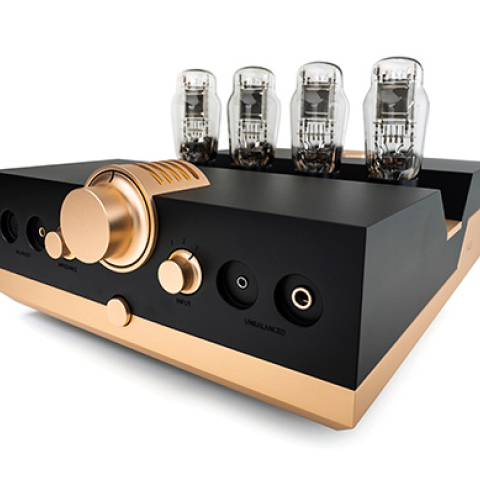
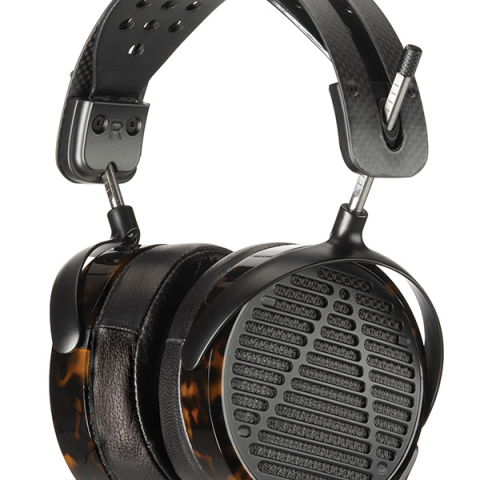
 Yes, I had those 'phones and their bespoke deco tube wonderbox for three wonderful months. When it was time to give them back, I inquired about the price. Sennheiser wanted nine grand for my beat-up ol' review unit—which, I assure you, had seen better days.
Never mind—the Orpheus is out of production anyway. But I'll never forget the musical thrills. Sennheiser's Ultimate Lust Beast sounded even better than it looked—and it started with the turn of a key! After it went away, I forswore headphones for three months and wore nothing but black. I was in mourning. Then, brightening (and wanting to drown out the movies K-10 watches while I write), I put together a system comprising a Cary CAD-300SEI integrated driven by a matched pair of Western Electric 300Bs and running Sennheiser HD580 headphones. You get the transformer output of the amp on the headphone jack. Later, I added a pair of Sennheiser's superior HD 600s. I've been happy ever since.
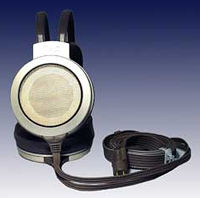
Which is why JA felt I'd be an ideal candidate to review Stax's Omega II.
Tom Norton wrote about the original Omega in the March 1995 Stereophile. He was particularly impressed by the fact that the "somewhat etched, crisp quality" of the older Stax Lambda headphones had been replaced by "a more relaxed, more natural, yet more subtly detailed" presentation. Major Tom had performed his review with Stax's SRM-T1S tube amplifier; the Omega II is available with either (or both!) of two new amplifiers/"energizers"—the SRM-007t tubed driver or the SRM-717 solid-state driver.
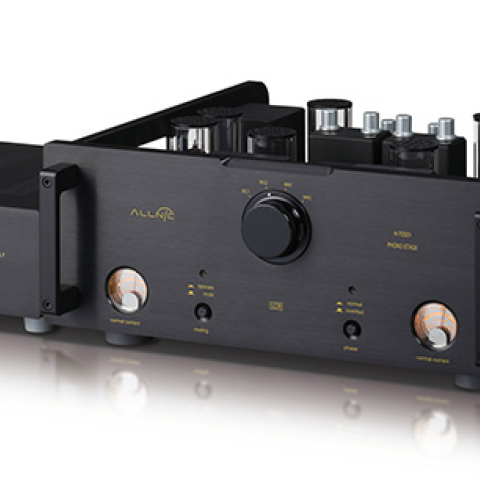
Plug a CD player or any other line-level source into one of the Stax amplifier's inputs, plug the Omega II headphones into one of the outputs, and you have a complete, high-performance system for private listening.
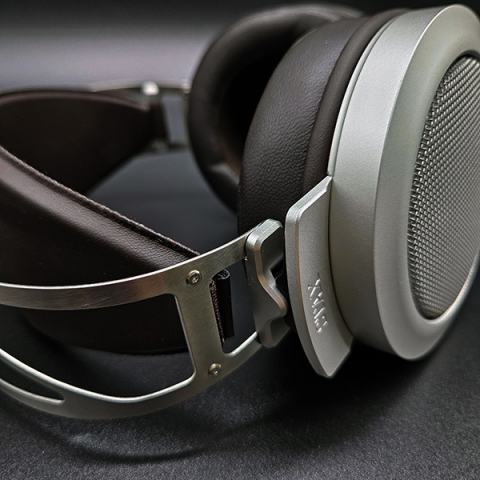
SR-007 Omega II Earspeakers: $4030
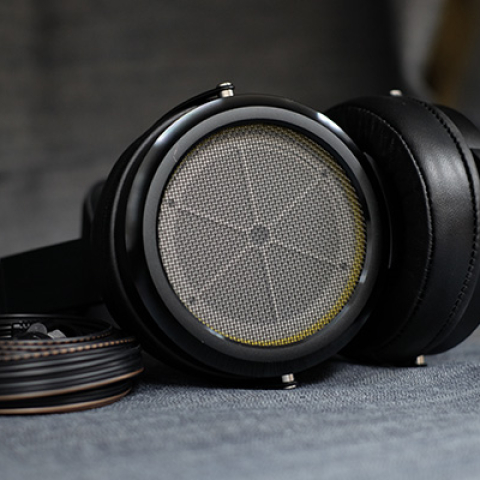
Stax Japan refers to its electrostatic headphone designs as "Earspeakers." The electrostatic transducer in a Stax Earspeaker consists of two "parallel-arranged fixed electrodes," between which is suspended a low-mass, high-polymer film that is less than 2µm thick. Simply put, it's a push-pull driver system. When the fluctuating voltage of the audio signal is applied to the electrodes, as in a MartinLogan speaker, the diaphragm is pulled and pushed. Manual: "The continuous flow of alternating voltage in interpretation of audio signals causes the diaphragm to vibrate in faithful compliance with the amplifier output without time lag, ensuring undistorted soundwaves."
It all makes technical sense.
SRM-717: $2875
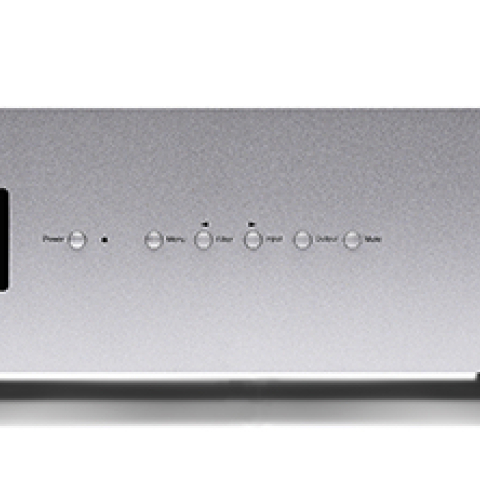
The SRM-717 is deceptively heavy. And even though it's solid-state, it runs fairly hot. The front panel is simple: a four-element dual-gang volume control to the right, a positive-action power On/Off switch, and a pair of five-pin Earspeaker outputs below, carrying Pro Only polarizing voltages (580V DC).
There are two pairs of RCA jacks and one pair of XLRs on the rear panel. (Pin 2 of the XLRs is negative, following the usual Japanese practice.) The inputs are paralleled; you can use single-ended or balanced connections, but not both. A Bypass mode on the 717 allows its volume to be controlled by an outside source, presumably a preamp, passive volume controller, or an integrated amp or receiver with "preamp out" facilities.