Oh mama, was I ever excited when I heard rumors of the existence of AKG's K 701! If you're among the audiophiles who sneer at those of us who like headphones, you're probably rolling your eyes and thinking I must lack a rich inner life.
 But hold on there, Skippy—some of us use those cans in our prosumer studios, in recording sessions, and even in barn-burning late-night critical listening sessions where we employ ancillary equipment that would beggar your jaded high-end sensibilities. We're not talking about the three-buck, upchuck disposable 'phones your friendly flight attendant flogs before your in-flight main feature. We're talking about serious tools that can reveal a flea fart in a cathedral.
Well, some of us are. Me, I'm just a headphone geek, so news that AKG was going to launch a flagship dynamic headphone had me all aquiver with anticipation. After all, the company's last major assault on the state of the headphone art was the K 1000, which AKG called an "earspeaker," mostly because they resembled speakers in many ways—they sat off to the front of the ears and beamed music back into the pinnae, rather than pumping it more or less straight into the ear canal, as most phones do. They were also brutes to drive. John Marks was a big fan, and John's got great taste in gear—but I admired the K 1000s more than I loved 'em, mostly because I found them incredibly fiddly. I was never convinced that I'd angled both earspeakers equally, so I was always trying to get them in better balance. As Bob Reina once opined about electrostatic speakers: great for a desert-island system, where you'd be desperate for something to do, but for regular listening, not so much. Besides, the K 1000s cost nearly a grand by the time AKG discontinued them last year.
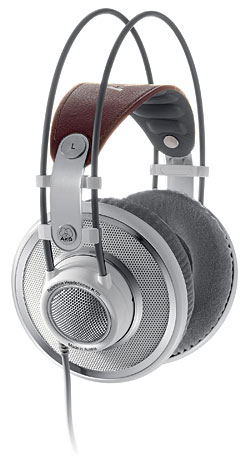
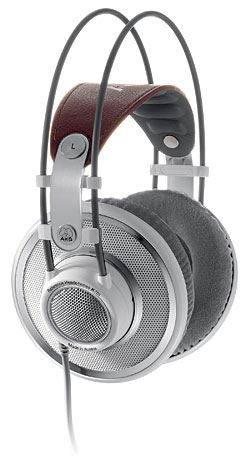
Rumor had it that the K 701s would come in closer to $400, which they did—$450 and frequently discounted. And by the time Head-Fi had its regional NY Meet in November 2005, word had gone around the Internet that the K 701s would be there, which they were—just barely. AKG's US distributor had sent out two pairs prior to the meet, one to HeadRoom's Tyll Hertsens and another to a hard-core headphoner. Neither pair had logged more than a few hours of music-playing, and while they sounded intriguing, they had a hardness that didn't make me ready to trade in my reference Sennheiser HD-650s. But they were extremely comfortable, and their wire frames, leather headband, and white porcelain-like rims and motor housing made a dashing retro-futuristic fashion statement. They were also quiet—not a shred of hiss or hum.
Two days later, I got an e-mail from Hertsens: "I've now logged over 100 hours of music playing on the 701s and I have a new reference. You didn't hear half of what they could do." You better believe that the five months I waited to receive a review sample seemed like a long time. Why so long? AKG had a hit on its hands. They couldn't make 'em fast enough to cover demand.
Time after time you refuse to even listen
But hold on there, Skippy—some of us use those cans in our prosumer studios, in recording sessions, and even in barn-burning late-night critical listening sessions where we employ ancillary equipment that would beggar your jaded high-end sensibilities. We're not talking about the three-buck, upchuck disposable 'phones your friendly flight attendant flogs before your in-flight main feature. We're talking about serious tools that can reveal a flea fart in a cathedral.
Well, some of us are. Me, I'm just a headphone geek, so news that AKG was going to launch a flagship dynamic headphone had me all aquiver with anticipation. After all, the company's last major assault on the state of the headphone art was the K 1000, which AKG called an "earspeaker," mostly because they resembled speakers in many ways—they sat off to the front of the ears and beamed music back into the pinnae, rather than pumping it more or less straight into the ear canal, as most phones do. They were also brutes to drive. John Marks was a big fan, and John's got great taste in gear—but I admired the K 1000s more than I loved 'em, mostly because I found them incredibly fiddly. I was never convinced that I'd angled both earspeakers equally, so I was always trying to get them in better balance. As Bob Reina once opined about electrostatic speakers: great for a desert-island system, where you'd be desperate for something to do, but for regular listening, not so much. Besides, the K 1000s cost nearly a grand by the time AKG discontinued them last year.
Rumor had it that the K 701s would come in closer to $400, which they did—$450 and frequently discounted. And by the time Head-Fi had its regional NY Meet in November 2005, word had gone around the Internet that the K 701s would be there, which they were—just barely. AKG's US distributor had sent out two pairs prior to the meet, one to HeadRoom's Tyll Hertsens and another to a hard-core headphoner. Neither pair had logged more than a few hours of music-playing, and while they sounded intriguing, they had a hardness that didn't make me ready to trade in my reference Sennheiser HD-650s. But they were extremely comfortable, and their wire frames, leather headband, and white porcelain-like rims and motor housing made a dashing retro-futuristic fashion statement. They were also quiet—not a shred of hiss or hum.
Two days later, I got an e-mail from Hertsens: "I've now logged over 100 hours of music playing on the 701s and I have a new reference. You didn't hear half of what they could do." You better believe that the five months I waited to receive a review sample seemed like a long time. Why so long? AKG had a hit on its hands. They couldn't make 'em fast enough to cover demand.
Time after time you refuse to even listen
If you haven't been paying attention to high-end headphones, $450 probably sounds like a lot of dough—and it is. You could be forgiven for thinking, What are those things made of, gold? Actually, nothing in the K 701s is all that rare, unless you count as rare the kind of engineering that sweats all the small details. Take the cabling, for example. AKG's German-to-English translation machine calls it "true bi-wiring" in some publications and "balanced" in others. What they mean by that is that the 701s use separate grounds for each motor assembly rather than a common ground (although the ¼" jack does feature a common ground, of course). That's probably one reason I was struck by how silent the 701s were the first time I heard them—and all the times after that.
AKG uses 99.99% pure OFC, which may not be "six nines" (99.9999% pure) copper, but it isn't what most headphones use, either. The voice-coils use flat wire, which is common enough in high-end loudspeakers and microphones, but again is less than common in cans. Flat-wire windings are said to better concentrate the magnetic field within the voice-coil, thus exerting superior control over the diaphragm's movement.
The 701s also boast AKG's Varimotion transducer. The diaphragm is contoured to be thicker at the center than at the periphery. The stiffer center acts as the tweeter, while the more pliant boundaries produce the low frequencies. AKG cuts runnels into the stiffer portion in order to tweak the diaphragm's mechanical impedance—or, as AKG puts it, "the diaphragm has been optimized to prevent unwanted vibration modes." The point is to keep the center of the diaphragm acting as pistonically as possible and thus keep the voice-coil centered in the magnetic field. This, AKG says, "results in lower harmonic distortion, extended bass response, and higher maximum loudness."
As I mentioned earlier, the 701s are extremely comfortable. Their huge, ear-enveloping foam pads, clad in some kind of velveteen, sat on my head for hours without seeming warm or tight. AKG says it uses "3-D foam," which I take to mean foams of different densities. They also claim the shape of the earpads allows the drivers to be aimed at the ears "at the proper angle." I can't prove that they were, but the sonic results were hard to argue with. The leather hammock-style sling that runs under the springy-wire connecting rails to cradle the listener's head also contributes to the luxe fit. Any way you slice it, the 701s coddle your head and ears.
Because the K 701 is aimed not at the iPod generation but at AKG's studio market, the phones are terminated with a ¼" jack plug. Still, a substantial machined-metal ¼"-to-1/8" converter is included in case you need to use 'em with a source equipped only with a mini jack (my HeadRoom Micro headphone amp, for instance). AKG also includes a "docking cradle"—essentially a pedestal with a foam cutout that lets you perch the 701s atop your recording console or desktop. At first I thought this the dumbest gimme I'd ever seen, but I ended up using it a lot. Actually having a place to put something makes it more likely that I'll find it again in the chaos that is my office. Oh, who am I kidding—in the chaos that is my life.
Is there anybody going to listen to my story?
Despite the shiny whiteness of its ear cups, the K 701 isn't really intended to connect to the ubiquitous iPod. There's that ¼" connector issue, of course, and the headsets are large, even if they are light, and aren't really easy to balance on the noggin while jogging or biking. Even if you're going to use 'em in a sedentary position, such as reclined in your commodious airplane seat, the leakage from their open backs would make you poor company. So where would you use the K 701s? Monitoring recording sessions, obviously, as well as any place you need high-quality listening tools, which in my house means anywhere I have a headphone amp set up: office, living room, and laundry room (strange, I know, but my wife is devious about finding ways to get me to do chores).
Why use a headphone amp? Well, the K 701s aren't exceedingly hard to drive, but the flea wattage of the average portable (or even the ¼" jack present on most separates) tends to accentuate that initial edginess I alluded to in my first experience with the 701s in much the way listening to a pair of speakers near an amplifier's maximum output accentuates the amp's inadequacies. The 701s aren't unique in this regard; most ambitious headphone designs benefit tremendously from a well-designed headphone amp. Fortunately, I had a ton of such amps around the house: several generations of HeadRoom, Channel Island Audio's VHP-1, and Ray Samuels Audio's SR-71 and Hornet. All of them let the K 701s' tonal balance and authority blossom.
Say the word I'm thinking of
When I first received the AKG K 701s, I listened to them briefly to confirm my initial impression of an aggressive assertiveness I wouldn't cotton to. Forewarned by Tyll Hertsens' assertion that they needed to be run in, I set them up in an unused room, connected to a Channel Islands Audio VHP-1 and Musical Fidelity X-RayV3 CD player set to repeat. I didn't listen to them again for a few hundred hours, so no, I wasn't being broken in—they were. About a week later, I checked in on the K 701s and that edginess was gone, replaced by balanced sound with a natural top-end sparkle and a ridiculously robust bottom end. What causes such a change? Some folks speculate that the diaphragm becomes more supple with play, or that the motor mechanism wears in. I don't pretend to know what goes on, only that a few hundred hours of vigorous play transformed the K 701s.
But hold on there, Skippy—some of us use those cans in our prosumer studios, in recording sessions, and even in barn-burning late-night critical listening sessions where we employ ancillary equipment that would beggar your jaded high-end sensibilities. We're not talking about the three-buck, upchuck disposable 'phones your friendly flight attendant flogs before your in-flight main feature. We're talking about serious tools that can reveal a flea fart in a cathedral.
Well, some of us are. Me, I'm just a headphone geek, so news that AKG was going to launch a flagship dynamic headphone had me all aquiver with anticipation. After all, the company's last major assault on the state of the headphone art was the K 1000, which AKG called an "earspeaker," mostly because they resembled speakers in many ways—they sat off to the front of the ears and beamed music back into the pinnae, rather than pumping it more or less straight into the ear canal, as most phones do. They were also brutes to drive. John Marks was a big fan, and John's got great taste in gear—but I admired the K 1000s more than I loved 'em, mostly because I found them incredibly fiddly. I was never convinced that I'd angled both earspeakers equally, so I was always trying to get them in better balance. As Bob Reina once opined about electrostatic speakers: great for a desert-island system, where you'd be desperate for something to do, but for regular listening, not so much. Besides, the K 1000s cost nearly a grand by the time AKG discontinued them last year.
Rumor had it that the K 701s would come in closer to $400, which they did—$450 and frequently discounted. And by the time Head-Fi had its regional NY Meet in November 2005, word had gone around the Internet that the K 701s would be there, which they were—just barely. AKG's US distributor had sent out two pairs prior to the meet, one to HeadRoom's Tyll Hertsens and another to a hard-core headphoner. Neither pair had logged more than a few hours of music-playing, and while they sounded intriguing, they had a hardness that didn't make me ready to trade in my reference Sennheiser HD-650s. But they were extremely comfortable, and their wire frames, leather headband, and white porcelain-like rims and motor housing made a dashing retro-futuristic fashion statement. They were also quiet—not a shred of hiss or hum.
If you haven't been paying attention to high-end headphones, $450 probably sounds like a lot of dough—and it is. You could be forgiven for thinking, What are those things made of, gold? Actually, nothing in the K 701s is all that rare, unless you count as rare the kind of engineering that sweats all the small details. Take the cabling, for example. AKG's German-to-English translation machine calls it "true bi-wiring" in some publications and "balanced" in others. What they mean by that is that the 701s use separate grounds for each motor assembly rather than a common ground (although the ¼" jack does feature a common ground, of course). That's probably one reason I was struck by how silent the 701s were the first time I heard them—and all the times after that.
Despite the shiny whiteness of its ear cups, the K 701 isn't really intended to connect to the ubiquitous iPod. There's that ¼" connector issue, of course, and the headsets are large, even if they are light, and aren't really easy to balance on the noggin while jogging or biking. Even if you're going to use 'em in a sedentary position, such as reclined in your commodious airplane seat, the leakage from their open backs would make you poor company. So where would you use the K 701s? Monitoring recording sessions, obviously, as well as any place you need high-quality listening tools, which in my house means anywhere I have a headphone amp set up: office, living room, and laundry room (strange, I know, but my wife is devious about finding ways to get me to do chores).
When I first received the AKG K 701s, I listened to them briefly to confirm my initial impression of an aggressive assertiveness I wouldn't cotton to. Forewarned by Tyll Hertsens' assertion that they needed to be run in, I set them up in an unused room, connected to a Channel Islands Audio VHP-1 and Musical Fidelity X-RayV3 CD player set to repeat. I didn't listen to them again for a few hundred hours, so no, I wasn't being broken in—they were. About a week later, I checked in on the K 701s and that edginess was gone, replaced by balanced sound with a natural top-end sparkle and a ridiculously robust bottom end. What causes such a change? Some folks speculate that the diaphragm becomes more supple with play, or that the motor mechanism wears in. I don't pretend to know what goes on, only that a few hundred hours of vigorous play transformed the K 701s.