I am a Revel junkie. Their Ultima Studios have been my reference loudspeakers for years, and I've spent many happy hours with their Performa F-30s and Ultima Gems. They're all great speakers. When the original Gem was launched, it was made clear that all the corporate and economic weight of Revel's parent company, Harman International, was behind the development of this new line. When I visited Revel some years back, I saw cutting-edge design and development, in-house manufacturing of the most critical parts under the tightest scrutiny, and quality control of nearly compulsive meticulousness. All of this was reflected in the speakers' prices, which were reasonable for their quality and performance.
 How do you translate such an approach into a line of speakers whose prices barely edge into four figures? Well, Revel's in-house expertise and technology are there, their costs presumably already somewhat amortized by the earlier models' success. The crunch has got to be in the hardware and assembly. Revel's new Concerta line incorporates more outsourced components than the more expensive models, and assembly has been moved south of the border, to Mexico. Still, when I saw the Concertas at last year's CEDIA Expo, I could detect no downside to those practices. The fit'n'finish were impressive: Considering their heritage, the prices almost seemed too low!
Description & Setup
How do you translate such an approach into a line of speakers whose prices barely edge into four figures? Well, Revel's in-house expertise and technology are there, their costs presumably already somewhat amortized by the earlier models' success. The crunch has got to be in the hardware and assembly. Revel's new Concerta line incorporates more outsourced components than the more expensive models, and assembly has been moved south of the border, to Mexico. Still, when I saw the Concertas at last year's CEDIA Expo, I could detect no downside to those practices. The fit'n'finish were impressive: Considering their heritage, the prices almost seemed too low!
Description & Setup
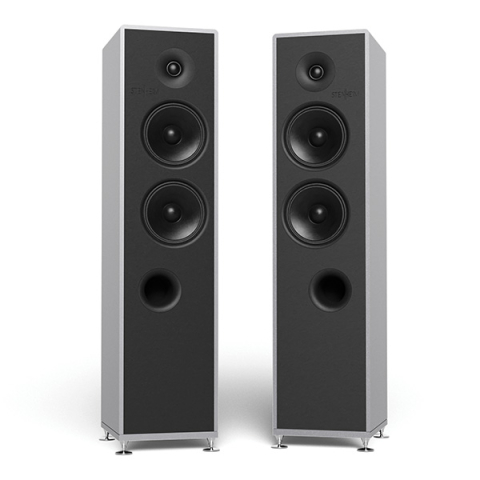
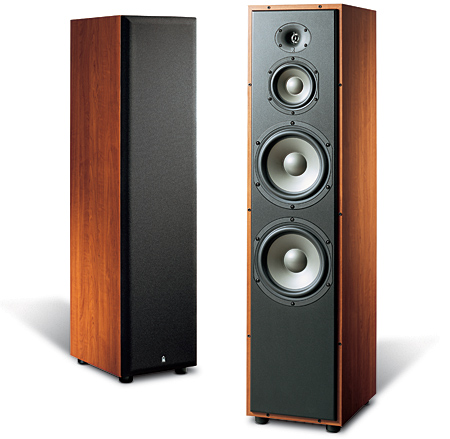
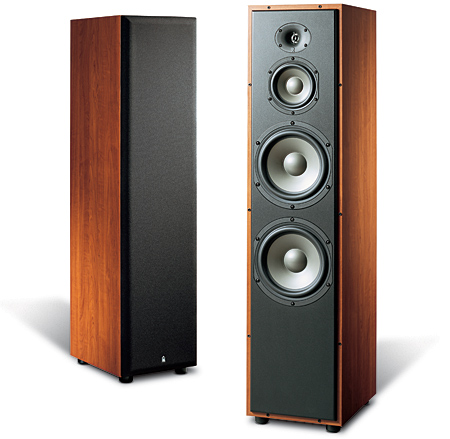
That impression of value was not dispelled when the Concerta F12s arrived at my house. First, the F12 is a big speaker, and in many ways seems a low-cost parallel to Revel's venerable Ultima Studio. It sports a small dome tweeter, an inverted-dome midrange of exotic material, an Organic Ceramic Composite, or OCC, and two 8" woofers in a ported enclosure, all integrated with high-slope crossovers. Okay, the Ultima Studio has two tweeters, but that's not why it costs more than 10 times as much as the Concerta F12. Was it the switch from the Ultimas' mica/carbon-filled copolymer and titanium diaphragms to the Concertas' OCC?
Maybe, but the biggest, most obvious difference is the design and construction of the enclosure. The Concerta F12's cabinet is a simple rectangular prism that weighs about 100 lbs less than the Ultima Studio's. There's no room in the F12's bill of materials for exotic molded synthetics, sharply styled side panels, or the labor needed to assemble and finish it all, but it's still a nicely finished box with a synthetic veneer. As in the Studio, the F12's drivers are vertically aligned on the front panel, the biwirable terminals are in a recessed area near the bottom of the rear panel, and just above that is a large flared port. But the F12 has no level controls.
Like earlier Revels, though, the F12s slid neatly from their cartons, and were among the easiest floorstanding speakers to unpack and set up that I've dealt with. I removed the Styrofoam endcaps, snapped on the front grilles, and walked them into position. I first auditioned them in my Connecticut system, where the stiffness of my Kubala-Sosna cables conspired with the very limited clearance around the inset terminals to make for some uncomfortable and repeated twisting and turning. That done, I put on a series of familiar two-channel recordings to hear how the F12s needed to be positioned.
From the get-go, the F12s were so strikingly clean in the midrange that they gave me a lot of positioning leeway. Center-image fill was always dead-on when the speakers were anywhere from 7' to 11' apart. The speakers' distance from the front wall was equally uncritical, as long as it was at least 6" so that the rear port could breathe. Of course, the amount of bass and the interactions with room boundaries changed along with the distance from the front wall; I settled on a wall-to-front-panel distance of about 32", or only about 4" more than I use with my Paradigm Studio/60s. At that position, bass was not so much noticeably strong as it was easily available when the recording demanded it, and well extended. Because the midrange was apparently generous with gross position changes, it was the treble that dictated the toe-in angle. Regardless of how far the F12s were from me and each other, they always sounded best when toed-in so that my ears were directly on their tweeter axes. Off axis, there was the predictable reduction in overall treble; the F12s seemed better balanced on axis.
Connecticut listening
If speakers were simply the sums of their parts, anyone could design them. Revel's approach has been to minimize interaction between the outputs of the drive-units by using high-slope crossovers, although the precise slopes of the Concerta series are not specified. With recordings ranging from simple solo voice up through to complex large-scale ensembles, the Concerta F12s presented an integrated and stable image extending between the speakers. Solo voices, especially female, were glorious: unusually present, warm, and human. The F12's overall tonal balance was lighter than I'd gotten from the Ultima Studio, though certainly not bright or lightweight. It was almost as if the treble and bass ceded precedence to the F12's marvelous midrange, a characteristic that made it almost ideal for the female voice, and quite revealing of male voices. On Dvorák's song "Lasst mich allein," from Secrets of Dvorák's Cello Concerto (CD, Sony Classical 82876737162), Angelika Kirchschlager's creamy mezzo floated just right of center but just in front of the accompanying piano. Both were presented with just enough warmth to be part of the acoustic space of the recording venue, the Baumgartner Casino in Vienna, while retaining enough sweetness to seem quite present in my living room. I thought the F12's treble somewhat timid, even on axis, but A/B'd with the other speakers on hand, the F12's tweeter lost no details and was quite transparent. It had just a little more grain than the Ultima's tweeter, which mitigated just a bit the splashiness of struck cymbals.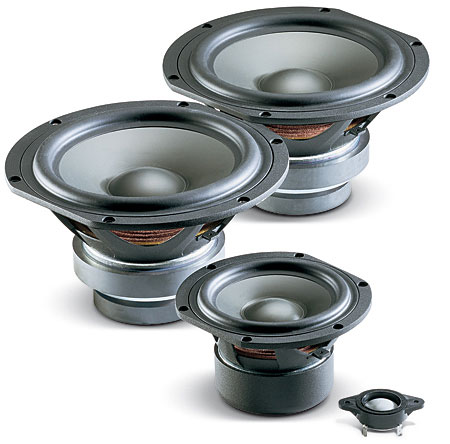 Bass reached impressively far into the nether regions, but then again, the F12 ain't no small speaker. It could fill my room with strong organ-pedal tones but, more significant, it was nimble enough to delineate and distinguish among those tones, as well as among various drum and low string instruments, in a way that extended its midrange clarity down to new lows. A carefully positioned and equalized Paradigm Servo-15 subwoofer made an easily perceived improvement for movies but was certainly not required, even for pipe-organ music. The throbbing weight of Trinity Church's twin Marshall & Ogletree organs on organist Douglas Marshall's Opus 1 (CD/DVD-Audio, Seemusic SMD-051), even from the two-channel CD side.
But—and this is a significant but—the presentation of the paired F12s was much different from what I was used to hearing. The central image was outstanding in its clarity and stability, but it also was shallow and failed to give the impression of a very deep soundstage when I knew the recording included that information. The soundstage also did not extend to the sides much beyond the speakers themselves. I could conjure up a truly large, wide soundstage by placing the F12s as far apart as the room permitted, although the speaker spacing still defined the limits of that stage. Consequently, my enjoyment of the F12s greatly depended on the recording. If I could logically expect the performance to fit between the speakers, the F12s were very convincing—even a large concert grand piano and its rich, imposing resonances were ably portrayed. Solo voices had a presence and immediacy that I didn't expect to hear in this price range. Large orchestral forces, too, were well portrayed, though they sounded to me as if I'd arrived late to a concert and was standing in a large portal at the rear rather than inside the hall.
Room acoustics play a major role in such effects, and my Connecticut listening room is fairly well treated and more highly damped than the typical space. But I'm a sucker for multichannel, and the bulk of my listening in this room is to multichannel music, so it seemed incumbent on me to try the F12s in my other system, in Manhattan, where two-channel music is the norm. It would also give the Concerta F12s an opportunity to go head to head with their big brothers, Revel's Ultima Studios.
Manhattan listening
Bass reached impressively far into the nether regions, but then again, the F12 ain't no small speaker. It could fill my room with strong organ-pedal tones but, more significant, it was nimble enough to delineate and distinguish among those tones, as well as among various drum and low string instruments, in a way that extended its midrange clarity down to new lows. A carefully positioned and equalized Paradigm Servo-15 subwoofer made an easily perceived improvement for movies but was certainly not required, even for pipe-organ music. The throbbing weight of Trinity Church's twin Marshall & Ogletree organs on organist Douglas Marshall's Opus 1 (CD/DVD-Audio, Seemusic SMD-051), even from the two-channel CD side.
But—and this is a significant but—the presentation of the paired F12s was much different from what I was used to hearing. The central image was outstanding in its clarity and stability, but it also was shallow and failed to give the impression of a very deep soundstage when I knew the recording included that information. The soundstage also did not extend to the sides much beyond the speakers themselves. I could conjure up a truly large, wide soundstage by placing the F12s as far apart as the room permitted, although the speaker spacing still defined the limits of that stage. Consequently, my enjoyment of the F12s greatly depended on the recording. If I could logically expect the performance to fit between the speakers, the F12s were very convincing—even a large concert grand piano and its rich, imposing resonances were ably portrayed. Solo voices had a presence and immediacy that I didn't expect to hear in this price range. Large orchestral forces, too, were well portrayed, though they sounded to me as if I'd arrived late to a concert and was standing in a large portal at the rear rather than inside the hall.
Room acoustics play a major role in such effects, and my Connecticut listening room is fairly well treated and more highly damped than the typical space. But I'm a sucker for multichannel, and the bulk of my listening in this room is to multichannel music, so it seemed incumbent on me to try the F12s in my other system, in Manhattan, where two-channel music is the norm. It would also give the Concerta F12s an opportunity to go head to head with their big brothers, Revel's Ultima Studios.
Manhattan listening
Repacked, schlepped, and again unpacked, the F12s were hooked up to two-thirds of my Classé C-3200 power amp, this time using single-wire AudioQuest Gibraltar speaker cable. I was only a bit less annoyed at the close quarters of the F12s' recessed terminal panels (though those who don't disconnect and reconnect speakers all that often won't be much bothered).
Going from a square room with lots of damping panels to a larger, more rectangular room with concrete walls and only rugs and couches was a good change of climate for the F12s. The bigger, smoother Classé amp probably helped as well, providing a little more richness in the upper bass, which translated into the greater presence of male voices, lower winds and strings, and guitars. The treble was, as before, smooth and transparent but just slightly subdued.
With the F12s toed-in as before—ie, aimed squarely at me—I perceived greater senses of weight, size, and space, the overall sound approaching that of the similarly positioned Ultima Studios. Just above the lowest bass, the somewhat overripe midbass of many of the tracks of Geno d'Auri's Flamenco Mystico (CD, Golden String GSCD 016) was less luscious through the F12s than through either my Ultima Studios or B&W 802Ds. The F12's sound was a little more open and transparent in this room, but I'd rather wallow a bit, anyway. Also, in this room the soundstage's width exceeded the speakers' outer edges and seemed much less tethered to them. Where before I had been influenced in my music choices by the F12's preferences, here I had greater freedom. When I played the main event on Secrets of Dvorák's Cello Concerto, Jan Vogler's cello was warmly and firmly positioned front and center, while the still slightly hard acoustics of Avery Fisher Hall were realistically spread across the front of the stage in a pretty accurate depiction of a very familiar hall.
Still, the depth of the F12s' central soundstage seemed shallower than that of either the Ultima Studios or the B&W 802Ds in the same room. It's not that there was a lack of resolution in that dimension—the F12s were capable of as many tiers of depth in the orchestra as the other speakers. Rather, it was that those tiers seemed more tightly spaced. By analogy, the F12s offered a view similar to the characteristic foreshortening created by a mild telephoto lens. The big Revel Ultima Studios are extraordinary in their ability to throw a deeper soundstage; it was only by this comparison that the illusion created by the F12s was lacking in any way.
A fairer comparison
A more pointed and relevant comparison was with the only slightly more expensive Paradigm Studio/60s ($1600/pair), in my Connecticut room. The Concerta F12 is significantly bigger than the Studio, but not heavier. Because of this, I had expected that the F12's larger panels might be less rigid, but rapping both speakers with my knuckles gave similar results. The F12's larger, 8" woofers and larger enclosure gave it more extension and bass resolution than did the Paradigm's 7" woofers, but the latter had more upper-bass weight. On paper, the F12 is more efficient than the Paradigm: 90.5dB vs 88dB, anechoic. Indeed, I easily noted the difference between them in my room. The Paradigm had more treble output, which gave it the apparent edge in detail—but there was nothing missing from or, indeed, out of line with the F12, especially when I listened on axis. The F12s' weakness in soundstaging, laterally but mostly in depth, might be due to the speaker's relatively wide front panel, framed as it is by sharp edges. The Paradigms could throw a wider soundstage with the speakers closer together, possibly because they are narrower than the F12s (8.25" vs 9.75") and/or their tweeters are enclosed in a special cowl very close to the cabinet edge.
The F12's superiority was most apparent in the meat of the midrange. Undoubtedly, many factors contribute to its outstanding clarity, but it's significant that the F12 has a dedicated midrange driver, while the 2½-way Paradigm uses a mid-woofer to cover the same range. And in my more typical Manhattan room, with less acoustic treatment, the F12s did a great job of approaching true high-end stereo performance.
Conclusions
On paper, the F12 is more efficient than the Paradigm: 90.5dB vs 88dB, anechoic. Indeed, I easily noted the difference between them in my room. The Paradigm had more treble output, which gave it the apparent edge in detail—but there was nothing missing from or, indeed, out of line with the F12, especially when I listened on axis. The F12s' weakness in soundstaging, laterally but mostly in depth, might be due to the speaker's relatively wide front panel, framed as it is by sharp edges. The Paradigms could throw a wider soundstage with the speakers closer together, possibly because they are narrower than the F12s (8.25" vs 9.75") and/or their tweeters are enclosed in a special cowl very close to the cabinet edge.
The F12's superiority was most apparent in the meat of the midrange. Undoubtedly, many factors contribute to its outstanding clarity, but it's significant that the F12 has a dedicated midrange driver, while the 2½-way Paradigm uses a mid-woofer to cover the same range. And in my more typical Manhattan room, with less acoustic treatment, the F12s did a great job of approaching true high-end stereo performance.
Conclusions
I think that Revel's Concerta series is more audacious than their more expensive lines. Given the constraints of price and size, the Concerta F12 is a true full-range loudspeaker with a midrange to rival those of much more expensive designs. Positioning is unusually flexible, and the F12 is easy to drive. Compared directly with speakers costing in excess of $10,000/pair, the difference was striking only until I put on some music and closed my eyes. I hate to put numbers on relative performance, but the Concerta F12 sounded many times better than a 1:10 price ratio might indicate. Anyway, who needs such number games? Even in its own price class, Revel's Concerta F12 is a bargain.
How do you translate such an approach into a line of speakers whose prices barely edge into four figures? Well, Revel's in-house expertise and technology are there, their costs presumably already somewhat amortized by the earlier models' success. The crunch has got to be in the hardware and assembly. Revel's new Concerta line incorporates more outsourced components than the more expensive models, and assembly has been moved south of the border, to Mexico. Still, when I saw the Concertas at last year's CEDIA Expo, I could detect no downside to those practices. The fit'n'finish were impressive: Considering their heritage, the prices almost seemed too low!
Description & Setup
That impression of value was not dispelled when the Concerta F12s arrived at my house. First, the F12 is a big speaker, and in many ways seems a low-cost parallel to Revel's venerable Ultima Studio. It sports a small dome tweeter, an inverted-dome midrange of exotic material, an Organic Ceramic Composite, or OCC, and two 8" woofers in a ported enclosure, all integrated with high-slope crossovers. Okay, the Ultima Studio has two tweeters, but that's not why it costs more than 10 times as much as the Concerta F12. Was it the switch from the Ultimas' mica/carbon-filled copolymer and titanium diaphragms to the Concertas' OCC?
If speakers were simply the sums of their parts, anyone could design them. Revel's approach has been to minimize interaction between the outputs of the drive-units by using high-slope crossovers, although the precise slopes of the Concerta series are not specified. With recordings ranging from simple solo voice up through to complex large-scale ensembles, the Concerta F12s presented an integrated and stable image extending between the speakers. Solo voices, especially female, were glorious: unusually present, warm, and human. The F12's overall tonal balance was lighter than I'd gotten from the Ultima Studio, though certainly not bright or lightweight. It was almost as if the treble and bass ceded precedence to the F12's marvelous midrange, a characteristic that made it almost ideal for the female voice, and quite revealing of male voices. On Dvorák's song "Lasst mich allein," from Secrets of Dvorák's Cello Concerto (CD, Sony Classical 82876737162), Angelika Kirchschlager's creamy mezzo floated just right of center but just in front of the accompanying piano. Both were presented with just enough warmth to be part of the acoustic space of the recording venue, the Baumgartner Casino in Vienna, while retaining enough sweetness to seem quite present in my living room. I thought the F12's treble somewhat timid, even on axis, but A/B'd with the other speakers on hand, the F12's tweeter lost no details and was quite transparent. It had just a little more grain than the Ultima's tweeter, which mitigated just a bit the splashiness of struck cymbals.
Bass reached impressively far into the nether regions, but then again, the F12 ain't no small speaker. It could fill my room with strong organ-pedal tones but, more significant, it was nimble enough to delineate and distinguish among those tones, as well as among various drum and low string instruments, in a way that extended its midrange clarity down to new lows. A carefully positioned and equalized Paradigm Servo-15 subwoofer made an easily perceived improvement for movies but was certainly not required, even for pipe-organ music. The throbbing weight of Trinity Church's twin Marshall & Ogletree organs on organist Douglas Marshall's Opus 1 (CD/DVD-Audio, Seemusic SMD-051), even from the two-channel CD side.
Repacked, schlepped, and again unpacked, the F12s were hooked up to two-thirds of my Classé C-3200 power amp, this time using single-wire AudioQuest Gibraltar speaker cable. I was only a bit less annoyed at the close quarters of the F12s' recessed terminal panels (though those who don't disconnect and reconnect speakers all that often won't be much bothered).
A more pointed and relevant comparison was with the only slightly more expensive Paradigm Studio/60s ($1600/pair), in my Connecticut room. The Concerta F12 is significantly bigger than the Studio, but not heavier. Because of this, I had expected that the F12's larger panels might be less rigid, but rapping both speakers with my knuckles gave similar results. The F12's larger, 8" woofers and larger enclosure gave it more extension and bass resolution than did the Paradigm's 7" woofers, but the latter had more upper-bass weight.
On paper, the F12 is more efficient than the Paradigm: 90.5dB vs 88dB, anechoic. Indeed, I easily noted the difference between them in my room. The Paradigm had more treble output, which gave it the apparent edge in detail—but there was nothing missing from or, indeed, out of line with the F12, especially when I listened on axis. The F12s' weakness in soundstaging, laterally but mostly in depth, might be due to the speaker's relatively wide front panel, framed as it is by sharp edges. The Paradigms could throw a wider soundstage with the speakers closer together, possibly because they are narrower than the F12s (8.25" vs 9.75") and/or their tweeters are enclosed in a special cowl very close to the cabinet edge.
The F12's superiority was most apparent in the meat of the midrange. Undoubtedly, many factors contribute to its outstanding clarity, but it's significant that the F12 has a dedicated midrange driver, while the 2½-way Paradigm uses a mid-woofer to cover the same range. And in my more typical Manhattan room, with less acoustic treatment, the F12s did a great job of approaching true high-end stereo performance.
I think that Revel's Concerta series is more audacious than their more expensive lines. Given the constraints of price and size, the Concerta F12 is a true full-range loudspeaker with a midrange to rival those of much more expensive designs. Positioning is unusually flexible, and the F12 is easy to drive. Compared directly with speakers costing in excess of $10,000/pair, the difference was striking only until I put on some music and closed my eyes. I hate to put numbers on relative performance, but the Concerta F12 sounded many times better than a 1:10 price ratio might indicate. Anyway, who needs such number games? Even in its own price class, Revel's Concerta F12 is a bargain.