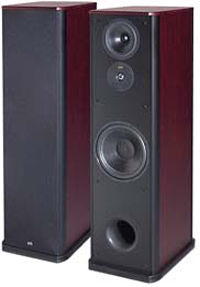
This must be the month I drew the right straw to review "loudspeakers with three-letter initials." Elsewhere in this issue I describe my experiences with pair of JBLs. Everyone knows that JBL stands for "James B. Lansing," founder of that company. You do, don't you? But PSB? If you've been paying attention here, you probably remember that JGH reviewed one of their loudspeakers back in May 1988. If you haven't, well, listen up. PSB is named after Paul Barton and his wife Sue, who formed Canada-based PSB in 1971. (Paul is still their chief designer.) The company was unknown in the US until just a few years ago, and still has a lower profile here than, well, certainly that other three-letter company. But not for lack of trying. They have at least 10 models—at last count. 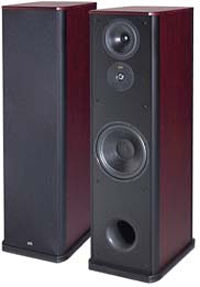 The Stratus Gold is PSB's flagship. It is a large, heavy, floor-standing design incorporating three externally (at least) conventional dynamic drive-units; the metal-dome tweeter is the closest of the three to being unconventional, but the use of such a device is not today, in itself, news. Still, the drivers are not exactly ordinary. PSB considers their design to be basically a two-way with an integral subwoofer. The 10" driver used for the latter has a large, 54oz magnet with a cone of felted fiber treated with plastic, loaded into a 3.5 ft3 bass-reflex enclosure. The cabinet itself is solidly constructed, braced, and heavily damped. The veneer comes from the cabinet maker Custom Woodwork and Design, and the dark oak finish precisely matches the latter's equipment cabinets of the same color. (PSB is investigating offering a variety of other finishes, some exotic, as of this writing.) The one flaw I noted near the end of the evaluation period was some warpage in the (apparently solid) oak tops—perhaps the result of several months in the dry Santa Fe climate. These tops are decorative, not structural, and may be removed and replaced in case of damage. My only reservations about the cabinet concern the overhanging lip on the top, designed to mate cosmetically with the grille (which I left off for my auditions in any case—see below), and the lack of provision for integral spikes (I used Tiptoes). And oh yes, I must add that the bottom mounting of the bi-wire terminals may enhance the (finished) rear of the enclosure, but is a major pain in the keester when hooking up the system. Probably more of an irritation for a reviewer than for a typical user.
The top of the woofer's response is rolled off at 250Hz at 18dB/octave (Butterworth), mating with the 6" midrange driver. The latter has a mineral-filled polypropylene cone, a 28oz magnet, cast basket, and has its own, separate, acoustic-suspension subenclosure. This driver is mounted, unconventionally, above the tweeter. The normal justification for such a configuration is to direct the acoustic radiation upward in the overlap region between the two drivers (with an appropriate crossover), which is useful in a system mounted below ear height—say, on a low stand. While that would not seem to be the case here, designer Paul Barton says that the resulting lobe in the Stratus Gold is designed to cover the region from a normal seated position to standing height. If the positions of the drivers were reversed, the lobe would cover the area from the seated position down. Which, I suppose, means no serious listening to the PSBs while you're sitting on the floor. The optimum listening axis is designed to be from just above the tweeter dome to just above the center of the midrange. A 24dB/octave, Linkwitz-Riley, mid-to-tweeter crossover feeds the signal above 2.2kHz to PSB's metal-domed, polyamide-suspension tweeter. Made by Vifa of Denmark specifically for PSB (the diaphragm is made in Germany), this tweeter uses an aluminum voice-coil former to improve cooling under stress. Ferrofluid is also used in the voice-coil gap. A proprietary face-plate incorporates an integral "phase-plug" to improve the coherence of the radiated signal from various points on the dome, and also slightly recesses the driver from the front baffle, which PSB says smooths the tweeter response in the low treble. Setup of the Stratus Golds presented no particular problems. Although lifting them to experiment with positioning was out of the question, they were easily "walked" around the room. In the final setup they were toed-in toward the listening position.
Equipment used in the review of the PSBs included the Oracle Delphi Mk.IV turntable, Oracle 345 arm, Dynavector XX-1L cartridge, Sony CDP-X77ES CD player, Rowland Consonance preamplifier, and Threshold SA/12e and Krell KSA-250 amplifiers. Interconnects were AudioQuest Lapis and Cardas Hexlink (the latter in balanced configuration from preamp to power amp). Additionally, two new Forté amplifiers and a Sumo Andromeda II were used briefly. Since the latter three amplifiers do not have balanced inputs, unbalanced Cardas Hexlink was used with them—though this cable was slightly shorter than the balanced (25' balanced, 20' unbalanced). All listening was done in the bi-wire mode using 7' of AudioQuest Clear. Although PSB's literature suggests that the grilles may safely be left in place (some effort has been made to round the frame's inside corners to minimize diffraction), I found the sound to be marginally more transparent with them removed, and did most of my listening with the drivers uncovered.
The Stratus Gold is PSB's flagship. It is a large, heavy, floor-standing design incorporating three externally (at least) conventional dynamic drive-units; the metal-dome tweeter is the closest of the three to being unconventional, but the use of such a device is not today, in itself, news. Still, the drivers are not exactly ordinary. PSB considers their design to be basically a two-way with an integral subwoofer. The 10" driver used for the latter has a large, 54oz magnet with a cone of felted fiber treated with plastic, loaded into a 3.5 ft3 bass-reflex enclosure. The cabinet itself is solidly constructed, braced, and heavily damped. The veneer comes from the cabinet maker Custom Woodwork and Design, and the dark oak finish precisely matches the latter's equipment cabinets of the same color. (PSB is investigating offering a variety of other finishes, some exotic, as of this writing.) The one flaw I noted near the end of the evaluation period was some warpage in the (apparently solid) oak tops—perhaps the result of several months in the dry Santa Fe climate. These tops are decorative, not structural, and may be removed and replaced in case of damage. My only reservations about the cabinet concern the overhanging lip on the top, designed to mate cosmetically with the grille (which I left off for my auditions in any case—see below), and the lack of provision for integral spikes (I used Tiptoes). And oh yes, I must add that the bottom mounting of the bi-wire terminals may enhance the (finished) rear of the enclosure, but is a major pain in the keester when hooking up the system. Probably more of an irritation for a reviewer than for a typical user.
The top of the woofer's response is rolled off at 250Hz at 18dB/octave (Butterworth), mating with the 6" midrange driver. The latter has a mineral-filled polypropylene cone, a 28oz magnet, cast basket, and has its own, separate, acoustic-suspension subenclosure. This driver is mounted, unconventionally, above the tweeter. The normal justification for such a configuration is to direct the acoustic radiation upward in the overlap region between the two drivers (with an appropriate crossover), which is useful in a system mounted below ear height—say, on a low stand. While that would not seem to be the case here, designer Paul Barton says that the resulting lobe in the Stratus Gold is designed to cover the region from a normal seated position to standing height. If the positions of the drivers were reversed, the lobe would cover the area from the seated position down. Which, I suppose, means no serious listening to the PSBs while you're sitting on the floor. The optimum listening axis is designed to be from just above the tweeter dome to just above the center of the midrange. A 24dB/octave, Linkwitz-Riley, mid-to-tweeter crossover feeds the signal above 2.2kHz to PSB's metal-domed, polyamide-suspension tweeter. Made by Vifa of Denmark specifically for PSB (the diaphragm is made in Germany), this tweeter uses an aluminum voice-coil former to improve cooling under stress. Ferrofluid is also used in the voice-coil gap. A proprietary face-plate incorporates an integral "phase-plug" to improve the coherence of the radiated signal from various points on the dome, and also slightly recesses the driver from the front baffle, which PSB says smooths the tweeter response in the low treble. Setup of the Stratus Golds presented no particular problems. Although lifting them to experiment with positioning was out of the question, they were easily "walked" around the room. In the final setup they were toed-in toward the listening position.
Equipment used in the review of the PSBs included the Oracle Delphi Mk.IV turntable, Oracle 345 arm, Dynavector XX-1L cartridge, Sony CDP-X77ES CD player, Rowland Consonance preamplifier, and Threshold SA/12e and Krell KSA-250 amplifiers. Interconnects were AudioQuest Lapis and Cardas Hexlink (the latter in balanced configuration from preamp to power amp). Additionally, two new Forté amplifiers and a Sumo Andromeda II were used briefly. Since the latter three amplifiers do not have balanced inputs, unbalanced Cardas Hexlink was used with them—though this cable was slightly shorter than the balanced (25' balanced, 20' unbalanced). All listening was done in the bi-wire mode using 7' of AudioQuest Clear. Although PSB's literature suggests that the grilles may safely be left in place (some effort has been made to round the frame's inside corners to minimize diffraction), I found the sound to be marginally more transparent with them removed, and did most of my listening with the drivers uncovered.
The Stratus Gold is PSB's flagship. It is a large, heavy, floor-standing design incorporating three externally (at least) conventional dynamic drive-units; the metal-dome tweeter is the closest of the three to being unconventional, but the use of such a device is not today, in itself, news. Still, the drivers are not exactly ordinary. PSB considers their design to be basically a two-way with an integral subwoofer. The 10" driver used for the latter has a large, 54oz magnet with a cone of felted fiber treated with plastic, loaded into a 3.5 ft3 bass-reflex enclosure. The cabinet itself is solidly constructed, braced, and heavily damped. The veneer comes from the cabinet maker Custom Woodwork and Design, and the dark oak finish precisely matches the latter's equipment cabinets of the same color. (PSB is investigating offering a variety of other finishes, some exotic, as of this writing.) The one flaw I noted near the end of the evaluation period was some warpage in the (apparently solid) oak tops—perhaps the result of several months in the dry Santa Fe climate. These tops are decorative, not structural, and may be removed and replaced in case of damage. My only reservations about the cabinet concern the overhanging lip on the top, designed to mate cosmetically with the grille (which I left off for my auditions in any case—see below), and the lack of provision for integral spikes (I used Tiptoes). And oh yes, I must add that the bottom mounting of the bi-wire terminals may enhance the (finished) rear of the enclosure, but is a major pain in the keester when hooking up the system. Probably more of an irritation for a reviewer than for a typical user.