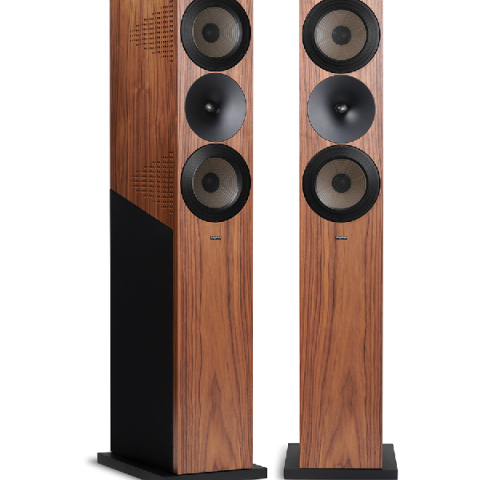
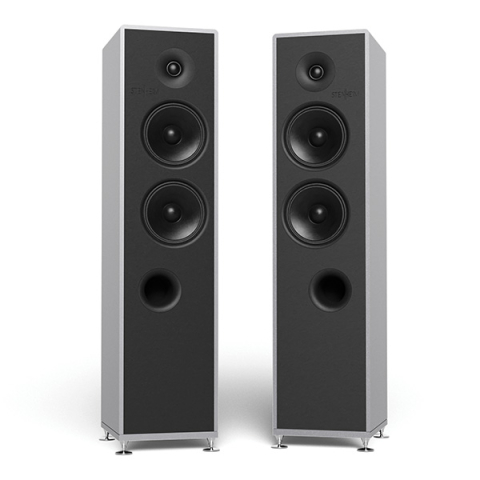
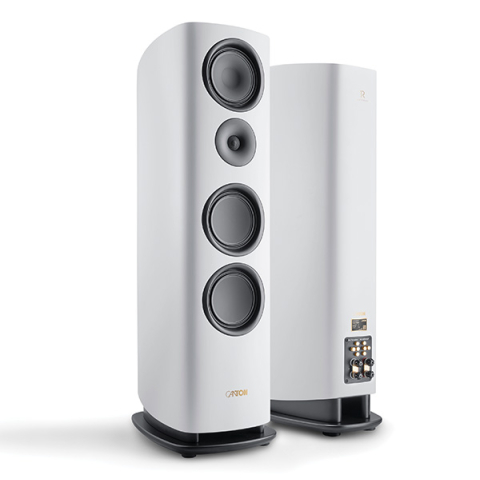
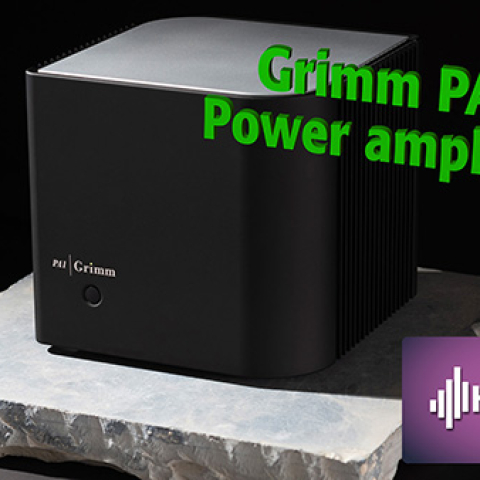
How does the Stratus Gold stack up against the competition? As mentioned earlier, I have recently spent a great deal of time listening to the Apogee Stages which, with their stands, are just a bit more expensive than the PSBs. The Apogees have the softer top octave. Their sound is not as obviously open and airy as that from the PSBs, but they do not lack for detail. The Stages sound, to this listener, more coherent, with a more precise soundstage (both in width and depth), but the PSBs sound decidedly more convincing from a non-optimum listening position than do the Apogees. The low end of the Apogees can be absolutely stunning with the right material, but its elevated response in the 40-50Hz region, and rapidly dropping response below that, while often exciting and seriously impressive, can be a bit too ripe next to the clearly more linear, extended, though not obviously tauter response of the PSBs. But the Apogees win the palm in the mid and upper bass. And through the midrange there is no contest; the Stages have that alluring, "palpable" quality on vocals that the PSBs cannot match, despite the fact that their midrange is otherwise excellent. I also very briefly compared the PSBs with the new Snell C/IVs (soon to be reviewed). The Snells appeared to be a bit less crisp in the top octave—on the average a more natural balance, but with some sacrifice in the appealing sense of unrestricted spaciousness provided by the PSBs. Low bass seemed comparable—with the PSB being perhaps a shade fuller and less well damped. The lower midrange of the PSB seemed leaner and more transparent than that of the Snell. But aside from this lower midrange (points to the PSB) and the top octave (points to the Snell), the two loudspeakers were not dramatically dissimilar. Which doesn't surprise me: they have many design similarities, and were both fine-tuned using the acoustical facilities of Canada's National Research Council. I should add that, extended though the Stratus Gold's LF range is, it never quite knocked me out of my chair (which may be a plus in some circumstances) the way yet another NRC-assisted loudspeaker, the Mirage M-3, did. During most of my listening, the Stratus Golds were driven with the Threshold SA/12e monoblocks. I also experimented with several other amplifiers. The Krell KSA-250 produced a bit more low-bass energy—though with no better tautness, extension, or control, this did not result in a net plus with the PSBs. It was extremely clean with plenty of detail through the midrange and highs. But ultimately the Threshold's top end struck me as sweeter through the PSBs and, overall, I preferred it. While the remaining three amplifiers couldn't match the SA/12es either, they made a valiant attempt at a far lower price. The new Fortés (the Model 4, 50Wpc class-A, and Model 5, 100Wpc class-AB) sounded very sweet on top, but were considerably less dynamic than the SA/12e. And neither could really do justice to the Stratus Gold's low end, either in drive or control. Still, the higher-powered Model 5 might be a decent match if you're not addicted to pipe organ.
The PSB seemed to thrive on power (it was a shade less sensitive than the Snell C/IVs). The Sumo Andromeda II had the power, but could not quite equal the subjective bass potency of the big Thresholds. While this was not a total negative (some of that mid- to upper-bass warmth from the PSBs was reduced with the Sumo), the Dorian Pictures lost a trace of its room-shaking power. But not all of it, by a long shot. The Sumo was a bit more laid-back than the Threshold, and somewhat less sweet and more clinical—though very clean—at the top. Some of the Thresholds' spacious three-dimensionality was missed with the Andromeda II. Still, at a tenth the price, it performed gallantly. My point here is that although the SA/12es were the best amplifiers I tried for making the PSBs sing, you can get the Stratus Golds to perform superbly with considerably less ambitious motive power. Conclusions
When I first heard the PSB Stratus Golds in last summer's (1990) CES, I knew immediately that I wanted to review them. That positive first impression held up as I put them through their paces in my own listening room. They weren't without flaws. Their mid to upper bass will not please audiophiles who want a "lean, mean" sound, and, to a lesser degree, their top octave is just a bit too vigorous. System matching may be a bit tricky—you want to avoid mating them with other components which are either too warm and/or too top-heavy. But careful matching will pay off in an open, detailed sound, low in coloration through the midrange, with an extended, even at times awesome low end. Not every corner hi-fi shop carries PSB; auditioning the Stratus Golds may take some persistence. But it will be time well spent.—Thomas J. Norton
When I first heard the PSB Stratus Golds in last summer's (1990) CES, I knew immediately that I wanted to review them. That positive first impression held up as I put them through their paces in my own listening room. They weren't without flaws. Their mid to upper bass will not please audiophiles who want a "lean, mean" sound, and, to a lesser degree, their top octave is just a bit too vigorous. System matching may be a bit tricky—you want to avoid mating them with other components which are either too warm and/or too top-heavy. But careful matching will pay off in an open, detailed sound, low in coloration through the midrange, with an extended, even at times awesome low end. Not every corner hi-fi shop carries PSB; auditioning the Stratus Golds may take some persistence. But it will be time well spent.—Thomas J. Norton