Back in March 1998, Revel's Ultima Salon1 floorstanding loudspeaker generated quite a stir at Stereophile (Vol.22 No.3). Our reviewers were impressed by its seven designed-from-scratch drive-units, its ultramodern enclosure with curved rosewood side panels, exposed front tweeter and midrange, rear-facing reflex port and tweeter, and a flying grille over the mid-woofer and woofers. In the December issue (Vol.22 No.12), the Ultima Salon1 ($16,000/pair) was named Stereophile's "Joint Speaker of 1999" for its "big bass, timbral accuracy, low distortion, dynamics, lack of compression, and best fit'n'finish."
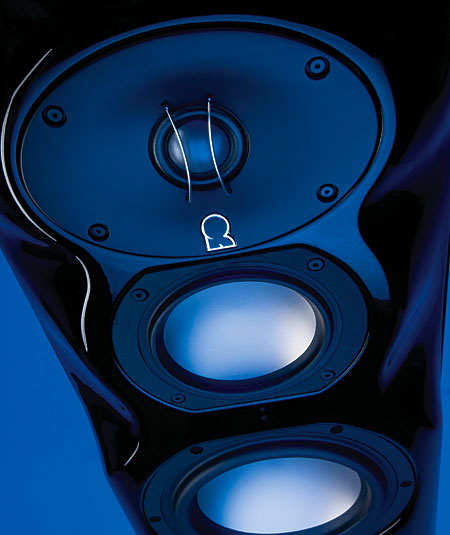 Not everyone shared this enthusiasm, finding the Salon1's Bauhaus aesthetic too industrial-looking. The speaker's 240-lb shipping weight, 51" height, and 30" depth also presented distinct challenges in placement and décor. Evidently, Revel listened—the Ultima Salon2 is slimmer, taller, and lighter.
What's the Same
Not everyone shared this enthusiasm, finding the Salon1's Bauhaus aesthetic too industrial-looking. The speaker's 240-lb shipping weight, 51" height, and 30" depth also presented distinct challenges in placement and décor. Evidently, Revel listened—the Ultima Salon2 is slimmer, taller, and lighter.
What's the Same
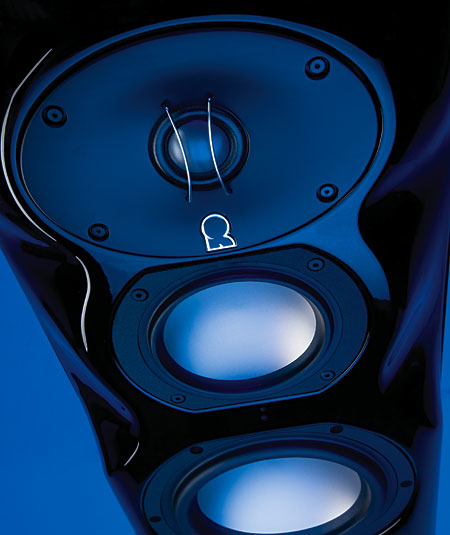
The Salon1 and Salon2 are both tall, heavy, floorstanding, four-way, ported dynamic loudspeakers bristling with Revel-designed drivers: a 1" dome tweeter, a 4" inverted titanium-dome midrange unit, a 6.5" midwoofer, and three 8" woofers. Their enclosures are constructed from 45mm-thick, nine-layer MDF molded into a gracefully curved form. Then, instead of the flat front panel and mitered sides of a typical box speaker, a thick, curved front baffle designed to minimize cabinet resonances is attached.
For each Salon, the goal was the same: achieve an off-axis response that closely matches the on-axis response. To this end, both speakers have: steep, fourth-order (24dB/octave) crossover slopes to prevent the distortions that occur when drivers work outside their optimal ranges; small midrange drivers; a relatively low tweeter crossover frequency; crossover components matched to within 0.5dB of the original reference prototype; and curved front baffles to minimize diffraction effects.
What's New
To create the Salon2, Revel put the Salon1 on a diet, morphing it into a slim, oval column that's 2.3" taller, 3" narrower, 7" shallower, and 72 lbs lighter than its predecessor. Gone are the Salon1's heavy side panels of rosewood veneer, separate head baffle, rear reflex port, and rear tweeter. Instead, the rear of the Salon2 is a smooth curve. The speaker-terminal panel is now covered by a door of smoked plastic. The curved front baffle is black, and the recessed drivers are now free of external mounting hardware. A new, magnet-fastened, black grille covers all six drivers. The Salon2's Revel-designed midrange drive-units use titanium diaphragms, this material chosen for its greater tensile strength. Dual motor pole-pieces are placed between two inverted and opposing neodymium magnets centered inside each voice-coil, to increase magnetic performance; smaller magnet/motor structures provide more usable internal speaker volume; new aluminum flux-stabilization rings further minimize flux modulation to reduce second-harmonic distortion; oversized voice-coils—2" for the woofer, 1.5" for the midrange—maximize output and minimize dynamic compression; and vent holes have been cut through the motor's pole and shield cup to remove trapped heat from inside the woofer's motor and reduce air noise inside the voice-coil.
The Salon2 has a tweeter with a beryllium dome, which has a low density but a high stiffness. These qualities push the tweeter dome's first breakup mode above 50kHz—twice as high as that of the Salon1's aluminum-dome tweeter—with usable frequency response up past 40kHz. A unique pin at the back of the tweeter's rear cavity helps break up standing waves, while a copper cap on the tweeter's pole-piece reduces inductance modulation and the corresponding harmonic distortion.
The tweeter is mounted in a shallow 4" by 5.5" waveguide, formed in the front baffle, that matches the tweeter's directivity to that of the midrange's at the crossover frequency. It also adds 3–7dB more gain around and above the crossover region, and reduces the tweeter's directivity above 9kHz. Because all of this increases the tweeter's output by 2dB, Revel decided that the Salon1's rear tweeter would not be needed in the Salon2.
The Salon2's woofers use aluminum cones rather than the Salon1's mica/carbon-filled copolymer cones, and are reflex-aligned with a hyperbolic, downward-firing, 16" by 4" port with an asymmetrical flare rate, to eliminate "chuffing" noise when the speaker is driven at high levels. The tunnel's tapered shape "behaves as if it is longer than a straight ducted port," according to Revel.
The use of separate filter boards for each of the crossover's four frequency ranges is said to prevent distortion-causing magnetic interference. Connections soldered point-to-point and large, air-core inductors are used on each board. The two pairs of heavy, gold-plated binding posts are mounted in a cast-aluminum panel set into a shallow depression cut into the Salon2's curved back. The hollowed-out posts accommodate spade lugs as well as speaker-cable plug adapters. Dual pairs of posts mean that the Salon2 can be driven by two stereo amplifiers (ie, biamplified) or with double speaker cables (ie, biwired). The owner's manual clearly explains these setups. If the owner prefers a more conventional arrangement of one stereo power amp and two pairs of speaker cables, two accessory jumper straps (supplied) connect the posts of the upper and lower drivers.
The Salon2's terminal panel is covered by a door of smoked plastic to maintain the enclosure's curved exterior. This door is too small and light to generate sonic disturbance when the speaker is playing, but the channel at the door's bottom proved too narrow for my speaker cables. As a result, I had to leave the door open.
The Salon2's terminal panel has two rotary controls for adjusting Tweeter Level and Low-Frequency Compensation. The Tweeter Level control offers five positions: 0, and ±0.5 and ±1.0dB. The Low-Frequency Compensation control has three settings: Contour produces a small (–1.5dB) but audible bass cut from 30 to 50Hz, to deal with standing-wave effects in the room; Boundary reduces the bass response by 5dB from 30 to 50Hz, to compensate for placing the speaker very close to a wall or building it into some sort of enclosure; Normal is for the optimum free-space placement.
Not everyone shared this enthusiasm, finding the Salon1's Bauhaus aesthetic too industrial-looking. The speaker's 240-lb shipping weight, 51" height, and 30" depth also presented distinct challenges in placement and décor. Evidently, Revel listened—the Ultima Salon2 is slimmer, taller, and lighter.
What's the Same
The Salon1 and Salon2 are both tall, heavy, floorstanding, four-way, ported dynamic loudspeakers bristling with Revel-designed drivers: a 1" dome tweeter, a 4" inverted titanium-dome midrange unit, a 6.5" midwoofer, and three 8" woofers. Their enclosures are constructed from 45mm-thick, nine-layer MDF molded into a gracefully curved form. Then, instead of the flat front panel and mitered sides of a typical box speaker, a thick, curved front baffle designed to minimize cabinet resonances is attached.
To create the Salon2, Revel put the Salon1 on a diet, morphing it into a slim, oval column that's 2.3" taller, 3" narrower, 7" shallower, and 72 lbs lighter than its predecessor. Gone are the Salon1's heavy side panels of rosewood veneer, separate head baffle, rear reflex port, and rear tweeter. Instead, the rear of the Salon2 is a smooth curve. The speaker-terminal panel is now covered by a door of smoked plastic. The curved front baffle is black, and the recessed drivers are now free of external mounting hardware. A new, magnet-fastened, black grille covers all six drivers. The Salon2's Revel-designed midrange drive-units use titanium diaphragms, this material chosen for its greater tensile strength. Dual motor pole-pieces are placed between two inverted and opposing neodymium magnets centered inside each voice-coil, to increase magnetic performance; smaller magnet/motor structures provide more usable internal speaker volume; new aluminum flux-stabilization rings further minimize flux modulation to reduce second-harmonic distortion; oversized voice-coils—2" for the woofer, 1.5" for the midrange—maximize output and minimize dynamic compression; and vent holes have been cut through the motor's pole and shield cup to remove trapped heat from inside the woofer's motor and reduce air noise inside the voice-coil.