Audiophiles sure don't have it easy. We put in a hard day sweating to hear those diminishing-return differences, and when we're finally ready to pontificate, no one at the party will obligingly ask us what we think. They've made that mistake before, you see, then spent the next 45 minutes frantically looking around the room for someone to rescue them.
 The trick is to save the long version for the online audio forums or these pages, and prepare a brief but enticing sound bite just in case anyone is unwary enough to ask.
My upstairs neighbor, an audio engineer, usually does know better, but one day he bit: "What speakers were you playing last night?"
Penaudio Serenades.
"I never heard of them before, but it sure sounded like somebody was playing the cello in your living room. What do you think of 'em?"
I pounced. "At $9000/pair, they'll cost you more than a song, but they really sing."
He wanted to hear more. Heh-heh-heh.
The usual song and dance
The trick is to save the long version for the online audio forums or these pages, and prepare a brief but enticing sound bite just in case anyone is unwary enough to ask.
My upstairs neighbor, an audio engineer, usually does know better, but one day he bit: "What speakers were you playing last night?"
Penaudio Serenades.
"I never heard of them before, but it sure sounded like somebody was playing the cello in your living room. What do you think of 'em?"
I pounced. "At $9000/pair, they'll cost you more than a song, but they really sing."
He wanted to hear more. Heh-heh-heh.
The usual song and dance
You may never have heard of Penaudio, either. I hadn't when I first encountered their diminutive Charisma two-way and Charm powered subwoofer at London's HiFi Show & AV Expo 2002. I couldn't believe how good those teensy things sounded. I wanted to review them. So I asked designer and impresario Sami Penttilä if he had Stateside distribution. "I don't have any distribution outside Finland," he said. "That's why I came to the show." I didn't have the heart to tell him how hard it was to break into the US and UK markets. That proved to be a wise move—Penttilä and Joe Abrams began bringing Penaudio into the States not long afterward (the speakers are now distributed by Penaudio USA). I reviewed Penaudio's Charisma two-way monitors and Chara passive subwoofer elsewhere, and they reinforced my first impression: that Penttilä knows what music is supposed to sound like.
He should. He's a musician—he plays piano, guitar, and acoustic bass guitar, and he frequently gigs with his brother, a drummer, and his wife, a violinist. He's also an engineer who relies on measurements to take him deep into the design of a loudspeaker. Then he relies on his everyday experience of music to hone his designs into real speakers.
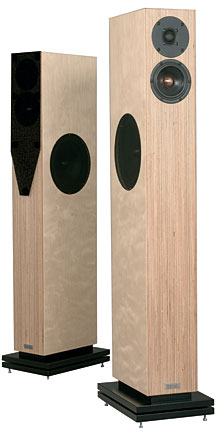
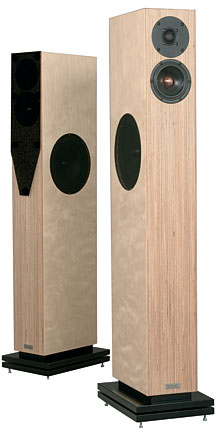
In the case of the Serenade, Penttilä began with the custom-made midrange driver he'd employed in his Charisma two-way, a specially modified 4.5" (120mm) driver from the SEAS Excel line that he liked to run wide-range—in the Charisma, from 180Hz to around 5.5kHz. The 4.5" driver has a 26mm voice-coil, and heavy copper rings above and below the pole-piece "to reduce nonlinear and modulation distortion." You don't see any of that, but what is visible is a solid copper phase plug that also serves as a heatsink for the pole-piece, something Penttilä deems "crucial" when you run a driver as wide open as he does.
He doesn't run the midrange driver quite as wide open in the Serenade. In addition to adding a woofer to the driver complement (more anon), Penttilä found a tweeter that scratched an itch he'd developed while comparing loudspeakers to the music he and his wife were making. "It was pretty obvious to me that there's something in live music's overtones that's missing in most loudspeakers, so I did some research with the University of Jyväskylä and we learned more about ultra-high frequencies, especially when we measured live music and SACD reproduction."
When Penttilä found the SEAS Excel-1, a 1" fabric-dome tweeter with silver voice-coil and magnetic-fluid cooling, he knew he'd found a mate for the midrange driver he was already enamored of. "[The tweeter] has an effective limit of 28kHz and then smoothly rolls off," Penttilä said. He had SEAS tweak the Excel-1 to his specs, and crossed over to it from the midrange at a "mere" 4.5kHz. The side-firing bass driver is also from SEAS, an 8" long-throw aluminum cone that has also been modified to Penttilä's specs, this time to include a four-layer, 1.5" voice-coil. It crosses over to the midrange at 180Hz.
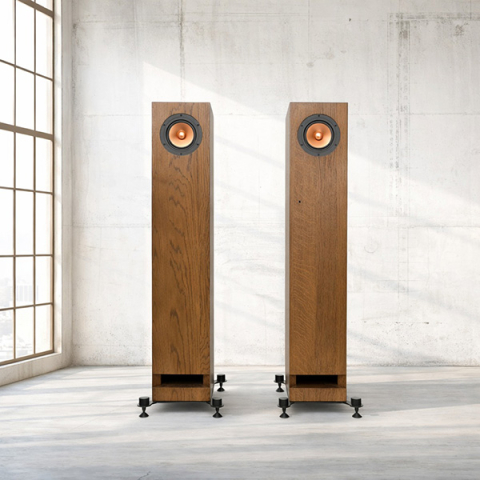
The Serenade's cabinet is striking. The speakers are narrow and tall (44.5" H by 6" W by 11" D), with birch-veneered side panels. The top, front, and back are finished in a 1.5mm veneer that shows the alternating laminations of the birch plywood. As a reformed wood butcher, I find this gorgeous. You may not, but it is impressive. Penttilä says the laminating adds to the damping, as does the ¾" MDF it covers (the interior side of the MDF is also veneered with birch) and the asymmetrically configured interior enclosures for the midrange/tweeter and woofer.
The crossover is acoustic fourth-order. "Well," says Penttilä, "I use a first-order on the midrange and a third-order on the tweeter, but add in the acoustical properties of the drivers and it's a fourth-order network. Actually, I try to use very little electric crossover and mostly rely on the acoustical properties of the drivers to cut off the band. That's also what dictated my crossover points, in addition to my belief that most instruments have their primary tones between 50Hz and about 3kHz—put a crossover point in there and it can be very audible."
He uses Alpha Core foil cores and polypropylene capacitors and WBT biwire binding posts. All in all, the Serenade comes with all the high-end-audio bling you'd expect from a $9000/pair loudspeaker.
Singing for my supper
Setting the Serenades up in my room was simple: I threaded the cone feet into the speakers' bases—the bases give the Serenades a larger, more stable footprint—and I was done. Well, not really. That's all I had to do to get them to sound okay (the anal-retentive in me notes that I also had to connect them to an amplifier), but I had to move the Serenades around a bit more than I'm used to to get them tuned in to my room. I ended up with the speakers closer to my front wall (about 36" did the trick) than has been my custom. The other placement parameter that proved tricky was splitting the optimum distance between each speaker and the nearest sidewall and the optimum distance between the speakers themselves. I never got this one quite right; placing the speakers closer to the sidewalls gave me deeper-sounding bass but put the speakers a tad too far apart than was ideal for soundstage solidity. (My listening room is 12.5' wide and I listen from about 15' in front of the speakers.) I opted for soundstage over extension, but this is one you'll have to figure out for yourself in your own room. It occurred to me that I was spending a lot of time getting the speakers in just the right spots, but the payoff was pretty spectacular.
Without a song, the bush knife is dull
But I hadn't even begun playing the speaker-placement game when the Serenades gave me notice that something special was in the house. I grabbed Might as Well...The Persuasions Sing Grateful Dead (CD, Arista GDCD 4070) and cued "Ripple." Time stopped. Well, that can't be right—music has to happen in time—but everything outside the music faded into insignificance. There is a road, no simple highway
Between the dawn and the dark of night
And if you go no one may follow
That path is for your steps alone. Three minutes later, everything started back up again. Jimmy Hayes' deep bass voice was solid enough to build a bridge on, and Jerry Lawson's sanctified tenor added just the right amount of raspy texture to tether all those silken harmonies to exactly between the dawn and the dark of night. I love that album, and I've heard that song hundreds of times—and because I do this for a living, I've heard tons of really great loudspeakers—but I knew from the git-go that the Serenades were something special. And that, my friends, is why I was willing to move 'em again and again to extract the last drop of performance from 'em.
The trick is to save the long version for the online audio forums or these pages, and prepare a brief but enticing sound bite just in case anyone is unwary enough to ask.
My upstairs neighbor, an audio engineer, usually does know better, but one day he bit: "What speakers were you playing last night?"
Penaudio Serenades.
"I never heard of them before, but it sure sounded like somebody was playing the cello in your living room. What do you think of 'em?"
You may never have heard of Penaudio, either. I hadn't when I first encountered their diminutive Charisma two-way and Charm powered subwoofer at London's HiFi Show & AV Expo 2002. I couldn't believe how good those teensy things sounded. I wanted to review them. So I asked designer and impresario Sami Penttilä if he had Stateside distribution. "I don't have any distribution outside Finland," he said. "That's why I came to the show." I didn't have the heart to tell him how hard it was to break into the US and UK markets. That proved to be a wise move—Penttilä and Joe Abrams began bringing Penaudio into the States not long afterward (the speakers are now distributed by Penaudio USA). I reviewed Penaudio's Charisma two-way monitors and Chara passive subwoofer elsewhere, and they reinforced my first impression: that Penttilä knows what music is supposed to sound like.
Setting the Serenades up in my room was simple: I threaded the cone feet into the speakers' bases—the bases give the Serenades a larger, more stable footprint—and I was done. Well, not really. That's all I had to do to get them to sound okay (the anal-retentive in me notes that I also had to connect them to an amplifier), but I had to move the Serenades around a bit more than I'm used to to get them tuned in to my room. I ended up with the speakers closer to my front wall (about 36" did the trick) than has been my custom. The other placement parameter that proved tricky was splitting the optimum distance between each speaker and the nearest sidewall and the optimum distance between the speakers themselves. I never got this one quite right; placing the speakers closer to the sidewalls gave me deeper-sounding bass but put the speakers a tad too far apart than was ideal for soundstage solidity. (My listening room is 12.5' wide and I listen from about 15' in front of the speakers.) I opted for soundstage over extension, but this is one you'll have to figure out for yourself in your own room. It occurred to me that I was spending a lot of time getting the speakers in just the right spots, but the payoff was pretty spectacular.
But I hadn't even begun playing the speaker-placement game when the Serenades gave me notice that something special was in the house. I grabbed Might as Well...The Persuasions Sing Grateful Dead (CD, Arista GDCD 4070) and cued "Ripple." Time stopped. Well, that can't be right—music has to happen in time—but everything outside the music faded into insignificance. There is a road, no simple highway
Between the dawn and the dark of night
And if you go no one may follow
That path is for your steps alone. Three minutes later, everything started back up again. Jimmy Hayes' deep bass voice was solid enough to build a bridge on, and Jerry Lawson's sanctified tenor added just the right amount of raspy texture to tether all those silken harmonies to exactly between the dawn and the dark of night. I love that album, and I've heard that song hundreds of times—and because I do this for a living, I've heard tons of really great loudspeakers—but I knew from the git-go that the Serenades were something special. And that, my friends, is why I was willing to move 'em again and again to extract the last drop of performance from 'em.