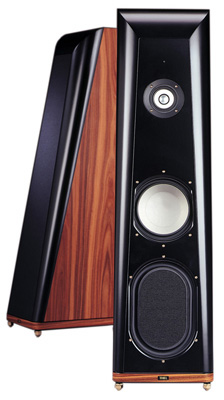
Jim Thiel sounded almost bored. "Almost everything about the CS2.4 is pretty standard stuff—short-coil, long-gap, low-distortion drivers, aluminum diaphragms, polystyrene capacitors, spatial coherence, time coherence, reduced diffraction baffles, reduced cabinet vibration, etc., etc. Of course, I think the execution of the 2.4 is more successful than our previous models, but in terms of what's really different, that mechanical crossover is what's special."
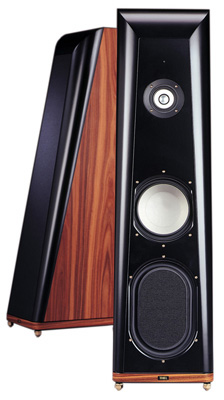 That mechanical crossover is the compound driver Thiel devised for the CS2.3: a 1" tweeter mounted coaxially inside a 3.5" midrange cone, both driven by a single voice-coil. Both drivers have anodized aluminum diaphragms, separated from one another by a compliant polypropylene surround. Because the two share a single magnetic system, there's no electrical crossover between them. At low frequencies, the voice-coil drives both diaphragms just as it would with any midrange driver, but at frequencies above 2.5kHz, that polypropylene "coupling suspension" has enough compliance to allow the midrange cone to decouple, and the voice-coil drives the tweeter diaphragm, to which it is directly connected.
"For not much more than the cost of a high-quality two-way (which is what the electrical crossover system is), you get the performance of a three-way. You get a lot more performance for the money."
That, to those of us who aren't genius speaker designers, is pretty special indeed. Thiel balks at such praise, however. "If you only knew how much time I spend mulling over and working on some of these ideas, well, the few solutions I've developed are..." He laughed ruefully. "It was one of those simple ideas that's easy to model on the computer—you can get the ratio of masses and the areas and the damping and compliance and the coupling suspension, and it works great in theory—but getting it to actually work in practice was quite a development project."
One that apparently paid huge sonic dividends in the CS2.3, to judge from Brian Damkroger's enthusiastic review in the January 1999 Stereophile, in which he compared its quickness of response to that of a Porsche 911. So when Thiel Audio Products' Kathy Gornik mentioned that the CS2.4 had never been examined by Stereophile, I quickly volunteered for the task. I don't have a driveway, let alone a Porsche, but I certainly have parking space in my listening room.
Magic is what we do. Music is the way we do it.
That mechanical crossover is the compound driver Thiel devised for the CS2.3: a 1" tweeter mounted coaxially inside a 3.5" midrange cone, both driven by a single voice-coil. Both drivers have anodized aluminum diaphragms, separated from one another by a compliant polypropylene surround. Because the two share a single magnetic system, there's no electrical crossover between them. At low frequencies, the voice-coil drives both diaphragms just as it would with any midrange driver, but at frequencies above 2.5kHz, that polypropylene "coupling suspension" has enough compliance to allow the midrange cone to decouple, and the voice-coil drives the tweeter diaphragm, to which it is directly connected.
"For not much more than the cost of a high-quality two-way (which is what the electrical crossover system is), you get the performance of a three-way. You get a lot more performance for the money."
That, to those of us who aren't genius speaker designers, is pretty special indeed. Thiel balks at such praise, however. "If you only knew how much time I spend mulling over and working on some of these ideas, well, the few solutions I've developed are..." He laughed ruefully. "It was one of those simple ideas that's easy to model on the computer—you can get the ratio of masses and the areas and the damping and compliance and the coupling suspension, and it works great in theory—but getting it to actually work in practice was quite a development project."
One that apparently paid huge sonic dividends in the CS2.3, to judge from Brian Damkroger's enthusiastic review in the January 1999 Stereophile, in which he compared its quickness of response to that of a Porsche 911. So when Thiel Audio Products' Kathy Gornik mentioned that the CS2.4 had never been examined by Stereophile, I quickly volunteered for the task. I don't have a driveway, let alone a Porsche, but I certainly have parking space in my listening room.
Magic is what we do. Music is the way we do it.
As Jim Thiel suggests, the CS2.4 is an evolutionary product, albeit one designed intelligently. It shares many of the characteristics of all Thiel loudspeakers, including Thiel's preferred acoustic first-order crossover, drivers designed and built in-house, and rigidly braced cabinets with sloping, radiused, 3"-thick baffles. Also like all Thiel designs, the CS2.4 is time-aligned and phase-coherent. "Etc, etc.," as Jim Thiel says. The tweeter and midrange drivers have neodymium magnets and boast a newly redesigned magnet venting system, which Thiel says reduces resonance. The 8" inverted-dome aluminum woofer is driven by a 2.5-lb magnet and is allied with a 7.5" by 11" oval passive radiator—a change from the CS2.3's round, 9" radiator.
As usual with Thiel speakers, the woodcraft, veneer matching, and overall fit'n'finish are exceptional. I've never been disappointed with this aspect of Thiel's total package, so I was surprised and impressed by several apparently small touches, including the adjustable, threaded brass cone feet, the brass binding posts (easily tightened with bare fingers or, if you're really into torque, a hex driver), and the magnetically attached speaker grilles. I say apparently small touches because these little luxuries cemented my impression that the CS2.4 is an awful lot of speaker for $4400/pair.
If your cup is full may it be again
Thiel supplies unusually detailed setup instructions in its manual, and you really need to follow them if you want to hear the CS2.4 sing in tune. Although the speaker benefits immensely from being situated well away from the front and sidewalls (my review pair wound up 3' from my sidewalls and slightly more than 4' into the room), the most important parameters will be your seating distance from the CS2.4s and the height of your ears. The speakers need at least 8' between your sweet spot and them or they won't be phase- and time-coherent. I sat about 13' away. Listeners who sit lower in their seats than I do might find they need to get closer to the speakers—carefully observing Thiel's minimum suggestions, of course. I've reviewed Thiels before, and usually this is the point where I have to say something like Be careful to mate them to an amp that's capable of really driving them. That's because Jim Thiel believes in speakers having low impedances, that requires a stiff kick in the chops. Thiel's answer to the question why is simple: "Watts is cheap."
If the CS2.4 was hard to drive, it did not reveal itself to me. I tried a 35Wpc tube amp, several 100Wpc solid-state amps, and several more powerful hybrid and solid-state amps. I even connected it to my newly acquired Fisher 500-B (thank you, Peter Breuninger, for your series of Stereophile reviews of vintage audio gear), which, while not my first choice for the job, did not acquit itself too badly. In other words, the CS2.4 seemed a fairly easy Thiel to drive. I'm tempted to attribute this to the mechanical crossover between the tweeter and midrange, but I suppose John Atkinson's measurements will confirm or refute this conjecture.
That mechanical crossover is the compound driver Thiel devised for the CS2.3: a 1" tweeter mounted coaxially inside a 3.5" midrange cone, both driven by a single voice-coil. Both drivers have anodized aluminum diaphragms, separated from one another by a compliant polypropylene surround. Because the two share a single magnetic system, there's no electrical crossover between them. At low frequencies, the voice-coil drives both diaphragms just as it would with any midrange driver, but at frequencies above 2.5kHz, that polypropylene "coupling suspension" has enough compliance to allow the midrange cone to decouple, and the voice-coil drives the tweeter diaphragm, to which it is directly connected.
"For not much more than the cost of a high-quality two-way (which is what the electrical crossover system is), you get the performance of a three-way. You get a lot more performance for the money."
That, to those of us who aren't genius speaker designers, is pretty special indeed. Thiel balks at such praise, however. "If you only knew how much time I spend mulling over and working on some of these ideas, well, the few solutions I've developed are..." He laughed ruefully. "It was one of those simple ideas that's easy to model on the computer—you can get the ratio of masses and the areas and the damping and compliance and the coupling suspension, and it works great in theory—but getting it to actually work in practice was quite a development project."
As Jim Thiel suggests, the CS2.4 is an evolutionary product, albeit one designed intelligently. It shares many of the characteristics of all Thiel loudspeakers, including Thiel's preferred acoustic first-order crossover, drivers designed and built in-house, and rigidly braced cabinets with sloping, radiused, 3"-thick baffles. Also like all Thiel designs, the CS2.4 is time-aligned and phase-coherent. "Etc, etc.," as Jim Thiel says. The tweeter and midrange drivers have neodymium magnets and boast a newly redesigned magnet venting system, which Thiel says reduces resonance. The 8" inverted-dome aluminum woofer is driven by a 2.5-lb magnet and is allied with a 7.5" by 11" oval passive radiator—a change from the CS2.3's round, 9" radiator.
Thiel supplies unusually detailed setup instructions in its manual, and you really need to follow them if you want to hear the CS2.4 sing in tune. Although the speaker benefits immensely from being situated well away from the front and sidewalls (my review pair wound up 3' from my sidewalls and slightly more than 4' into the room), the most important parameters will be your seating distance from the CS2.4s and the height of your ears. The speakers need at least 8' between your sweet spot and them or they won't be phase- and time-coherent. I sat about 13' away. Listeners who sit lower in their seats than I do might find they need to get closer to the speakers—carefully observing Thiel's minimum suggestions, of course. I've reviewed Thiels before, and usually this is the point where I have to say something like Be careful to mate them to an amp that's capable of really driving them. That's because Jim Thiel believes in speakers having low impedances, that requires a stiff kick in the chops. Thiel's answer to the question why is simple: "Watts is cheap."