I'd heard rumors about Peak Consult. John Marks was all a-burble, having reviewed the InCognito in "The Fifth Element" in the September 2003 Stereophile, but I'd never actually heard anything designed by PC's Per Kristoffersen. Therefore, when US distributor Chris Sommovigo proposed that I audition the $25,000/pair Empress, I was intrigued. Well, who wouldn't be?
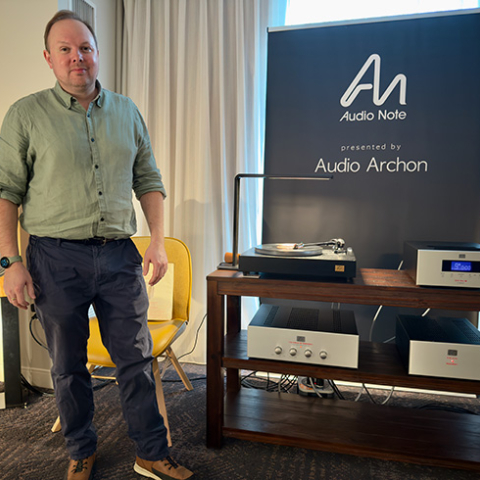
 But, as anyone who has ever been talked into a blind date will attest, getting fixed up with a complete stranger can be intimidating. Obviously, what I needed was the audio equivalent of the "safe" first date, hooking up in neutral territory—someplace where the Empress or I could safely withdraw if the chemistry weren't right. As it turned out, PC's American distributor, Signals SuperFi LLC, had sent a pair of the Danish speakers to Sound by Singer, where store owner Andy Singer was on his own blind date—which has since developed into an ongoing relationship.
And before I put that metaphor to bed, let me just say that the Empress wound up going home with both of us—even if I do come off as less than a gentleman for saying so.
I am one of the people who love the why of things
But, as anyone who has ever been talked into a blind date will attest, getting fixed up with a complete stranger can be intimidating. Obviously, what I needed was the audio equivalent of the "safe" first date, hooking up in neutral territory—someplace where the Empress or I could safely withdraw if the chemistry weren't right. As it turned out, PC's American distributor, Signals SuperFi LLC, had sent a pair of the Danish speakers to Sound by Singer, where store owner Andy Singer was on his own blind date—which has since developed into an ongoing relationship.
And before I put that metaphor to bed, let me just say that the Empress wound up going home with both of us—even if I do come off as less than a gentleman for saying so.
I am one of the people who love the why of things
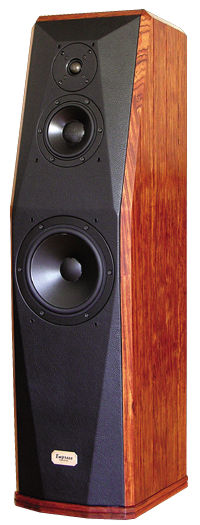
The Peak Consult Empress is a reasonably compact (42.5" H by 11.5" W by 15" D) floorstander with a rear-firing port. Its drive-units comprise a 1"-diameter, non–ferrofluid-cooled ScanSpeak soft-dome tweeter, a hand-built 4" Audiotechnology midrange, and a proprietary, hand-built, 8" Audiotechnology woofer. Per Kristoffersen worked closely with Audiotechnology's Ejvind Skaaning's son, Per, on the midrange and woofer designs.
The Empress's cabinet is made of HDF with separate subenclosures for each driver and the crossover, the latter varying in thickness from 1.5" to 3". All of this is sheathed in 1"-thick hardwood—not veneer—chosen by Danish woodworkers using the "knuckle-tap" test. Rosewood, oak, and beech are standard; my review pair was clad in gorgeous walnut. The cabinet's multifaceted baffle is covered in pebbled leather. Removable grilles are provided, but I didn't use them in the audition.
Kristoffersen describes the crossovers as an acoustical second-order filter for the tweeter/midrange section and a second-order for the transition from the midrange to the bass. The crossover points are 200Hz and 3800Hz. All solder is silver, and the wire is Stereovox's silver elliptical tubing (SET) in air-articulated Teflon tape. The Empress is biwirable.
Oedipus, have you ever been fueled by passion?
The Empress is rated at 90dB sensitivity, so I didn't think twice about simply popping them into the system I'd used for my review of the Ayre C-5xe universal disc player in the July 2005 issue, which included Ayre's K-5xe preamp and V-5xe 150Wpc power amp. After moving the speakers around a bit in my 13' by 25' by 8' living room, I found the best combination of bottom end, detail, and focus came with the speakers slightly toed in and 37" from the sidewalls, 57" from the front wall, 57" apart, and 13' from my listening position.
After several weeks of listening to the all-Ayre system, I began playing around with other components. Introducing the Conrad-Johnson ACT2 made a huge difference in soundstage depth, and ditto the Moscode 401HR—the Empresses really seemed to like tubes. The 200Wpc Moscode really clicked with the Peak Consult, causing me to wonder if it's a speaker that likes to be spanked a bit. When I later added the Tom Colangelo–designed, 200Wpc Viola Labs Symphony amplifier to the system, it seemed to confirm this, although Chris Sommovigo tells me that he uses one of Manley Labs' power amps in triode mode. All I can say is that the Empress displayed the greatest depth, soundstage layering, and inner detail with the 200Wpc amps I threw at it. Your room, your taste, your results may differ—but that's what happened chez Wes.
I praise loudly, I blame softly
My first impression of the Empress's sound, in that Sound by Singer showroom, was of three-dimensional soundstage reproduction melded to extremely natural tonality. Simple recordings of unamplified music, especially vocals, were scarily convincing—even down to scale. That's essentially the performance baseline I achieved early on in my audition, as well. Morten Lauridsen's O magnum mysterium, from Cantus's Comfort and Joy: Volume One (CD, Cantus CTS-1204), made the speakers and my room's walls "disappear," creating instead a far larger acoustic jumping with the clangy overtones of 10 unaccompanied voices. This was audio illusioneering at its very best—the Empresses didn't merely re-create Cantus standing in a crescent between the speakers, they reconstructed all of Sauder Hall around them.
Spacious? You have no idea. Neither did I, apparently, as I discovered when I added the C-J ACT2 to the system. And Shunyata Orion loudspeaker cables. And Viola Labs' silver Cables. In other words, as good as the sound was when I started, I managed to keep wresting greater and greater amounts of detail and clarity each time I paid attention to a new component. Royalty—go figure.
What consistently knocked me out with the Empress, in fact, was its way with the human voice. Choral groups such as Cantus, solo performers such as Emmylou Harris or Lucinda Williams, craggy male singers such as Elvis Costello—if it was sung, the Empress swung.
My pal Jeff Wong turned me on to the Heartless Bastards with a (legal) download of one of their shows. The sound quality was abysmal—John Atkinson found it so disturbing he threatened to measure the Empress in situ to ensure that it wasn't my room that was causing the problems he heard. ("Oh, that was an MP3," he sighed in relief.) But there was something there, and when I brought home Stairs and Elevators (CD, Fat Possum 1019), it was obvious what it was: Erika Wennerstrom's amazing voice. Her raw wail is like a combination of Jeff Buckley and Robert Plant, backed by a three-piece band (she's the guitarist) that channels the best elements of the Strokes and the White Stripes. Wubbawubba.
Husky, raw, primordial, and compelling, Wennerstrom's singing is almost too personal to bear—right up to the point where you realize that it might be the most committed singing you've ever heard. Maybe you won't react that way, but by track 5 ("Runnin' ") I was hooked, and by "Pass or Fail" two tracks later, I was head over heels.
Here's where we get back to the Empress: It was a great rock'n'roll loudspeaker. Even Stairs and Elevators isn't all that well engineered, a detail that it wouldn't take a $25,000 pair of loudspeakers to reveal, but a lot of high-performance speakers wouldn't let you get past that. I'm sure you've heard audiophiles complain, "My system is so good I can't even listen to most recordings!" Squeeze me? That's not good—that's broke!
Yes, a good hi-fi will reveal whether or not a recording is technically good—and given our druthers, we'd all prefer to listen to the good stuff. Unfortunately, a lot of the good stuff doesn't sound as good as we'd like it to. I, for one, don't want my hi-fi deciding which records I can and can't listen to, which is why I was delighted that the Empress let me hear the passion and power of Wennerstrom's voice even as it clearly illustrated that the Heartless Bastards got what they paid for when they budgeted $400 for recording Stairs and Elevators. Oh yeah, the Peak Consults can rock and roll.
Speaking of clangy, I stumbled across my copy of Stereophile webmaster Jon Iverson's Alternesia (CD, Momentum/M•A Recordings M3) while seeking demo material, and listened to JI's great grunge gamelan disc for the first time in a long while. Holy cow—I hadn't remembered it sounding anything like this. From the disc's slowly swelling gong washes to its breakneck percussive core, Alternesia put the Peak Consults through the wringer, alternating the extended decay of its bells and chimes with its deceptively deep (occasionally enhanced) bass pulse. This is really hard music to reproduce—it requires a combination of harmonic delicacy and profound authority. To my surprise, the Empress supplied both.
But, as anyone who has ever been talked into a blind date will attest, getting fixed up with a complete stranger can be intimidating. Obviously, what I needed was the audio equivalent of the "safe" first date, hooking up in neutral territory—someplace where the Empress or I could safely withdraw if the chemistry weren't right. As it turned out, PC's American distributor, Signals SuperFi LLC, had sent a pair of the Danish speakers to Sound by Singer, where store owner Andy Singer was on his own blind date—which has since developed into an ongoing relationship.
And before I put that metaphor to bed, let me just say that the Empress wound up going home with both of us—even if I do come off as less than a gentleman for saying so.
I am one of the people who love the why of things
The Peak Consult Empress is a reasonably compact (42.5" H by 11.5" W by 15" D) floorstander with a rear-firing port. Its drive-units comprise a 1"-diameter, non–ferrofluid-cooled ScanSpeak soft-dome tweeter, a hand-built 4" Audiotechnology midrange, and a proprietary, hand-built, 8" Audiotechnology woofer. Per Kristoffersen worked closely with Audiotechnology's Ejvind Skaaning's son, Per, on the midrange and woofer designs.
The Empress is rated at 90dB sensitivity, so I didn't think twice about simply popping them into the system I'd used for my review of the Ayre C-5xe universal disc player in the July 2005 issue, which included Ayre's K-5xe preamp and V-5xe 150Wpc power amp. After moving the speakers around a bit in my 13' by 25' by 8' living room, I found the best combination of bottom end, detail, and focus came with the speakers slightly toed in and 37" from the sidewalls, 57" from the front wall, 57" apart, and 13' from my listening position.
My first impression of the Empress's sound, in that Sound by Singer showroom, was of three-dimensional soundstage reproduction melded to extremely natural tonality. Simple recordings of unamplified music, especially vocals, were scarily convincing—even down to scale. That's essentially the performance baseline I achieved early on in my audition, as well. Morten Lauridsen's O magnum mysterium, from Cantus's Comfort and Joy: Volume One (CD, Cantus CTS-1204), made the speakers and my room's walls "disappear," creating instead a far larger acoustic jumping with the clangy overtones of 10 unaccompanied voices. This was audio illusioneering at its very best—the Empresses didn't merely re-create Cantus standing in a crescent between the speakers, they reconstructed all of Sauder Hall around them.