Back in 1984, when I still had all my hair and began listening to digital audio (wait a minute...), I was disappointed with the compact disc. Most of that disappointment came from the format's musical performance, which was poor, but a portion of my dismay came from realizing that my days as a hands-on hobbyist were numbered: I was used to selecting and setting up my own turntable, tonearm, and cartridge, but a CD player defied such involvement. Plugging it in and playing it were all that I or most anyone else could do.  Small consolation came when the first outboard D/A converters were introduced to the consumer marketplace: Some of our freedom to throw money at our stereos had been restored, along with, sometimes, a bit more of the music. But the thrill wore off as the numbing sameness of most DACs—and, for that matter, most transports—became obvious. We still had the right to spend money, but that was about all. Things are better now. We can choose digital technologies that suit our music, or at least our ways of imagining how music ought to be replayed. Even if we ignore such higher life forms as SACD and focus solely on "Red Book" CD, we can buy whatever it is we think we want: oversampling, upsampling, multi-bit, single-bit, one-box, two-box (red-box, blue-box)...
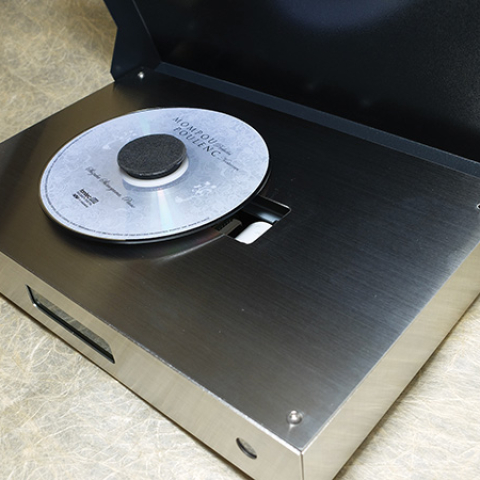
It seems to me that the two-box Shigaraki combo from Japan's 47 Laboratory is aimed more at that old-style hobbyist—the individualist, if you will—than the average audiophile. There are no doors or drawers on the 4716 transport, and the user must manually clamp the disc on its exposed drive hub. (The manufacturer suggests keeping the lightweight magnetic clamp in place when not in use, to protect the laser lens from dust.) He or she must also press a button to get the player to read the disc's table of contents prior to playback. And the low-contrast display won't even say if the disc is HDCD-encoded or not, let alone what song happens to be playing at that moment. Of course, there's a bigger reason for that last bit: The Shigaraki combo doesn't do HDCD, because it doesn't have a digital filter. This is an extremely stripped-down digital playback system whose designer, 47 Laboratory's Junji Kimura, has disregarded current digital practice in favor of what he believes is required to preserve and retrieve the most essential elements of the music. Or, more to the point, what isn't required. Let's take a closer look at that transport: The Shigaraki 4716 seems about as simple as such things can get, and the only reason it's even this large is because it uses old-fashioned resistors and capacitors on single-sided boards, rather than the surface-mount approach used in such high-tech things as MP3 players and my daughter's talking Barbie-as-Rapunzel doll. The laser unit is a straight-line, flat-gear sled from C.E.C., the only "modification" being its attachment to a chunky slab of ceramic. (The ceramic used, Shigaraki, is the origin of this product line's name.) The main circuit board also looks distinctly OEM, its only alterations being the addition of metal heatsinks to a few of the active parts. Digital output is S/PDIF coaxial only, although the user has a choice of two RCA jacks: one in which DC is present, and one with a capacitor for blocking same. The former is intended for use with the companion 4715 D/A converter.
The 4715 is surely among the smallest DACs in high-end audio, and the main reason for that is Kimura's desire to keep signal paths as short as possible. Mission accomplished, I'd say. The converter is the more radical of these two products: It has no digital filter chip—so it can run neither resolution-enhancement schemes à la HDCD nor bog-standard oversampling—and it doesn't even contain an analog filter. What it does contain is a total of only 20 parts: 7 resistors, 3 film capacitors, 6 electrolytic capacitors, 2 voltage regulators, and 2 chips. Of the last, one is a Philips TDA1543T 16-bit dual DAC, the other a Crystal CD8412 input receiver. That's it—that and a tiny circuit board, a few jacks, and a neat-looking ceramic box. There isn't even an op-amp for converting current to voltage at the output, because that's done passively, with two resistors. Now let's go back to the DAC's curious lack of oversampling, an otherwise common scheme in which digital spuriae are pushed into a higher frequency range, where they can then be removed by a more benign filter than the rightly maligned "brick walls" of yore. (I admit that such "make things worse before you make them better" techniques appeal to me, at least in theory—like early Dolby NR, or the fact that fishhooks, once embedded in your skin, have to be pushed in deeper before they can be got out.) The reason for omitting an oversampling filter has to do with that other CD bugaboo, jitter, which, as you know, refers to timing errors in the digital domain. Japanese audio writer Ryohei Kusunoki describes a parameter called "timing-error threshold," which is the amount of jitter allowable in a digital system before it corrupts the post-conversion waveform. Kusunoki predicts a timing-error threshold of 173 picoseconds for a 16-bit digital playback system with a 44.1kHz sampling rate (1÷44.1kHz÷216=173).
Small consolation came when the first outboard D/A converters were introduced to the consumer marketplace: Some of our freedom to throw money at our stereos had been restored, along with, sometimes, a bit more of the music. But the thrill wore off as the numbing sameness of most DACs—and, for that matter, most transports—became obvious. We still had the right to spend money, but that was about all. Things are better now. We can choose digital technologies that suit our music, or at least our ways of imagining how music ought to be replayed. Even if we ignore such higher life forms as SACD and focus solely on "Red Book" CD, we can buy whatever it is we think we want: oversampling, upsampling, multi-bit, single-bit, one-box, two-box (red-box, blue-box)...
It seems to me that the two-box Shigaraki combo from Japan's 47 Laboratory is aimed more at that old-style hobbyist—the individualist, if you will—than the average audiophile. There are no doors or drawers on the 4716 transport, and the user must manually clamp the disc on its exposed drive hub. (The manufacturer suggests keeping the lightweight magnetic clamp in place when not in use, to protect the laser lens from dust.) He or she must also press a button to get the player to read the disc's table of contents prior to playback. And the low-contrast display won't even say if the disc is HDCD-encoded or not, let alone what song happens to be playing at that moment. Of course, there's a bigger reason for that last bit: The Shigaraki combo doesn't do HDCD, because it doesn't have a digital filter. This is an extremely stripped-down digital playback system whose designer, 47 Laboratory's Junji Kimura, has disregarded current digital practice in favor of what he believes is required to preserve and retrieve the most essential elements of the music. Or, more to the point, what isn't required. Let's take a closer look at that transport: The Shigaraki 4716 seems about as simple as such things can get, and the only reason it's even this large is because it uses old-fashioned resistors and capacitors on single-sided boards, rather than the surface-mount approach used in such high-tech things as MP3 players and my daughter's talking Barbie-as-Rapunzel doll. The laser unit is a straight-line, flat-gear sled from C.E.C., the only "modification" being its attachment to a chunky slab of ceramic. (The ceramic used, Shigaraki, is the origin of this product line's name.) The main circuit board also looks distinctly OEM, its only alterations being the addition of metal heatsinks to a few of the active parts. Digital output is S/PDIF coaxial only, although the user has a choice of two RCA jacks: one in which DC is present, and one with a capacitor for blocking same. The former is intended for use with the companion 4715 D/A converter.
The 4715 is surely among the smallest DACs in high-end audio, and the main reason for that is Kimura's desire to keep signal paths as short as possible. Mission accomplished, I'd say. The converter is the more radical of these two products: It has no digital filter chip—so it can run neither resolution-enhancement schemes à la HDCD nor bog-standard oversampling—and it doesn't even contain an analog filter. What it does contain is a total of only 20 parts: 7 resistors, 3 film capacitors, 6 electrolytic capacitors, 2 voltage regulators, and 2 chips. Of the last, one is a Philips TDA1543T 16-bit dual DAC, the other a Crystal CD8412 input receiver. That's it—that and a tiny circuit board, a few jacks, and a neat-looking ceramic box. There isn't even an op-amp for converting current to voltage at the output, because that's done passively, with two resistors. Now let's go back to the DAC's curious lack of oversampling, an otherwise common scheme in which digital spuriae are pushed into a higher frequency range, where they can then be removed by a more benign filter than the rightly maligned "brick walls" of yore. (I admit that such "make things worse before you make them better" techniques appeal to me, at least in theory—like early Dolby NR, or the fact that fishhooks, once embedded in your skin, have to be pushed in deeper before they can be got out.) The reason for omitting an oversampling filter has to do with that other CD bugaboo, jitter, which, as you know, refers to timing errors in the digital domain. Japanese audio writer Ryohei Kusunoki describes a parameter called "timing-error threshold," which is the amount of jitter allowable in a digital system before it corrupts the post-conversion waveform. Kusunoki predicts a timing-error threshold of 173 picoseconds for a 16-bit digital playback system with a 44.1kHz sampling rate (1÷44.1kHz÷216=173).
Small consolation came when the first outboard D/A converters were introduced to the consumer marketplace: Some of our freedom to throw money at our stereos had been restored, along with, sometimes, a bit more of the music. But the thrill wore off as the numbing sameness of most DACs—and, for that matter, most transports—became obvious. We still had the right to spend money, but that was about all. Things are better now. We can choose digital technologies that suit our music, or at least our ways of imagining how music ought to be replayed. Even if we ignore such higher life forms as SACD and focus solely on "Red Book" CD, we can buy whatever it is we think we want: oversampling, upsampling, multi-bit, single-bit, one-box, two-box (red-box, blue-box)...