Even the most savvy Stereophile reader might wonder what a "network music player" is. Linn rightly considers a music server to be a combination of 1) stored digital files, 2) music-management software, and 3) a device that uses #2 to transfer #1 to your hi-fi. What Linn's Klimax DS is is a high-quality digital-to-analog converter (DAC) that receives digital data through an Ethernet connection rather than optical or electrical S/PDIF or AES/EBU inputs.
 The Klimax DS doesn't store your files—you'll need a network-attached storage (NAS) drive for that—nor does it allow you to organize your files or construct playlists, for which Linn does supply a graphic user interface (GUI), which runs on a computer or PC tablet (Linn's recommendation) that you supply. While it can be connected to your existing WiFi system, like other music servers, because the Klimax DS can handle192kHz sample rates at a word length of 24 bits, Linn very much prefers you to establish a wired network to ensure maximum performance. The Klimax doesn't have an optical disc drive, so you'll need a separate PC to rip your files—or you could do what Linn recommends and "hire a ripping service to do it for you."
The Klimax DS is unlike any other network music devices because it assumes you're starting with high-quality sources, not lossy compressed files. Linn's default standard is lossless-compressed FLAC files. But its real glory is handling higher-rez material—not only does it accept native resolutions up to 192kHz, it also upconverts to 384kHz or 352.8kHz.
The price for such clarity of purpose? Linn's CEO, Ivor Tiefenbrun, assures us that it's less than $20,000. Discovering if the Klimax DS is worth that price was hard work, but, as Sam Spade told the fat man, I don't mind a reasonable amount of trouble.
"These are facts, historical facts, not schoolbook history"
The Klimax DS doesn't store your files—you'll need a network-attached storage (NAS) drive for that—nor does it allow you to organize your files or construct playlists, for which Linn does supply a graphic user interface (GUI), which runs on a computer or PC tablet (Linn's recommendation) that you supply. While it can be connected to your existing WiFi system, like other music servers, because the Klimax DS can handle192kHz sample rates at a word length of 24 bits, Linn very much prefers you to establish a wired network to ensure maximum performance. The Klimax doesn't have an optical disc drive, so you'll need a separate PC to rip your files—or you could do what Linn recommends and "hire a ripping service to do it for you."
The Klimax DS is unlike any other network music devices because it assumes you're starting with high-quality sources, not lossy compressed files. Linn's default standard is lossless-compressed FLAC files. But its real glory is handling higher-rez material—not only does it accept native resolutions up to 192kHz, it also upconverts to 384kHz or 352.8kHz.
The price for such clarity of purpose? Linn's CEO, Ivor Tiefenbrun, assures us that it's less than $20,000. Discovering if the Klimax DS is worth that price was hard work, but, as Sam Spade told the fat man, I don't mind a reasonable amount of trouble.
"These are facts, historical facts, not schoolbook history"
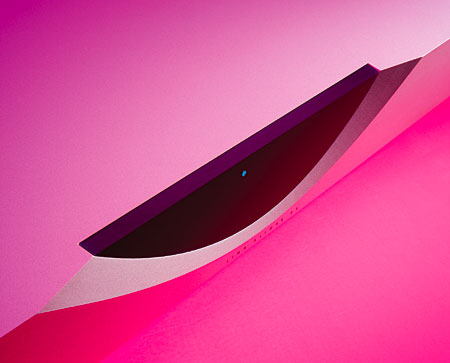
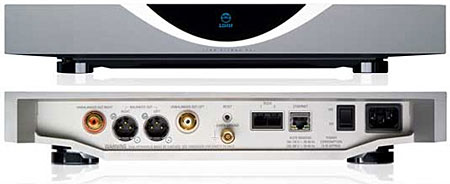
The Klimax DS shares the slimline chassis style established by the Sondek CD12 CD player (now discontinued) and carried on by the Klimax amplifiers and Kontrol preamplifier. That means it's machined from a solid billet of aluminum, which assures it of excellent EMF shielding and mechanical isolation. The front panel has an almost Zen-like simplicity: no buttons or controls. The dark, half-moon–shaped panel in the middle of its faceplate is the display. The rear panel, which is overhung by the Klimax DS's "lid," has pairs of RCA and balanced XLR outputs, two RS-232 ports to communicate with other Linn components, an Ethernet port, a power switch, and an IEC power socket. The proximity of the overhang to the AC module means you won't be able to use any macho power cables. As it happened, the power cable supplied by Linn did transmit AC just fine from my wall outlet to the Klimax DS. (Phew! )
What's under the hood? Upconversion is handled by a Xilinx field-programmable gate-array stage, and the D/A conversion is done by Wolfson delta-sigma devices with isolating output transformers. Linn doesn't include a drive in the Klimax, I was told, because they wanted the Klimax to be an entirely "open" product and not limited to specific optical disc formats.
"Here's to plain speaking and clear understanding"
The Klimax DS is not a component for anyone attempting to do a music server on the cheap. Whether you find this a deal-breaker or not will depend, I reckon, on two things: money, and your desire to have the "best" digital sound. Linn is obviously assuming you have lots of the first and a powerful version of the second. I'm not the typical Linn customer, so my experience with the Klimax DS wasn't what that customer would have. As Linn explains it, your Klimax would normally be installed by a dealer, who would encourage you to prepare by buying an NAS drive and having your digital library ripped to it by a service such as MusicShifter. If you purchased a 1TB NAS from MusicShifter and had them rip 600 discs to FLAC, you'd pay a little over $1000.
 Then your dealer would bring your Klimax DS over, install it in your system, and add a WiFi router (they start at around $50) and an Ethernet hub (another $50). Then he'd connect them all to your system and your now-filled NAS and show you how to operate your system with the tablet PC (another $1000), using Linn's graphic user interface (GUI) or one of the many open-source GUIs available. If that's your experience, your initial response to the Klimax DS will probably be fairly favorable.
I was at the opposite end of the spectrum. I picked up the Klimax DS, a pre-filled NAS, a WiFi router, the Ethernet hub, and a Samsung tablet PC from Wolfson's exhibit at last October's AES Convention, and proceeded to attempt to connect it intuitively. I do not recommend this approach. (Neither, I hasten to point out, does Linn—the company was notorious for cutting off dealers who would sell their LP12 turntable without setting it up, so I assume they're just as picky in the digital age footnote 1.)
My point is that Linn's GUI is not intuitive. It's also, as I discovered, rather clunky and, not to put too fine a point on it, stupid. For instance, the most basic attraction of a music server, as I understand it, is the ability to easily manipulate your digital files, creating and changing playlists—and, if you manage to come up with a good 'un, to store it. The Linn GUI will let you create a playlist, but it will play files only in the order in which you add them to the list. You can't randomize, you can't drag and drop the files into a more pleasing arrangement, and if you do put in the hours creating a playlist with tracks in the precise order that you'd like to listen to them, you can't save it.
To handle those chores, Linn suggests that you download Media Monkey, Music IP, or similar open-format applications. I tried Twonky Media Server at Linn's suggestion, but was not impressed.
One last setup grouse: The cooling fan of the Linn-supplied NAS drive was offensively noisy, alternating between very and extremely loud. (The case houses four 3.5" drives, which run hot.) My solution was simple: I put it in another room. Ethernet cables are cheap.
"You'll take it and like it"
Then your dealer would bring your Klimax DS over, install it in your system, and add a WiFi router (they start at around $50) and an Ethernet hub (another $50). Then he'd connect them all to your system and your now-filled NAS and show you how to operate your system with the tablet PC (another $1000), using Linn's graphic user interface (GUI) or one of the many open-source GUIs available. If that's your experience, your initial response to the Klimax DS will probably be fairly favorable.
I was at the opposite end of the spectrum. I picked up the Klimax DS, a pre-filled NAS, a WiFi router, the Ethernet hub, and a Samsung tablet PC from Wolfson's exhibit at last October's AES Convention, and proceeded to attempt to connect it intuitively. I do not recommend this approach. (Neither, I hasten to point out, does Linn—the company was notorious for cutting off dealers who would sell their LP12 turntable without setting it up, so I assume they're just as picky in the digital age footnote 1.)
My point is that Linn's GUI is not intuitive. It's also, as I discovered, rather clunky and, not to put too fine a point on it, stupid. For instance, the most basic attraction of a music server, as I understand it, is the ability to easily manipulate your digital files, creating and changing playlists—and, if you manage to come up with a good 'un, to store it. The Linn GUI will let you create a playlist, but it will play files only in the order in which you add them to the list. You can't randomize, you can't drag and drop the files into a more pleasing arrangement, and if you do put in the hours creating a playlist with tracks in the precise order that you'd like to listen to them, you can't save it.
To handle those chores, Linn suggests that you download Media Monkey, Music IP, or similar open-format applications. I tried Twonky Media Server at Linn's suggestion, but was not impressed.
One last setup grouse: The cooling fan of the Linn-supplied NAS drive was offensively noisy, alternating between very and extremely loud. (The case houses four 3.5" drives, which run hot.) My solution was simple: I put it in another room. Ethernet cables are cheap.
"You'll take it and like it"
You may well be asking: Enough already with CDs—how do I get the hi-rez files the Klimax DS was made to play?
Well, you can download them from the Internet. At the moment, there are two main sources: Linn's Studio Master downloads and Mark Waldrep's iTrax. They won't be the only game in town for long, however.
There are minor problems with this. For one thing, you'll need another computer. And you better get yourself a download manager, because 24-bit/96kHz files are huge, even in FLAC form, and you can't manually download an entire album, you have to do it track by track, at least at Linn's website. For $25 I bought iGetter, which uses segmented (accelerated) downloading. I simply put 96 tracks into the queue, turned iGetter loose, and forgot all about it—until my laptop told me it had 800MB of hard-drive space left. Yup, those are big files.
Footnote 1: The Klimax DS's shipping box warns in large print that "This product must be installed by an authorized retailer."—John Atkinson
The Klimax DS doesn't store your files—you'll need a network-attached storage (NAS) drive for that—nor does it allow you to organize your files or construct playlists, for which Linn does supply a graphic user interface (GUI), which runs on a computer or PC tablet (Linn's recommendation) that you supply. While it can be connected to your existing WiFi system, like other music servers, because the Klimax DS can handle192kHz sample rates at a word length of 24 bits, Linn very much prefers you to establish a wired network to ensure maximum performance. The Klimax doesn't have an optical disc drive, so you'll need a separate PC to rip your files—or you could do what Linn recommends and "hire a ripping service to do it for you."
The Klimax DS is unlike any other network music devices because it assumes you're starting with high-quality sources, not lossy compressed files. Linn's default standard is lossless-compressed FLAC files. But its real glory is handling higher-rez material—not only does it accept native resolutions up to 192kHz, it also upconverts to 384kHz or 352.8kHz.
The Klimax DS shares the slimline chassis style established by the Sondek CD12 CD player (now discontinued) and carried on by the Klimax amplifiers and Kontrol preamplifier. That means it's machined from a solid billet of aluminum, which assures it of excellent EMF shielding and mechanical isolation. The front panel has an almost Zen-like simplicity: no buttons or controls. The dark, half-moon–shaped panel in the middle of its faceplate is the display. The rear panel, which is overhung by the Klimax DS's "lid," has pairs of RCA and balanced XLR outputs, two RS-232 ports to communicate with other Linn components, an Ethernet port, a power switch, and an IEC power socket. The proximity of the overhang to the AC module means you won't be able to use any macho power cables. As it happened, the power cable supplied by Linn did transmit AC just fine from my wall outlet to the Klimax DS. (Phew! )
The Klimax DS is not a component for anyone attempting to do a music server on the cheap. Whether you find this a deal-breaker or not will depend, I reckon, on two things: money, and your desire to have the "best" digital sound. Linn is obviously assuming you have lots of the first and a powerful version of the second. I'm not the typical Linn customer, so my experience with the Klimax DS wasn't what that customer would have. As Linn explains it, your Klimax would normally be installed by a dealer, who would encourage you to prepare by buying an NAS drive and having your digital library ripped to it by a service such as MusicShifter. If you purchased a 1TB NAS from MusicShifter and had them rip 600 discs to FLAC, you'd pay a little over $1000.
Then your dealer would bring your Klimax DS over, install it in your system, and add a WiFi router (they start at around $50) and an Ethernet hub (another $50). Then he'd connect them all to your system and your now-filled NAS and show you how to operate your system with the tablet PC (another $1000), using Linn's graphic user interface (GUI) or one of the many open-source GUIs available. If that's your experience, your initial response to the Klimax DS will probably be fairly favorable.
I was at the opposite end of the spectrum. I picked up the Klimax DS, a pre-filled NAS, a WiFi router, the Ethernet hub, and a Samsung tablet PC from Wolfson's exhibit at last October's AES Convention, and proceeded to attempt to connect it intuitively. I do not recommend this approach. (Neither, I hasten to point out, does Linn—the company was notorious for cutting off dealers who would sell their LP12 turntable without setting it up, so I assume they're just as picky in the digital age footnote 1.)
My point is that Linn's GUI is not intuitive. It's also, as I discovered, rather clunky and, not to put too fine a point on it, stupid. For instance, the most basic attraction of a music server, as I understand it, is the ability to easily manipulate your digital files, creating and changing playlists—and, if you manage to come up with a good 'un, to store it. The Linn GUI will let you create a playlist, but it will play files only in the order in which you add them to the list. You can't randomize, you can't drag and drop the files into a more pleasing arrangement, and if you do put in the hours creating a playlist with tracks in the precise order that you'd like to listen to them, you can't save it.
You may well be asking: Enough already with CDs—how do I get the hi-rez files the Klimax DS was made to play?
Footnote 1: The Klimax DS's shipping box warns in large print that "This product must be installed by an authorized retailer."—John Atkinson