Sidebar 3: Measurements
I used DRA Labs' MLSSA system and a calibrated DPA 4006 microphone to measure the Wharfedale Jade 3's frequency response in the farfield, and an Earthworks QTC-40 for the nearfield response of its woofer. My estimate of the Jade 3's voltage sensitivity was 83.5dB(B)/2.83V/m, which is significantly lower than the specified 86dB/W/m. The Wharfedale is specified as a 6 ohm design. Its impedance remains at or below 4 ohms for the entire midrange (fig.1, solid trace), with a minimum magnitude of 3.2 ohms at 700Hz. The magnitude does remain above 6 ohms in the bass and treble, and other than a combination of –50° and 6 ohms at 58Hz, the electrical phase angle is generally benign.

 The single impedance peak in the bass, reaching 17.2 ohms at 40Hz, suggests that this is the tuning frequency of the sealed enclosure, and the woofer's nearfield output is indeed down by 6dB at this frequency (fig.3, red trace). The woofer is crossed over to the midrange unit (blue trace) close to the specified 350Hz. While some of the woofer's broad peak in the upper bass in this graph will be due to the nearfield measurement technique, it does appear that the low-frequency alignment is on the underdamped side, presumably to give the impression that the speaker has greater bass extension than it actually does. It's fascinating, therefore, to compare the Jade 3's frequency response with that of the floorstanding Jade 7 ($4200/pair), which Robert Deutsch reviewed in May 2013 and which uses a very similar HF/MF array (see fig.4 here). While the Jade 7's overall response is impressively flat, the Jade 3's response is plateaued up almost 5dB in the region covered by the tweeter. Bob Reina didn't remark on excess energy in this region, instead writing that "The Jade 3's highs were extended, detailed, clean, uncolored, and very revealing of every nuance," though he did add that "high frequencies were ruthlessly revealed." I suspect that this treble balance was chosen to balance the slightly underdamped low frequencies. As in the Jade 7, the Jade 3 tweeter's primary dome resonance results in a large peak at 20kHz. While this won't bother alte kockers like BJR and me, the frequency is a little on the low side for young listeners.
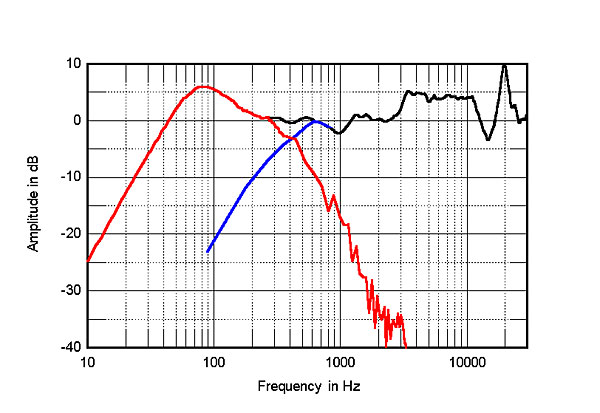


Fig.1 Wharfedale Jade 3, electrical impedance (solid) and phase (dashed) (2 ohms/vertical div.).
Other than at 20kHz, where a small wrinkle is due to the tweeter's primary dome resonance, the impedance traces are free from the discontinuities that would imply the presence of enclosure vibrational resonances. When I investigated the cabinet walls' behavior with a plastic-tape accelerometer, I found only a low-Q mode just above 500Hz at the center of both curved sidewalls (fig.2), and another at 700Hz on the top panel. I can confidently state that these modes are too high in frequency and too low in level to introduce any coloration.
Fig.2 Wharfedale Jade 3, cumulative spectral-decay plot calculated from output of accelerometer fastened to center of side panel (MLS driving voltage to speaker, 7.55V; measurement bandwidth, 2kHz).
Fig.3 Wharfedale Jade 3, anechoic response on tweeter axis at 50", averaged across 30° horizontal window and corrected for microphone response, with nearfield responses of midrange unit (blue) and woofer (red) and their complex sum, respectively plotted below 800Hz, 3kHz, 300Hz.
The Jade 3's horizontal dispersion was commendably wide and even (fig.4), with the treble output maintained to 15° off axis. The on-axis suckout between 12 and 18kHz fills in to the speaker's sides, which in all but very large rooms will add sufficient top-octave air to the speaker's balance. Vertically (fig.5), the Jade's response is maintained over a wide (±15°) window, though the appearance of a suckout just above 3kHz at 25° below the tweeter axis suggests that low stands will work better than high ones.
Fig.4 Wharfedale Jade 3, lateral response family at 50", normalized to response on tweeter axis, from back to front: differences in response 90–5° off axis, reference response, differences in response 5–90° off axis.
Fig.5 Wharfedale Jade 3, vertical response family at 50", normalized to response on tweeter axis, from back to front: differences in response 45–5° above axis, reference response, differences in response 5–45° below axis.
Looking at the Jade 3's behavior in the time domain, its step response on the tweeter axis (fig.6) reveals that the tweeter and midrange unit are both connected in positive acoustic polarity, the woofer in negative polarity, which I confirmed by examining the outputs of the individual units (not shown). Significantly, the decay of each unit's step smoothly blends with the start of the decay of the next step lower in frequency, which suggests optimal crossover design. The cumulative spectral-decay plot on the tweeter axis (fig.7) is superbly clean, other than the expected resonant ridge at 20kHz and a hint of delayed energy at 3.3kHz.
Fig.6 Wharfedale Jade 3, step response on tweeter axis at 50" (5ms time window, 30kHz bandwidth).
Fig.7 Wharfedale Jade 3, cumulative spectral-decay plot on tweeter axis at 50" (0.15ms risetime).
Like the Jade 7, Wharfedale's Jade 3 offers excellent measured performance. As BJR concluded, this Peter Comeau design "punches way beyond its price."—John Atkinson