Several seconds after I began listening to it, I knew that Theta Digital's Prometheus monoblock amplifier ($12,000/pair) was different from other amplifiers. The violins and brass were more dynamic, and had more pace. The orchestra sounded more three-dimensional, depicted in relief by a degree of hall ambience I hadn't heard when I played the same recording through my reference solid-state stereo amplifier, a Mark Levinson No.334.
I've experienced other such "revelations" on first hearing a new audio component. Sometimes this first impression is accurate, as with the unique transparency of Day Sequerra's Reference FM tuner. Sometimes it's misleading, such as the strong room lock in the bass response with pedal notes of pipe organs I heard through Escalante Design's Fremont loudspeakers—and later discovered was a serious coloration that troubled higher-frequency sources like voices and piano.
My first impression of the Theta was all the more interesting to me because the Prometheus has a class-D output section. In his review of MBL's Corona C15 class-D monoblock, John Atkinson noted that the "unique selling propositions of a class-D amplifier are that it is efficient, lightweight, and inexpensive." In his review of Anthem Statement's M1 class-D monoblock, Kalman Rubinson wrote that "everyone acknowledges the advantages of the [class-D] technology in terms of efficiency and ecological benevolence, but so far, neither has captured the souls of aficionados who demand cutting-edge sound regardless of the cost, whether in dollars or degrees." Although the MBL Corona C15 ($24,000/pair) won JA's qualified praise, other class-D monoblocks have not fared so well, including the relatively inexpensive Anthem Statement M1 ($6998/pair) and the cost-no-object Mark Levinson No.53 ($50,000/pair).
Theta Digital & the Hypex Ncore NC1200 amplifier
Because class-D amplifiers generate high levels of ultrasonic and RF energy, such designs typically employ a passive low-pass filter between their output devices and output terminals. This filter needs to be tuned to a single load impedance. Speakers that have a different impedance may cause the amplifier to prematurely roll off the top octave—or, much worse, the filter's maximum effect peaks above the audioband. To address this problem, in 2001, while working at Philips, Dutch engineer Bruno Putzeys developed a class-D output stage as a cheap drop-in replacement for linear amplifiers. "What Bruno did," Jeff Hipps, marketing director of Theta Digital told me, was to find "a way to include [the] load in the filter circuit." As a result, this amplifier design, which Putzeys dubbed Universal class-D (UcD), was "completely load agnostic [because its] frequency response is load invariant." The UcD, with its six-transistor comparator circuit, served as the basis of the more developed Linear Analog Switching Amplifier (LASA) output-circuit modules found in MBL's Corona C15 amplifier.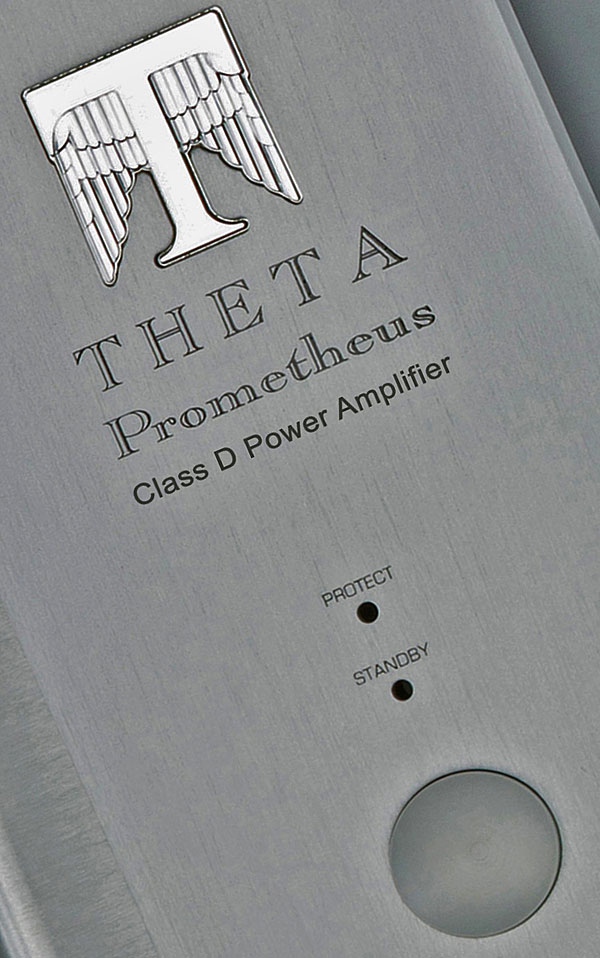 Later, while working at Hypex, Putzeys developed a second-generation design, the Ncore, in which the six transistors of the UcD's comparator circuit grew to 10. Putzeys named his new amplifier circuit the NC1200 because its maximum power rating is 1200W into 2 ohms. It is said to achieve 93% efficiency at full power, has a 38A output current capability, comfortably handles 98V rail voltages, and employs extensive, microprocessor-controlled error protection. It is faster and handles smaller signals than the UcD controller, and uses what Putzeys calls "higher order control loops" (footnote 1). Interestingly, the loop gain throughout the audioband never drops below 53dB. The NC1200's improved comparator circuit matches the output to the input, and a control loop circuit allows more open-loop gain thus a greater amount of feedback. It was designed, Putzeys wrote, to "have essentially frequency-independent distortion with 32dB loop gain from DC to 20kHz."
Theta Digital combined Putzeys's Ncore NC1200 class-D module with a linear power supply created by Theta's David Reich. Much of the weight of each Prometheus monoblock's 54.5 lbs comes from its 1.44kVA toroidal power transformer. Theta rates the amplifier's harmonic distortion at less than 0.01% at 500W RMS full-band into a 4 ohm load. Hipps was quick to point out that, at 0.001%, the Prometheus's total harmonic distortion plus noise (THD+N) at 1W is lower than it is at full power by a factor of 10. The Prometheus's output impedance is also extremely low, meaning that its damping factor is higher than is usually the case with a conventional class-D design.
Description
Later, while working at Hypex, Putzeys developed a second-generation design, the Ncore, in which the six transistors of the UcD's comparator circuit grew to 10. Putzeys named his new amplifier circuit the NC1200 because its maximum power rating is 1200W into 2 ohms. It is said to achieve 93% efficiency at full power, has a 38A output current capability, comfortably handles 98V rail voltages, and employs extensive, microprocessor-controlled error protection. It is faster and handles smaller signals than the UcD controller, and uses what Putzeys calls "higher order control loops" (footnote 1). Interestingly, the loop gain throughout the audioband never drops below 53dB. The NC1200's improved comparator circuit matches the output to the input, and a control loop circuit allows more open-loop gain thus a greater amount of feedback. It was designed, Putzeys wrote, to "have essentially frequency-independent distortion with 32dB loop gain from DC to 20kHz."
Theta Digital combined Putzeys's Ncore NC1200 class-D module with a linear power supply created by Theta's David Reich. Much of the weight of each Prometheus monoblock's 54.5 lbs comes from its 1.44kVA toroidal power transformer. Theta rates the amplifier's harmonic distortion at less than 0.01% at 500W RMS full-band into a 4 ohm load. Hipps was quick to point out that, at 0.001%, the Prometheus's total harmonic distortion plus noise (THD+N) at 1W is lower than it is at full power by a factor of 10. The Prometheus's output impedance is also extremely low, meaning that its damping factor is higher than is usually the case with a conventional class-D design.
Description
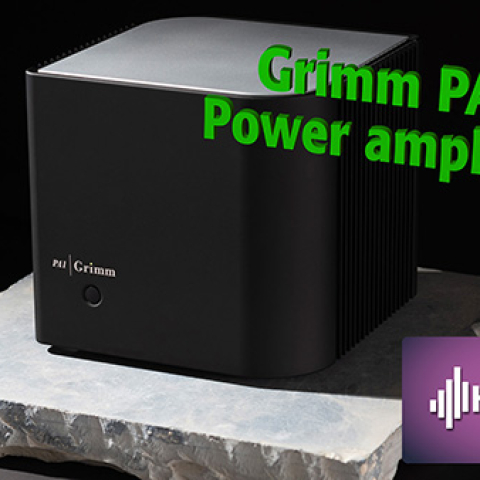
The Theta Prometheus is the shape and size of a small desktop tower computer and measures 13.5" high by 9" wide by 19.8" deep. The curved front panel is of aluminum, with a small built-in handle; the side panels have screened cutouts to dissipate heat. Unlike most monoblocks, the front panel is narrow and the case is deep. The amplifier is manufactured in mirrored pairs: the handle is on the right side of the faceplate of the left-channel unit, and vice versa. However, there's no reason not to reverse the amps' positions in your room.
You press the single button on the front panel to exit Standby mode (in which the Prometheus draws less than 1W from the wall and its Standby LED glows red) and enter operational mode (the LED glows green, then blue). A second LED will turn red if the amplifier exceeds its maximum operating temperature.
On the rear panel is a column of connectors. At the top are single-ended RCA and balanced XLR input jacks, separated by a toggle switch for selecting between them. Below these are two Cardas speaker binding posts, for use in biwiring. There is also a jack for the standby remote trigger. The Prometheus can be turned on remotely with a 5–12VDC signal. Below this, toward the bottom, is the Main Power switch, which connects AC to all circuits. Flipping this on illuminates yellow Standby LED on the front panel. Below that is a fuse bay, and at the bottom is an IEC inlet for the detachable AC power cord.
The Prometheus is specified as outputting 250W into 8 ohms, 500W into 4 ohms, or 850W into 2 ohms.
Sound
The two Theta Digital Prometheuses were easily unpacked. I attached balanced interconnects to their inputs, and the spade lugs of my PSC speaker cables to their binding posts, then flipped the Main Power switch on. As always, I used Stereophile's Test CD 2 to ensure that the channel assignments and phase were correct.
Footnote 1: This and subsequent quote: Bruno Putzeys, "Ncore Technology White Paper" (Hypex Electronics: February 2, 2012).
Because class-D amplifiers generate high levels of ultrasonic and RF energy, such designs typically employ a passive low-pass filter between their output devices and output terminals. This filter needs to be tuned to a single load impedance. Speakers that have a different impedance may cause the amplifier to prematurely roll off the top octave—or, much worse, the filter's maximum effect peaks above the audioband. To address this problem, in 2001, while working at Philips, Dutch engineer Bruno Putzeys developed a class-D output stage as a cheap drop-in replacement for linear amplifiers. "What Bruno did," Jeff Hipps, marketing director of Theta Digital told me, was to find "a way to include [the] load in the filter circuit." As a result, this amplifier design, which Putzeys dubbed Universal class-D (UcD), was "completely load agnostic [because its] frequency response is load invariant." The UcD, with its six-transistor comparator circuit, served as the basis of the more developed Linear Analog Switching Amplifier (LASA) output-circuit modules found in MBL's Corona C15 amplifier.
Later, while working at Hypex, Putzeys developed a second-generation design, the Ncore, in which the six transistors of the UcD's comparator circuit grew to 10. Putzeys named his new amplifier circuit the NC1200 because its maximum power rating is 1200W into 2 ohms. It is said to achieve 93% efficiency at full power, has a 38A output current capability, comfortably handles 98V rail voltages, and employs extensive, microprocessor-controlled error protection. It is faster and handles smaller signals than the UcD controller, and uses what Putzeys calls "higher order control loops" (footnote 1). Interestingly, the loop gain throughout the audioband never drops below 53dB. The NC1200's improved comparator circuit matches the output to the input, and a control loop circuit allows more open-loop gain thus a greater amount of feedback. It was designed, Putzeys wrote, to "have essentially frequency-independent distortion with 32dB loop gain from DC to 20kHz."
The Theta Prometheus is the shape and size of a small desktop tower computer and measures 13.5" high by 9" wide by 19.8" deep. The curved front panel is of aluminum, with a small built-in handle; the side panels have screened cutouts to dissipate heat. Unlike most monoblocks, the front panel is narrow and the case is deep. The amplifier is manufactured in mirrored pairs: the handle is on the right side of the faceplate of the left-channel unit, and vice versa. However, there's no reason not to reverse the amps' positions in your room.
The two Theta Digital Prometheuses were easily unpacked. I attached balanced interconnects to their inputs, and the spade lugs of my PSC speaker cables to their binding posts, then flipped the Main Power switch on. As always, I used Stereophile's Test CD 2 to ensure that the channel assignments and phase were correct.
Footnote 1: This and subsequent quote: Bruno Putzeys, "Ncore Technology White Paper" (Hypex Electronics: February 2, 2012).