Photo: Lionel Flusin
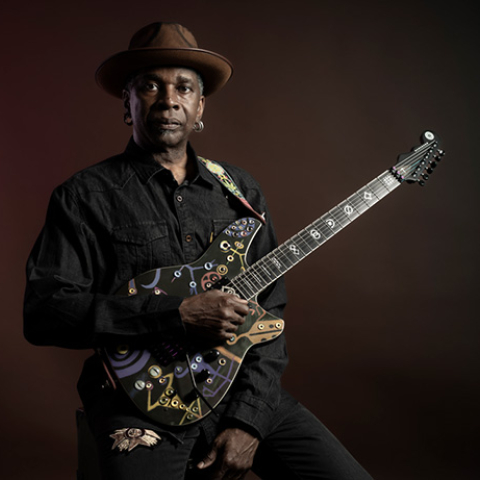
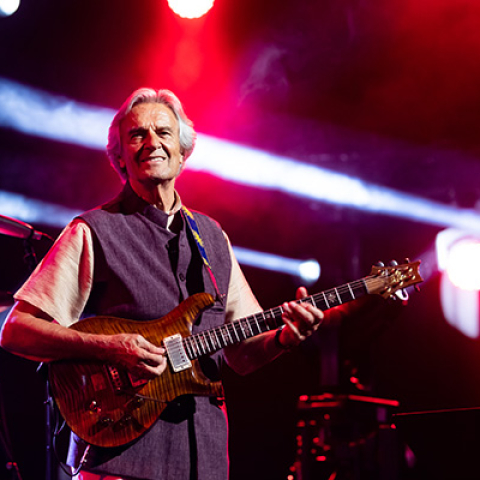
If you find yourself in Monaco on a Sunday night, make your way to La Note Bleue, a rant and music bar on the beach by the Avenue Princesse Grace. There, you're likely to find a legendary world/fusion guitarist sitting in with a group of young jazz musicians eager to cut heads with the acknowledged maestro of inner awareness and otherworldly spirits. Forever known to some as "Mahavishnu," you can call him by his birth name, John McLaughlin.
"Yes, I have a little group here at my local jazz restaurant," McLaughlin said during a recent Zoom call from his homebase overseas. "For the anglophones, we're known as the Blue Note Band. I've been doing it for about a year now, and what I do is, I invite graduate musicians between the ages of 18 and 24 from different academies around Europe—France, Germany, Switzerland, and the UK—to come out. It's the only place we play."
Having retired from touring, McLaughlin, still spry at 83, recently celebrated his career on the planks with
Live at the Montreux Jazz Festival 2022, a two-LP/two-CD plus Blu-ray disc set released by earMUSIC.
Montreux ... 2022 captures the maestro at the top of his late-career game with his longtime band, the 4th Dimension. The album's 12 tracks (footnote 1) include a stirring eight-minute cover of Pharoah Sanders's "The Creator Has a Master Plan" and recent solo gems like the fast-scatting "El Hombre Que Sabia," all culled from their July 11, 2022, show at the 4000-capacity Auditorium Stravinski, which featured McLaughlin, bassist étienne Mbappé, keyboardist-drummer Gary Husband, drummer Nicolas Viccaro, and special guest pianist-vocalist Jany McPherson. The McLaughlin-Montreux connection goes all the way back to July 6, 1974, when the young guitarist played the fabled Swiss festival with his fledgling-yet-worldly progressive outfit the Mahavishnu Orchestra. "Wings of Karma," indeed.
I ask McLaughlin, ever the master improviser, what the goal of his music was—whether it was simply to make people feel happy. "The music just takes you, as long as you surrender to it," he answered. "That's what happens when we improvise. If you don't let go, then you're
thinking—and that means you're not
playing. Sometimes you're playing a tune, and, okay, you gotta go from C to D—but how are you doing it? That is the key to the question you brought up. It's the emotion—the
deep emotion, and how much you care about it—that is shown in what you play."
McLaughlin likes music that takes listeners to another place. "Great musicians like Miles or Coltrane—or the great classical players, whether they're east or west—they could play just one note, and you feel it," he continued. "You feel the humanity. Without that, the notes are just notes, aren't they?"
Speaking of Miles: McLaughlin retains fond memories of working with the trumpeter on his March 1970 two-LP
avant-fusion opus on Columbia,
Bitches Brew. "I feel like I had passed a baptism of fire after playing with him on
In a Silent Way," McLaughlin recalled, referring to a three-hour session on February 18, 1969, at CBS's 30th Street Studio in New York for the 1969 album that ushered in the boundary-pushing artist's electric period. "From that point on, Miles was calling me every week to come by his house. I'd bring the guitar, and we'd just hang. He'd be there with his piano, and he'd play a chord. Then he'd say"—McLaughlin affects Miles's vocal rasp—"'What do you hear?' This went on for a few months, so by the time we got to the studio for
Bitches Brew, I knew him much better. I didn't know where he wanted to go, but I knew he was picking my brain through all the R&B, funk, and Motown stuff I'd done in the Sixties." (footnote 2)
Miles had a special way to get his musicians to bloom. "He would never tell us what to play; he'd tell us what
not to play," McLaughlin affirmed. "The classic example"—he affects Miles's voice again—"is, 'It's the blues in F—but don't play F.' Another time, Wayne [Shorter] was playing, and Miles stopped us. 'Wayne—you're scrambling those eggs again!' Or he'd go over to Jack [DeJohnette], and hanging over his drums, he'd say, 'Jack! Boom. [
pause] Bap-boom-boom! [pause] De-bop! Ok?' It's like what he said to me when we were recording
In a Silent Way: 'Play the guitar like you don't know how to play the guitar.' When your mind is wiped like that, you play from the whole body. He wanted to hear what you had inside of you."
The first gig McLaughlin played with Davis—in the Hill Auditorium at the University of Michigan in Ann Arbor on February 21, 1970—left a permanent impression. "I got grilled on the opening song. Instead of the solos being medium or slow, they were like 160 [beats] a minute!" McLaughlin exclaimed. "During my solo at that speed, he crouched down in front of me to watch me for the whole solo. No pressure—but somehow I made it. During the break, we're sitting in the locker room, and I'm in seventh heaven. I thought Miles had been playing like a
god—but all of a sudden, he sat down next to me and said, 'John, I didn't play
shit.' Honestly, that was the greatest lesson of humility ever, because he was like that with all his musicians." You can see McLaughlin doing something similar with his own protégés in the Blue Note Band every Sunday night.
"From Miles, I learned how to relate to the other musicians I'm playing with," he concluded. "Without them, you're nothing."
Footnote 1: The Blu-ray disc has 14, adding an "Introduction" and an "Outro."
Footnote 2: Like his friend and contemporary Jimmy Page, McLaughlin was an on-call studio musician in Britain in the 1960s.