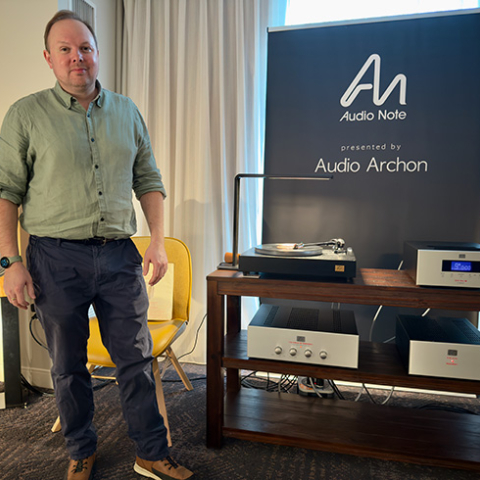
There I was, making my way room-to-room toward the end of the show when suddenly Jeffrey Catalano of New York City's "2 channel with attitude" High Water Sound appears.
"Aren't you coming to my room on the 10th floor?" asks a man who clearly has been hounding the hallways, asking everyone he knows if they've seen Jason Victor Serinus.
"OMG," says I. "I've already covered all the rooms I had time to cover on the 10th floor. Yours must have been so full that I gave up and skipped it."
Well, you know what happened next. Jeffrey's reputation for luring man and beast to his room with unusual musical finds is legendary. So off I went to hear, first, an EMI LP of Rodrigo's Concierto de Aranjuez, whose all-enveloping soundstage and thrilling transparency were marred only by wiry sound.
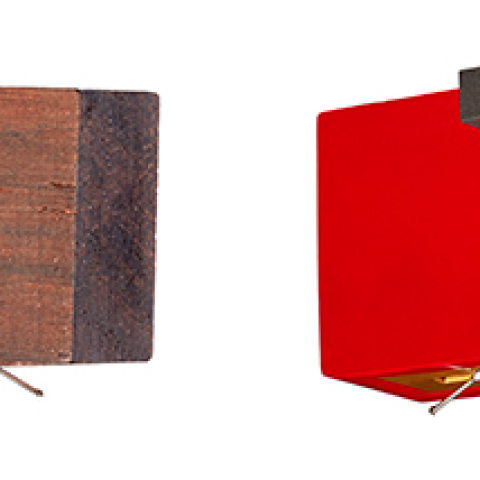
Next Jeffrey played an extremely rare LP of Electric Satie on the Moog. Somehow Jeffrey thought it was Satie himself who introduced the transcriptions, but moi, who makes reading liner notes a priority, discovered it was the composer/arranger channeling the spirit of Satie (who died in 1925, right before the advent of electrical recording). Once again loving everything except the wiry top, I questioned Jeffrey, and learned that he purposely brought a tipped-up Ortofon phono cartridge to the show because sound in rooms is usually so dark. (For confirmation, you need only read my blogs on the dark-sounding rooms with Pass Labs amplification, whose beauty, as John Atkinson has mentioned in his January 2014 review of the XA-60.5, is anything but dark.)
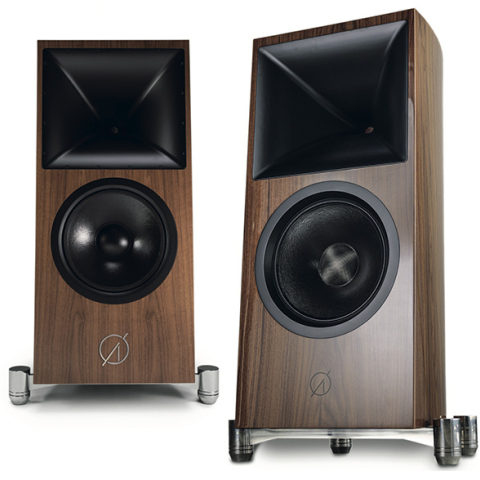
 Doing the honors, in addition to the TW-Acustic GT SE turntable with two 10.5 tonearms ($23,500 total) and "there must be an alternative" Ortofon Windfeld cartridge ($4200): the world premiere of TW-Acustic 1.5W 45 SE Monos, Horning Hybrid Systems Eufrodite Mark IV Ellipse loudspeakers ($30,000/pair), Tron-Electric Syren II GT and Seven Phono/Mono preamplifiers ($55,000 and $15,000), Silver Circle Audio's TCHAIK 6 ($10.50), and supports, cabling, and room tuning from Symposium Acoustics, Teo Audio, and Shun Mook Acoustics.
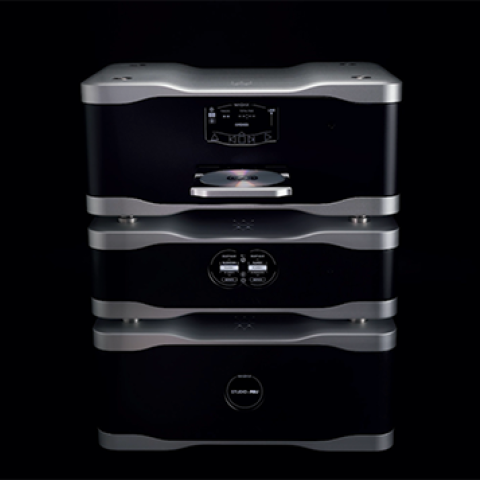
 In the PBN room, very transparent, beautiful, and clean sound distinguished LP playback of a baroque ensemble featuring occasionally stiff-voiced soprano Elisabeth Norberg-Shulz. The natural-sounding warmth of cello was especially excellent. Welcome to the world of PBN of El Cajon's Sammy loudspeakers($30,000/pair), Groovemaster direct-drive turntable ($35,000), EB-SA2 all-FET amplifier ($34,995), Olympia LXi preamplifier ($22,000) and PX phono preamplifier ($22,000). Oh yes, and ZenSati cabling, without which all would have come to naught.
 "Come see my new speakers!" begged the email from Santy Oropel of Twin Audio Video in Loma Linda. See and hear I did. Playing a recording by pianist Murray Perahia, I enjoyed the captivatingly spacious presentation. Highs were very beautiful, although different sounding than notes lower in the range. A Strauss track by the irreplaceable Beverly Sills further confirmed that the very nice top was not balanced by richness in the bottom end. But perhaps that had to do more with the room's challenging acoustics than the capabilities of the all-Japanese system's MLC XSeed single-driver loudspeakers ($18,000/pair), Black Ravioli supports, and Triode Corporation-Japan's tubed TRV DAC1.0 DAC ($2500), TRV-CD5SE CD player ($3200), TRX-2 preamp ($5000), and TRX-M300 300B 8W SET amplifier ($14,000).
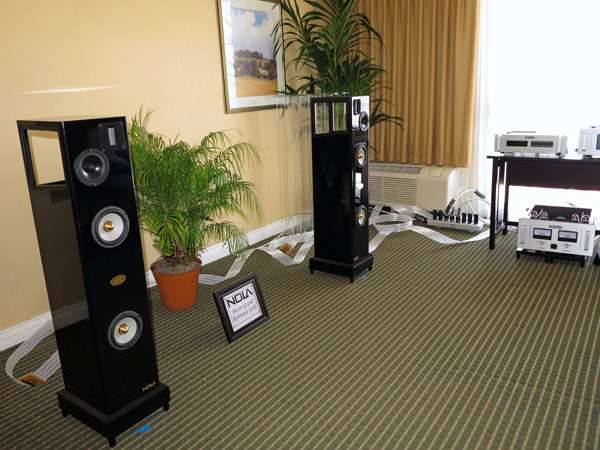 More good sound awaited in the Nola room, where Nola's Metro Grand Reference Gold loudspeakers ($33,000/pair) mated with Audio Research electronics and maximally transparent Nordost Odin cabling to reveal the wonderful timbres the Fines captured on their Mercury Living Presence recording of Prokofiev's Romeo and Juliet. I loved the openness of the sound, as well as the clarity. I've heard richer systems, but few have captured the dynamic shifts and subtle expressive turns of soprano Eileen Farrell's huge voice with such breathtaking accuracy and perfect control.
While this was yet another system where the quality of the piano's lowest notes seemed different from its treble—was this a crossover issue, or more a reflection of room anomalies?—midrange reproduction was exemplary. These are very fine loudspeakers.
More good sound awaited in the Nola room, where Nola's Metro Grand Reference Gold loudspeakers ($33,000/pair) mated with Audio Research electronics and maximally transparent Nordost Odin cabling to reveal the wonderful timbres the Fines captured on their Mercury Living Presence recording of Prokofiev's Romeo and Juliet. I loved the openness of the sound, as well as the clarity. I've heard richer systems, but few have captured the dynamic shifts and subtle expressive turns of soprano Eileen Farrell's huge voice with such breathtaking accuracy and perfect control.
While this was yet another system where the quality of the piano's lowest notes seemed different from its treble—was this a crossover issue, or more a reflection of room anomalies?—midrange reproduction was exemplary. These are very fine loudspeakers.
 I don't have the strength to write up every piece of equipment in the room sponsored by highend-electronics of Apple Valley. But I must point out the very open sound on Hans Theesink & Terry Evans' Delta Time LP, which I've heard before, as well as some booming bass. The system included, on one end, the new Voxativ PI loudspeakers ($14,000/pair), a new Wall Audio Opus 88 preamp ($6000), highend-electronics Music Server I ($99), KR Audio VA320 amplifier ($11,500), Synergistic Research's new PowerCell 10 SE Mk.III ($5500) and Tranquility Bases ($1999 each), Shakti Hallographs, and High Fidelity and Voxativ cabling. Overall presentation from a man who really cares about sound: very, very good.
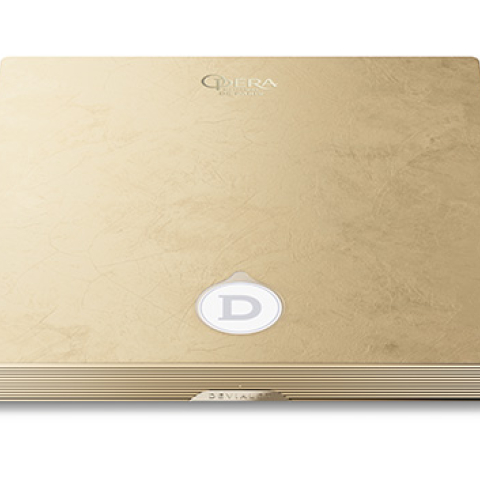
 I confess. Having mistakenly thought T.H.E. Show ended at 4pm on Sunday, I had trouble psyching myself up when I discovered the majority of exhibitors sticking it out until 6. Hence I went slowly, lingering in rooms I liked and ignoring cries for attention as one tends to ignore the cries of blades of grass that we so often cluelessly clomp through. But when I saw the room from The Audio Association of Gardena that offered the familiar and so often satisfying pairing of Evolution Acoustics MMMiniTwo loudspeakers ($39,000/pair with integrated subs) and cabling, and, in this case, the North American premieres of darTZeel's LHC-208 "DAnalogue Streaming Ethernet DAC with integrated amplifier ($13,000) and NHB-18NS Reference preamplifier with integrated reference phonostage ($TBD), I thought gold and red a good way to bid adieu.
Perhaps it was the nature Ortofon Anna MC cartridge ($8500), but as much as I admired the extremely well-controlled sound on an LP of Gerry Mulligan meets Ben Webster—well, I was so tired by then that I'm not certain if perhaps I was listening to a file on the LHC-208—the warmth was a bit too much for my taste. I did, however, enjoy being pulled around in my overstuffed chair as if I were Cleopatra in her carriage being led to the sweetest spot on the Nile.
I confess. Having mistakenly thought T.H.E. Show ended at 4pm on Sunday, I had trouble psyching myself up when I discovered the majority of exhibitors sticking it out until 6. Hence I went slowly, lingering in rooms I liked and ignoring cries for attention as one tends to ignore the cries of blades of grass that we so often cluelessly clomp through. But when I saw the room from The Audio Association of Gardena that offered the familiar and so often satisfying pairing of Evolution Acoustics MMMiniTwo loudspeakers ($39,000/pair with integrated subs) and cabling, and, in this case, the North American premieres of darTZeel's LHC-208 "DAnalogue Streaming Ethernet DAC with integrated amplifier ($13,000) and NHB-18NS Reference preamplifier with integrated reference phonostage ($TBD), I thought gold and red a good way to bid adieu.
Perhaps it was the nature Ortofon Anna MC cartridge ($8500), but as much as I admired the extremely well-controlled sound on an LP of Gerry Mulligan meets Ben Webster—well, I was so tired by then that I'm not certain if perhaps I was listening to a file on the LHC-208—the warmth was a bit too much for my taste. I did, however, enjoy being pulled around in my overstuffed chair as if I were Cleopatra in her carriage being led to the sweetest spot on the Nile.
 The show is over and here's Kurt Hopke of the San Diego Audio & Music Guild helping his friends at Audio Revelation pack up their gear. As I made my way back to the Atrium Hotel where superb musician William Artope Jr. was wishing us all adieu...
 I was already reflecting on the fact that, as Stereophile's sole reporter at the show, I had no choice but to arbitrarily skip a bunch of rooms, some of which, to my deep regret, premiered new equipment. My apologies to everyone whose accomplishments I passed over.
I was also reflecting on the past, present, and future of T.H.E. Show Newport Beach.
As you read my room reports, you will discover, over and over, reference to booming bass, and sound that was variously too hot or, far more often, either too dark or bleached-out for my taste. I also note, on many occasions, the difference in quality between a system's top, where timbres may have sounded quite natural, and its bottom, where bass may have either lacked focus or simply had a different sonic quality.
At show's end, as I was heading back to my room, I had a very brief exchange with Mikey Fremer about the sound in many of the rooms I visited. His response, which mirrors my own thoughts, was that no matter what the venue, there will always be problems. Yet, due to a combination of superior design, set-up savvy, and system synergy, certain loudspeaker brands, including Wilson, Magico, and YG Acoustics, almost always excel. Starting with their design and materials, these companies know what works. Their success enables them to secure superior rooms, and they do everything in their power to put on a good show.
Ultimately, my feeling is that any distributor, dealer, or manufacturer who succeeds in delivering good sound and/or playing good music in a hotel environment deserves our support. I urge you to take note, not just of the loudspeakers, but also of everything in the equipment chain that precedes them, including cabling, power and room treatment, racks, and equipment supports. In the best exhibits, you'll discover that virtually everything was chosen with intention, and set up with extreme care.
Ted Denney of Synergistic Research, for example, got such good sound from his repeat dance with Magico and VAC because he began setting up a day before most other exhibitors, thus allowing his cables an extra day to settle in, and more time for speaker positioning. Wilson has loudspeakers with multiple adjustment positions and, positioning them, Peter McGrath. Using Spectral gear, Peter was even able to produce good sound in an impossible room at the 2013 California Audio Show in which most of the wall behind the speakers was glass.
Hours before I tackled the last of these eight show blogs, Richard Beers, aka Mr. T.H.E. Show, opined that the quality of Atrium entertainment plus additions to the various Headphoniums—thank you, Michael Mercer and friends—seemed to attract new blood to this year's show. Although Richard's attendance guesstimate was admittedly off the top of his head, without benefit of computer verification, he estimates 6700 attendees plus 400 exhibitors. Note, however, that the 6700 figure includes all audio-society discount tickets, as well as VIP and exhibitor guests.
While the actual number of paying attendees was had yet to be determined when I wrote this report, I have a hunch that attendance at T.H.E. Show Newport Beach actually peaked two years ago. Regardless, it's clear that Sunday's $25,000 giveaway and increased passes offered to local colleges and music institutions noticeably increased last-day attendance over last year. Which is a very good thing.
Richard submits the following important announcement for publication:
While The Show Newport continues to build its audience and the attendance figures increase annually, we further recognize that the uniqueness of being in two hotels is a logistically nightmare for us—and some exhibitors may be overlooked with the current configuration. And, while some enjoy the way the lay-out works, with every turn of every corner presenting new, interesting items to see and hear, some "corners" may be overlooked.
At this time, The Show management is looking for good, solid answers to help the show layout overall—plus eliminate some of the parking and freight logistic problems. Stay tuned. Some exciting changes will happen in 2015.
That's the official word. But if you talk to any number of exhibitors in the know, they'll share their belief, anonymously of course, that T.H.E. Show hopes to head to the nearby Hotel Irvine. Everyone I've spoken with says it is a much finer hotel with bigger rooms (and hopefully better food). Whether that means that the room will actually sound better, or simply measure bigger and look better while presenting a whole new slew of acoustic problems, has YTBD. But isn't that the case with almost any piece of equipment you bring into your own listening space and move to a different location?
I for one look forward to the change of venue(s), which will undoubtedly bring with it a shift of energy and additional enticement for folks to exhibit and attend. Perhaps the new venue will allow more systems to fulfill their promise.
I was already reflecting on the fact that, as Stereophile's sole reporter at the show, I had no choice but to arbitrarily skip a bunch of rooms, some of which, to my deep regret, premiered new equipment. My apologies to everyone whose accomplishments I passed over.
I was also reflecting on the past, present, and future of T.H.E. Show Newport Beach.
As you read my room reports, you will discover, over and over, reference to booming bass, and sound that was variously too hot or, far more often, either too dark or bleached-out for my taste. I also note, on many occasions, the difference in quality between a system's top, where timbres may have sounded quite natural, and its bottom, where bass may have either lacked focus or simply had a different sonic quality.
At show's end, as I was heading back to my room, I had a very brief exchange with Mikey Fremer about the sound in many of the rooms I visited. His response, which mirrors my own thoughts, was that no matter what the venue, there will always be problems. Yet, due to a combination of superior design, set-up savvy, and system synergy, certain loudspeaker brands, including Wilson, Magico, and YG Acoustics, almost always excel. Starting with their design and materials, these companies know what works. Their success enables them to secure superior rooms, and they do everything in their power to put on a good show.
Ultimately, my feeling is that any distributor, dealer, or manufacturer who succeeds in delivering good sound and/or playing good music in a hotel environment deserves our support. I urge you to take note, not just of the loudspeakers, but also of everything in the equipment chain that precedes them, including cabling, power and room treatment, racks, and equipment supports. In the best exhibits, you'll discover that virtually everything was chosen with intention, and set up with extreme care.
Ted Denney of Synergistic Research, for example, got such good sound from his repeat dance with Magico and VAC because he began setting up a day before most other exhibitors, thus allowing his cables an extra day to settle in, and more time for speaker positioning. Wilson has loudspeakers with multiple adjustment positions and, positioning them, Peter McGrath. Using Spectral gear, Peter was even able to produce good sound in an impossible room at the 2013 California Audio Show in which most of the wall behind the speakers was glass.
Hours before I tackled the last of these eight show blogs, Richard Beers, aka Mr. T.H.E. Show, opined that the quality of Atrium entertainment plus additions to the various Headphoniums—thank you, Michael Mercer and friends—seemed to attract new blood to this year's show. Although Richard's attendance guesstimate was admittedly off the top of his head, without benefit of computer verification, he estimates 6700 attendees plus 400 exhibitors. Note, however, that the 6700 figure includes all audio-society discount tickets, as well as VIP and exhibitor guests.
While the actual number of paying attendees was had yet to be determined when I wrote this report, I have a hunch that attendance at T.H.E. Show Newport Beach actually peaked two years ago. Regardless, it's clear that Sunday's $25,000 giveaway and increased passes offered to local colleges and music institutions noticeably increased last-day attendance over last year. Which is a very good thing.
Richard submits the following important announcement for publication:
While The Show Newport continues to build its audience and the attendance figures increase annually, we further recognize that the uniqueness of being in two hotels is a logistically nightmare for us—and some exhibitors may be overlooked with the current configuration. And, while some enjoy the way the lay-out works, with every turn of every corner presenting new, interesting items to see and hear, some "corners" may be overlooked.
At this time, The Show management is looking for good, solid answers to help the show layout overall—plus eliminate some of the parking and freight logistic problems. Stay tuned. Some exciting changes will happen in 2015.
That's the official word. But if you talk to any number of exhibitors in the know, they'll share their belief, anonymously of course, that T.H.E. Show hopes to head to the nearby Hotel Irvine. Everyone I've spoken with says it is a much finer hotel with bigger rooms (and hopefully better food). Whether that means that the room will actually sound better, or simply measure bigger and look better while presenting a whole new slew of acoustic problems, has YTBD. But isn't that the case with almost any piece of equipment you bring into your own listening space and move to a different location?
I for one look forward to the change of venue(s), which will undoubtedly bring with it a shift of energy and additional enticement for folks to exhibit and attend. Perhaps the new venue will allow more systems to fulfill their promise.
Jeffrey Catalano in séance with Erik Satie
Once I understood why things sounded as they did, I could forgive the system's very top, and enjoy Gabor Szabo playing the 1928 Martin guitar formerly owned by Gene Autry. Perhaps the biggest treat was listening to the mesmerizing detail on a track from the LP version of the great Cecilia Bartoli's Mission album. With each successive note, my guilt over spending so much time actually ENJOYING MYSELF and having a transcendent experience with La Bartoli dissipated. Jeffrey Catalano assembled one helluva system.
In the PBN room, very transparent, beautiful, and clean sound distinguished LP playback of a baroque ensemble featuring occasionally stiff-voiced soprano Elisabeth Norberg-Shulz. The natural-sounding warmth of cello was especially excellent. Welcome to the world of PBN of El Cajon's Sammy loudspeakers($30,000/pair), Groovemaster direct-drive turntable ($35,000), EB-SA2 all-FET amplifier ($34,995), Olympia LXi preamplifier ($22,000) and PX phono preamplifier ($22,000). Oh yes, and ZenSati cabling, without which all would have come to naught.
"Come see my new speakers!" begged the email from Santy Oropel of Twin Audio Video in Loma Linda. See and hear I did. Playing a recording by pianist Murray Perahia, I enjoyed the captivatingly spacious presentation. Highs were very beautiful, although different sounding than notes lower in the range. A Strauss track by the irreplaceable Beverly Sills further confirmed that the very nice top was not balanced by richness in the bottom end. But perhaps that had to do more with the room's challenging acoustics than the capabilities of the all-Japanese system's MLC XSeed single-driver loudspeakers ($18,000/pair), Black Ravioli supports, and Triode Corporation-Japan's tubed TRV DAC1.0 DAC ($2500), TRV-CD5SE CD player ($3200), TRX-2 preamp ($5000), and TRX-M300 300B 8W SET amplifier ($14,000).
More good sound awaited in the Nola room, where Nola's Metro Grand Reference Gold loudspeakers ($33,000/pair) mated with Audio Research electronics and maximally transparent Nordost Odin cabling to reveal the wonderful timbres the Fines captured on their Mercury Living Presence recording of Prokofiev's Romeo and Juliet. I loved the openness of the sound, as well as the clarity. I've heard richer systems, but few have captured the dynamic shifts and subtle expressive turns of soprano Eileen Farrell's huge voice with such breathtaking accuracy and perfect control.
While this was yet another system where the quality of the piano's lowest notes seemed different from its treble—was this a crossover issue, or more a reflection of room anomalies?—midrange reproduction was exemplary. These are very fine loudspeakers.
I don't have the strength to write up every piece of equipment in the room sponsored by highend-electronics of Apple Valley. But I must point out the very open sound on Hans Theesink & Terry Evans' Delta Time LP, which I've heard before, as well as some booming bass. The system included, on one end, the new Voxativ PI loudspeakers ($14,000/pair), a new Wall Audio Opus 88 preamp ($6000), highend-electronics Music Server I ($99), KR Audio VA320 amplifier ($11,500), Synergistic Research's new PowerCell 10 SE Mk.III ($5500) and Tranquility Bases ($1999 each), Shakti Hallographs, and High Fidelity and Voxativ cabling. Overall presentation from a man who really cares about sound: very, very good.
I confess. Having mistakenly thought T.H.E. Show ended at 4pm on Sunday, I had trouble psyching myself up when I discovered the majority of exhibitors sticking it out until 6. Hence I went slowly, lingering in rooms I liked and ignoring cries for attention as one tends to ignore the cries of blades of grass that we so often cluelessly clomp through. But when I saw the room from The Audio Association of Gardena that offered the familiar and so often satisfying pairing of Evolution Acoustics MMMiniTwo loudspeakers ($39,000/pair with integrated subs) and cabling, and, in this case, the North American premieres of darTZeel's LHC-208 "DAnalogue Streaming Ethernet DAC with integrated amplifier ($13,000) and NHB-18NS Reference preamplifier with integrated reference phonostage ($TBD), I thought gold and red a good way to bid adieu.
Perhaps it was the nature Ortofon Anna MC cartridge ($8500), but as much as I admired the extremely well-controlled sound on an LP of Gerry Mulligan meets Ben Webster—well, I was so tired by then that I'm not certain if perhaps I was listening to a file on the LHC-208—the warmth was a bit too much for my taste. I did, however, enjoy being pulled around in my overstuffed chair as if I were Cleopatra in her carriage being led to the sweetest spot on the Nile.
The show is over and here's Kurt Hopke of the San Diego Audio & Music Guild helping his friends at Audio Revelation pack up their gear. As I made my way back to the Atrium Hotel where superb musician William Artope Jr. was wishing us all adieu...
I was already reflecting on the fact that, as Stereophile's sole reporter at the show, I had no choice but to arbitrarily skip a bunch of rooms, some of which, to my deep regret, premiered new equipment. My apologies to everyone whose accomplishments I passed over.
I was also reflecting on the past, present, and future of T.H.E. Show Newport Beach.
As you read my room reports, you will discover, over and over, reference to booming bass, and sound that was variously too hot or, far more often, either too dark or bleached-out for my taste. I also note, on many occasions, the difference in quality between a system's top, where timbres may have sounded quite natural, and its bottom, where bass may have either lacked focus or simply had a different sonic quality.