Déjà vu all over again?
Apart from being reminded of this Yogi-ism by the death, in September 2015, of its originator, I was all set to begin by commenting that this would be my first review for Stereophile of a Paradigm loudspeaker. But—the recent online posting of my June 1992 review of Paradigm's Studio Monitor took me back.
That speaker sold for $1899/pair in an era when $5000/pair was near the top of the price structure of high-end audio—apart from a very few nosebleed models. I have in my hands a copy of the April 1992 Stereophile. In that issue's edition of "Recommended Components," only four Class A speakers exceeded $10,000/pair: the B&W Matrix 800, the Infinity IRA Beta, the Meridian D6000, and the Wilson Audio WATT 3/Puppy 2 and WHOW. The average price of all Class B speakers was $4780/pair, not including the Wilson system sans WHOW—which, at $13,900/pair, would raise the average to $5315/pair. Wilson speakers were super-expensive then, and not much has changed!
Apart from the fact that, today, more audio gear is being built outside the US, $5000 can't buy the same quality it once did. In fact, it now takes about $8400, on average, to buy what $5000 bought in 1992—and not just in audio gear.
Don't tell Paradigm. Their current speaker line tops out at $8998/pair, for the Signature S8. But the recently launched, midline Prestige series—comprising three tower models, a stand-mount, two centers, and a dedicated surround speaker—can be had at prices more reminiscent of 1990 than of 2016. Nostalgia can be fun.
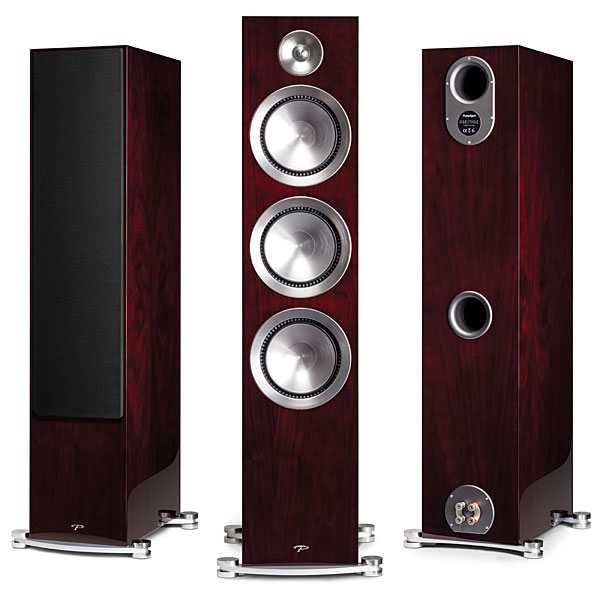
The 95F ($4998/pair) is the flagship of the Prestige range. At 44.4" high by 13.2" wide by 17" deep, each stands almost 4' high, though the two of them were less imposing in my room than my 1994-vintage Energy Veritas v2.8s (50.25" by 12.2" by 14.4"). Our samples came in flawless Piano Black, but I recommend that anyone contemplating this or any model in the Prestige range look carefully at the gorgeous Midnight Cherry finish (add $600/pair) before deciding.
The Prestige range drops the modern trend toward cabinets with curved side and rear panels in favor of a more traditional, rectilinear design. That's not necessarily a bad thing. Those curvy cabinets are a bit more rigid, but the popular claim that they reduce internal standing waves is, at best, specious (footnote 1). Having the 95F's side panels at right angles to its front baffle also makes it easier to judge the toe-in angle from the listening position.
The 95F rests on aluminum outriggers with height-adjustable feet. (The dimensions stated above include the space taken up by those outriggers.) The feet can be used as delivered, with their flat metal surfaces in place, or removed, inverted, and reinserted to make use of the spikes on the reverse side. I used their flat sides to keep from marring the hardwood floor under the near-room-sized rug the speakers sat on. Even so, the feet's spikeless sides are indeed flat, not rounded, with edges sharp enough to scratch the wood as I walked each 99-lb (also including outriggers) Prestige 95F into position. I discovered this a bit too late. The damage would have been more serious had I not noticed the problem almost immediately, but fortunately it was small and hard to see. Later, I tried to use those adhesive, hardware-store felt pads on the 95F's feet, but they wouldn't stick to the smooth metal and fell off almost immediately under the walking motion. Luckily, I was able to protect the normally bare areas of my hardwood floors with small throw rugs, until I could move the speakers onto the larger, carpeted area.
 The 95F's rear panel has two pair of binding posts, with jumper straps that can be removed by those who elect to biwire or biamp (I did neither). The posts are high quality, but thanks to European safety regulations are spaced too far apart for double banana plugs. Also on the rear are the speaker's two ports. The inner aperture of the top port is covered with acoustically transparent foam; the bottom port is open. Both ports are fully functional: The foam in the top port is there only to obscure the view inside the cabinet—and perhaps to keep a three-year-old from giving Mr. Potato Head a cozy new home.
The 95F is a 2.5-way speaker, rather than one of the three-way designs more common at this size and price. All three of its 8" drivers operate in the bass. The two lower woofers roll off above 400Hz, while the topmost 8" cone, operated as a mid/woofer, continues alone up to 2kHz, where it hands off to the tweeter. All crossovers are second-order (acoustical).
The woofers and mid/woofer all share the same cabinet volume but aren't precisely identical. Each has one of Paradigm's pure-aluminum X-PAL cones, with concave dustcap, Nomex spider, die-cast basket, 1.5" voice-coil on a Kapton former, Active Ridge Technology (ART) surrounds that are over-molded (in-house) onto the cone, and butyl rubber inserts and gaskets to isolate the baffle from the driver's vibration. But while the woofer drivers have copper-wound voice-coils, the mid/woofer's coil is of aluminum, whose lower density is claimed to benefit midrange performance.
The 95F's X-PAL-dome tweeter is also made of aluminum, but beyond that, its real innovation is its Perforated Phase Alignment (PPA) tweeter lens. (Paradigm seems to have an entire department dedicated to the coining of initialisms and acronyms.) At first look, the PPA appears to be a protective screen covering the tweeter, but the function of this screen is far more than mere protection of the X-PAL dome. Its solid center is surrounded by rings of round holes that steadily increase in diameter as those rings approach the PPA's outer circumference. Paradigm says that this lens is designed to block "out-of-phase frequencies for smoother, extended high frequencies."
My theory was that the PPA's goal might be similar in intent to that of a tweeter with a donut-shaped diaphragm and phase plug, or a pinned center (footnote 2). Paradigm didn't agree:
"What PPA corrects has [its] root in dome geometry: at high frequencies[,] dome size becomes comparable to the wavelength of sound it reproduces. For [a] 1" dome, for example, [the] wavelength equals the dome diameter at 13.6kHz. Sound radiated by different portions of a dome reaches [the] listener (or microphone) with a different phase due to [the] varying distance it travels. This phase shift results in sound waves not adding up perfectly and creates dips in frequency response. This phenomenon also affects off-axis response. PPA helps smooth on- and off-axis response by blocking out-of-phase sound."
The 95F's rear panel has two pair of binding posts, with jumper straps that can be removed by those who elect to biwire or biamp (I did neither). The posts are high quality, but thanks to European safety regulations are spaced too far apart for double banana plugs. Also on the rear are the speaker's two ports. The inner aperture of the top port is covered with acoustically transparent foam; the bottom port is open. Both ports are fully functional: The foam in the top port is there only to obscure the view inside the cabinet—and perhaps to keep a three-year-old from giving Mr. Potato Head a cozy new home.
The 95F is a 2.5-way speaker, rather than one of the three-way designs more common at this size and price. All three of its 8" drivers operate in the bass. The two lower woofers roll off above 400Hz, while the topmost 8" cone, operated as a mid/woofer, continues alone up to 2kHz, where it hands off to the tweeter. All crossovers are second-order (acoustical).
The woofers and mid/woofer all share the same cabinet volume but aren't precisely identical. Each has one of Paradigm's pure-aluminum X-PAL cones, with concave dustcap, Nomex spider, die-cast basket, 1.5" voice-coil on a Kapton former, Active Ridge Technology (ART) surrounds that are over-molded (in-house) onto the cone, and butyl rubber inserts and gaskets to isolate the baffle from the driver's vibration. But while the woofer drivers have copper-wound voice-coils, the mid/woofer's coil is of aluminum, whose lower density is claimed to benefit midrange performance.
The 95F's X-PAL-dome tweeter is also made of aluminum, but beyond that, its real innovation is its Perforated Phase Alignment (PPA) tweeter lens. (Paradigm seems to have an entire department dedicated to the coining of initialisms and acronyms.) At first look, the PPA appears to be a protective screen covering the tweeter, but the function of this screen is far more than mere protection of the X-PAL dome. Its solid center is surrounded by rings of round holes that steadily increase in diameter as those rings approach the PPA's outer circumference. Paradigm says that this lens is designed to block "out-of-phase frequencies for smoother, extended high frequencies."
My theory was that the PPA's goal might be similar in intent to that of a tweeter with a donut-shaped diaphragm and phase plug, or a pinned center (footnote 2). Paradigm didn't agree:
"What PPA corrects has [its] root in dome geometry: at high frequencies[,] dome size becomes comparable to the wavelength of sound it reproduces. For [a] 1" dome, for example, [the] wavelength equals the dome diameter at 13.6kHz. Sound radiated by different portions of a dome reaches [the] listener (or microphone) with a different phase due to [the] varying distance it travels. This phase shift results in sound waves not adding up perfectly and creates dips in frequency response. This phenomenon also affects off-axis response. PPA helps smooth on- and off-axis response by blocking out-of-phase sound."
 The tweeter also sits at the apex of a shallow waveguide, the likes of which can be used to narrow a tweeter's radiation pattern at its lower end, to better match the dispersion of the midrange driver at the mid/tweeter crossover frequency. In doing so, the waveguide also boosts the tweeter's sensitivity. This response bulge must be compensated for in the crossover to produce a linear response. In doing so, the power the tweeter receives is decreased, thereby increasing its power handling. According to the proponents of waveguides, this is a win-win.
The drivers' mounting hardware is concealed under metal trim rings, for a clean look. The appearance is striking, particularly against the darker finishes. At first I found the shiny aluminum drivers and trim a bit blingy, but I soon warmed to them. Lightweight removable grilles, held in place by magnets, conceal the shiny drivers, but I didn't use them; grilles are rarely acoustically benign.
Paradigm touts the Prestige line as being "Handcrafted in Canada," claiming that all engineering and development are done there, and that almost all component parts are manufactured at Paradigm's factory in Mississauga, Ontario, or are locally sourced. Some parts are made by suppliers outside Canada, but the speaker cabinets are made, and the drivers and crossovers assembled, in Mississauga.
Room, Setup, Gear
The tweeter also sits at the apex of a shallow waveguide, the likes of which can be used to narrow a tweeter's radiation pattern at its lower end, to better match the dispersion of the midrange driver at the mid/tweeter crossover frequency. In doing so, the waveguide also boosts the tweeter's sensitivity. This response bulge must be compensated for in the crossover to produce a linear response. In doing so, the power the tweeter receives is decreased, thereby increasing its power handling. According to the proponents of waveguides, this is a win-win.
The drivers' mounting hardware is concealed under metal trim rings, for a clean look. The appearance is striking, particularly against the darker finishes. At first I found the shiny aluminum drivers and trim a bit blingy, but I soon warmed to them. Lightweight removable grilles, held in place by magnets, conceal the shiny drivers, but I didn't use them; grilles are rarely acoustically benign.
Paradigm touts the Prestige line as being "Handcrafted in Canada," claiming that all engineering and development are done there, and that almost all component parts are manufactured at Paradigm's factory in Mississauga, Ontario, or are locally sourced. Some parts are made by suppliers outside Canada, but the speaker cabinets are made, and the drivers and crossovers assembled, in Mississauga.
Room, Setup, Gear
My new listening room is dramatically different from my previous environment. Although the 16' by 21' floor area is a bit smaller, the ceiling is, on average, higher. At its center, the ceiling rises to a shallow pyramid (!) that measures about 12' at its highest. A soffit around the base of this pyramid follows the perimeter of the room. The entire right side of the listening area, which is part of an open floorplan, is open to a kitchen/breakfast area that in turn opens to the dining room through a doorway that, at 7' by 6', is essentially transparent to sound. Overall, it's a huge, irregularly shaped space, and while the listening area itself is roughly 3200 cubic feet, those other open spaces add at least another 5000 cubic feet—a challenge for any system. I chose the house because the main listening space could easily accommodate not only two-channel listening but also a home-theater surround system, for my work for Sound & Vision, as well as day-to-day living.
The room is definitely livelier than the listening space in my previous home. While the floors in the new area are hardwood over slab, they're mostly covered with large rugs, apart from the kitchen space. The wall behind the listening seats holds shelves filled with books, CDs, and videos. I'm still experimenting, but so far, the results, without draconian use of damping and diffusing panels, have been much better than anticipated.
I place speakers at an end of the room that splays outward behind them into a bay with three separate windows. The speakers sit 9' apart, with their front baffles about 7' from the deepest part of the bay and about 10.5' from the main listening seat, angled inward. The equipment rack sits to one side, in front of an unused and covered fireplace.
One problem I have with tall speakers is that their tweeters are often well above the height of my ears when I'm seated. In the case of the Prestige 95Fs, the difference was over 4". To compensate for this, I tilted the speakers forward slightly. Whether or not you'll need to do this will depend on your seated ear height. (This is important to keep in mind when listening to speakers at dealers and shows. Folding and director's chairs are popular in such venues, but they're typically much higher than domestic seating.)
Footnote 1: The frequency of standing waves in any enclosed space is a function of the distance between opposing sides. In a speaker cabinet, this frequency is nearly always high enough that these waves can be easily tamed by internal damping. In a room, however, with dimensions measured in feet rather than inches, they're far lower in frequency and not so easy to avoid. Curved cabinets and rooms with splayed walls don't eliminate standing waves: They merely make their frequency and distribution less predictable and therefore harder to deal with. Footnote 2: The voice-coil that drives a dome tweeter is located at or near the dome's outer rim. If the center responds too slowly to the signal, it could be out of phase with the dome's sides at some frequencies, canceling them and producing a ragged response. Eliminate the output from the dome's center, either by giving the diaphragm a donut shape with a phase plug at its center, or by pinning or restraining the center of the dome (often visible as a dimple at the center of the dome), and any such cancellation is reduced. This could be more of an issue with soft than with metal domes, but the latter can be made thin and light enough to perhaps be subject to some of the same forces. But as far as I know, no metal-dome tweeters have phase plugs or pinned centers.
The 95F's rear panel has two pair of binding posts, with jumper straps that can be removed by those who elect to biwire or biamp (I did neither). The posts are high quality, but thanks to European safety regulations are spaced too far apart for double banana plugs. Also on the rear are the speaker's two ports. The inner aperture of the top port is covered with acoustically transparent foam; the bottom port is open. Both ports are fully functional: The foam in the top port is there only to obscure the view inside the cabinet—and perhaps to keep a three-year-old from giving Mr. Potato Head a cozy new home.
The 95F is a 2.5-way speaker, rather than one of the three-way designs more common at this size and price. All three of its 8" drivers operate in the bass. The two lower woofers roll off above 400Hz, while the topmost 8" cone, operated as a mid/woofer, continues alone up to 2kHz, where it hands off to the tweeter. All crossovers are second-order (acoustical).
The tweeter also sits at the apex of a shallow waveguide, the likes of which can be used to narrow a tweeter's radiation pattern at its lower end, to better match the dispersion of the midrange driver at the mid/tweeter crossover frequency. In doing so, the waveguide also boosts the tweeter's sensitivity. This response bulge must be compensated for in the crossover to produce a linear response. In doing so, the power the tweeter receives is decreased, thereby increasing its power handling. According to the proponents of waveguides, this is a win-win.
The drivers' mounting hardware is concealed under metal trim rings, for a clean look. The appearance is striking, particularly against the darker finishes. At first I found the shiny aluminum drivers and trim a bit blingy, but I soon warmed to them. Lightweight removable grilles, held in place by magnets, conceal the shiny drivers, but I didn't use them; grilles are rarely acoustically benign.
My new listening room is dramatically different from my previous environment. Although the 16' by 21' floor area is a bit smaller, the ceiling is, on average, higher. At its center, the ceiling rises to a shallow pyramid (!) that measures about 12' at its highest. A soffit around the base of this pyramid follows the perimeter of the room. The entire right side of the listening area, which is part of an open floorplan, is open to a kitchen/breakfast area that in turn opens to the dining room through a doorway that, at 7' by 6', is essentially transparent to sound. Overall, it's a huge, irregularly shaped space, and while the listening area itself is roughly 3200 cubic feet, those other open spaces add at least another 5000 cubic feet—a challenge for any system. I chose the house because the main listening space could easily accommodate not only two-channel listening but also a home-theater surround system, for my work for Sound & Vision, as well as day-to-day living.
Footnote 1: The frequency of standing waves in any enclosed space is a function of the distance between opposing sides. In a speaker cabinet, this frequency is nearly always high enough that these waves can be easily tamed by internal damping. In a room, however, with dimensions measured in feet rather than inches, they're far lower in frequency and not so easy to avoid. Curved cabinets and rooms with splayed walls don't eliminate standing waves: They merely make their frequency and distribution less predictable and therefore harder to deal with. Footnote 2: The voice-coil that drives a dome tweeter is located at or near the dome's outer rim. If the center responds too slowly to the signal, it could be out of phase with the dome's sides at some frequencies, canceling them and producing a ragged response. Eliminate the output from the dome's center, either by giving the diaphragm a donut shape with a phase plug at its center, or by pinning or restraining the center of the dome (often visible as a dimple at the center of the dome), and any such cancellation is reduced. This could be more of an issue with soft than with metal domes, but the latter can be made thin and light enough to perhaps be subject to some of the same forces. But as far as I know, no metal-dome tweeters have phase plugs or pinned centers.