Sidebar 3: Measurements
I used Stereophile's loan sample of the top-of-the-line Audio Precision SYS2722 system to perform the measurements on the Musical Fidelity M1DAC (see www.ap.com and the January 2008 "As We See It"); for some tests, I also used my vintage Audio Precision System One Dual Domain and the Miller Audio Research Jitter Analyzer. Except where noted, all tests were performed on the M1DAC's balanced analog outputs using its AES/EBU data input.
Probing the M1DAC's USB input identified the processor as "USB Audio DAC," manufactured by "Burr-Brown from Texas Instruments Japan" and operating in isochronous adaptive mode. It also confirmed that the M1DAC's USB port was limited to 16-bit data at sample rates of 32, 44.1, and 48kHz. The M1DAC's maximum output at 1kHz from its unbalanced outputs conformed to the "Red Book" standard of 2.06V RMS. As expected, the maximum level from the balanced outputs was exactly twice this voltage: 4.12V. Both sets of outputs preserved absolute polarity (ie, were non-inverting), with the XLR jacks wired with pin 2 hot. The unbalanced output impedance was 47 ohms, as specified, at high and midrange frequencies, rising to 79 ohms at 20Hz. The balanced output impedance was twice this value, again as expected.
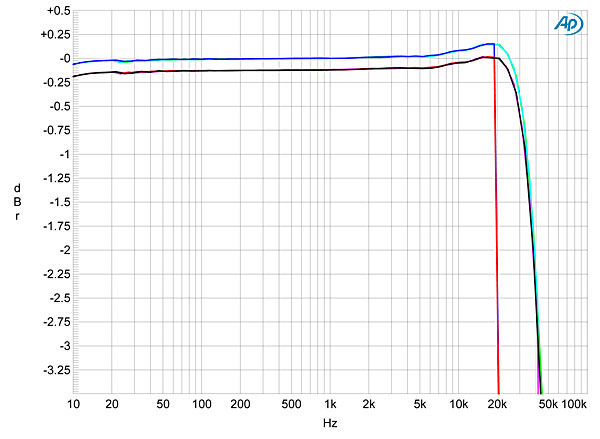
The M1DAC's frequency response rises to a small peak at 20kHz with CD data (fig.1, blue and red traces) before dropping off precipitously, as expected. With 96kHz data (cyan and magenta traces), the M1DAC's output rolls off above 30kHz to reach –3dBFS at 41kHz, also as expected. What I didn't expect was that the response was the same with 192kHz data (green and gray traces) as with 96kHz data, again lying 3dB down at 41kHz, but with a very slightly slower rolloff above that frequency compared with 96kHz data. It could be argued that this misbehavior is academic, considering how little music is available with sample rates higher than 96kHz, and that the M1DAC still offers some extended ultrasonic output at these sample rates. But it suggests that something is not quite optimal with the Musical Fidelity's circuit topology. Channel separation (fig.2) was excellent, at better than 105dB in both directions below 3kHz, though this did decrease slightly in the bass, to a still-good 90dB at 20Hz.

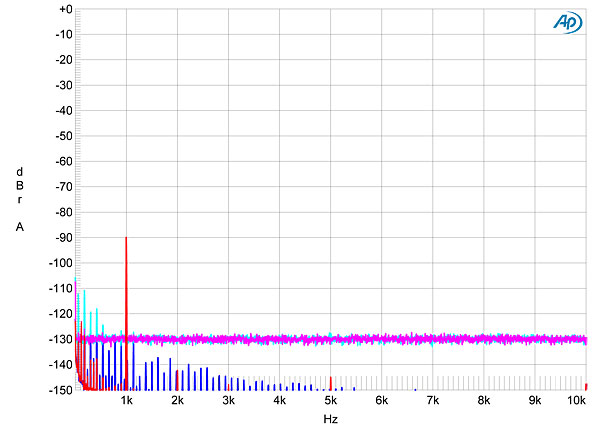
 These supply-related spuriae are very low in level, but both their presence and the superb higher-frequency resolution were confirmed by FFT analysis (fig.4). Fig.5 shows the spuriae in greater detail, but also shows that raising the level of a 1kHz tone from –40dBFS (blue and red traces) to 0dBFS (cyan and magenta) increases the level of the noise floor by 5dB or so. This small degree of noise modulation, though not as extreme as that of the Bel Canto DAC3.5VB, is something I am starting to become aware of with D/A processors, though it is also possible that it is a measurement artifact.
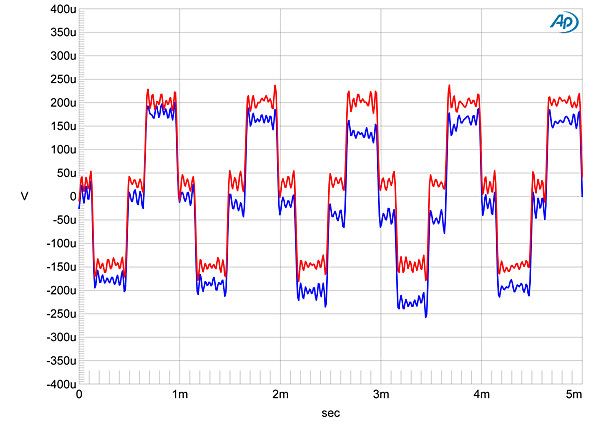
 Linearity error with 16-bit data was negligibly small, to below –110dBFS (not shown), and with its low levels of noise and linearity error, the M1DAC perfectly reproduced an undithered tone at exactly –90.31dBFS (fig.6). The three DC voltage levels described by these data are readily resolved, as is the time-symmetrical Gibbs Phenomenon "ringing" on the waveform tops and bottoms. However, the presence of the supply-related low-frequency noise in the left channel results in a slight displacement of the left-channel trace (blue). Increasing the bit depth to 24 gave a superbly defined sinewave, even at this very low level (fig.7).
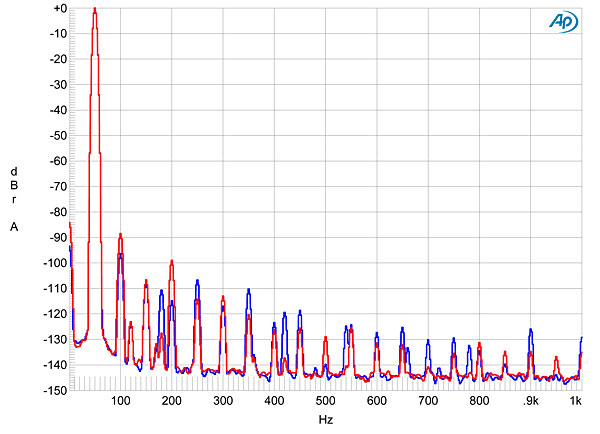
 Like many of Musical Fidelity's earlier solid-state designs, the M1DAC's output stage is based on 5534-type op-amps, in this case one JRC 5532 dual op-amp chip per channel, used as a differential line driver. This decades-old op-amp has always offered low static distortion and the ability to drive low impedances, as can be seen in fig.8. The M1DAC was driving the punishing 600 ohm load for this spectral analysis, but the highest-level distortion harmonic (the subjectively innocuous second) lies at –96dBFS in the left channel (blue trace, 0.0015%) and –89dBFS in the right (red, 0.003%). The next-highest harmonic (the third) lies at –114dBFS in the left channel (0.0002%) and –99dBFS in the right (0.001%). This is superb output-stage linearity, and increasing the load impedance to 100k ohms didn't change the picture by much. Intermodulation distortion was similarly low (fig.9).
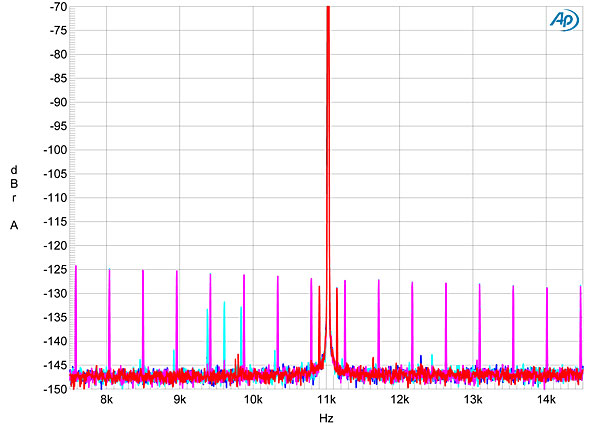
 The M1DAC demonstrated superb rejection of jitter on all its inputs. The cyan and magenta traces in fig.10, for example, show the spectrum of the Musical Fidelity's analog output while it decoded 16-bit J-Test data. The 229Hz-spaced spuriae are at the residual level of the low-frequency squarewave—increasing the bit depth of the data to 24 eliminated these (blue and red traces)—and the only other sidebands visible in this graph lie at ±120Hz, which must stem from the power supply. However, these are too low in level to be resolved by my Miller Analyzer. Despite operating in the jitter-prone adaptive mode, the M1DAC's USB input, fed 16-bit J-Test data, performed as well as did its AES/EBU and TosLink inputs (fig.11).
 It may be affordably priced, but in almost all ways, Musical Fidelity's M1DAC offers performance that is close to the state of the art.—John Atkinson
Fig.1 Musical Fidelity M1DAC, frequency response at –12dBFS into 100k ohms from balanced outputs with data sampled at: 44.1kHz (left channel blue, right red), 96kHz (left cyan, right magenta), 192kHz (left green, right gray). (0.25dB/vertical div.)
Fig.2 Musical Fidelity M1DAC, channel separation (5dB/vertical div.)
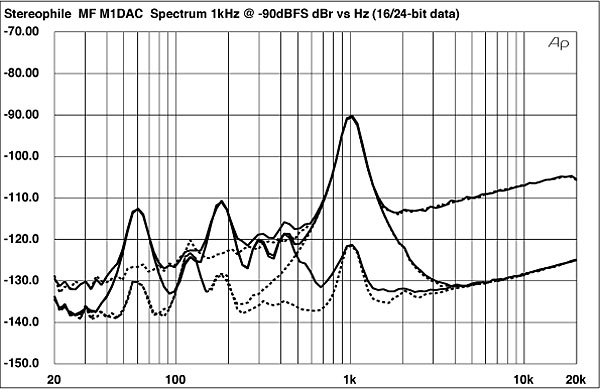
The M1DAC uses the Burr-Brown DSD1796 D/A chip, a 24-bit part capable of running at sample rates up to 192kHz. As used in the Musical Fidelity D/A processor, this chip offers at least 19-bit resolution, which is excellent performance in such an inexpensive product. The top two pairs of traces in fig.3, which was taken by sweeping a 1/3-octave bandpass filter from 20kHz to 20Hz while the M1DAC decoded dithered data representing a tone at –90dBFS, indicate that the increase in bit depth from 16 to 24 drops the noise floor by almost 20dB in the treble, which is easily sufficient resolution to allow the D/A to decode a tone at –120dBFS (bottom pair of traces). In the midrange and below, however, the drop in the noise floor is disturbed by spectral peaks centered on the supply-related frequencies of 60, 120, 180, 300, and 420Hz, primarily in the left channel (solid traces), the circuit for which is physically closer to the transformer and choke than the right-channel circuit.
Fig.3 Musical Fidelity M1DAC, 1/3-octave spectrum with noise and spuriae of dithered 1kHz tone at –90dBFS with 16-bit data (top) and 24-bit data (middle), and of dithered tone at –120dBFS with 24-bit data (right channel dashed).
Fig.4 Musical Fidelity M1DAC, FFT-derived spectrum with noise and spuriae of dithered 1kHz tone at –90dBFS with: 16-bit data (left channel cyan, right magenta), 24-bit data (left blue, right red).
Fig.5 Musical Fidelity M1DAC, spectrum of 1kHz sinewave, DC–1kHz, at: 0dBFS into 100k ohms (left channel cyan, right magenta) and –40dBFS (left blue, right red). (Linear frequency scale.)
Fig.6 Musical Fidelity M1DAC, waveform of undithered 1kHz sinewave at –90.31dBFS, 16-bit data (left channel blue, right red).
Fig.7 Musical Fidelity M1DAC, waveform of undithered 1kHz sinewave at –90.31dBFS, 24-bit data (left channel blue, right red).
Fig.8 Musical Fidelity M1DAC, spectrum of 50Hz sinewave, DC–1kHz, at 0dBFS into 600 ohms (left channel blue, right red; linear frequency scale).
Fig.9 Musical Fidelity M1DAC, HF intermodulation spectrum, DC–24kHz, 19+20kHz at 0dBFS into 600 ohms (left channel blue, right red; linear frequency scale).
Fig.10 Musical Fidelity M1DAC, high-resolution jitter spectrum of analog output signal, 11.025kHz at –6dBFS, sampled at 44.1kHz with LSB toggled at 229Hz: 16-bit data via AES/EBU (left channel cyan, right magenta); 24-bit data via AES/EBU (left blue, right red). Center frequency of trace, 11.025kHz; frequency range, ±3.5kHz.
Fig.11 Musical Fidelity M1DAC, high-resolution jitter spectrum of analog output signal, 11.025kHz at –6dBFS, sampled at 44.1kHz with LSB toggled at 229Hz: 16-bit data via USB from MacBook (left channel blue, right red). Center frequency of trace, 11.025kHz; frequency range, ±3.5kHz.