I examined the Meridian Explorer's electrical performance with Stereophile's loan sample of the top-of-the-line Audio Precision SYS2722 system (see www.ap.com and the January 2008 "As We See It.") For some tests, I also used my vintage Audio Precision System One. I used the supplied USB cable and played files with Bias Peak Pro running on my MacBook Pro, using Apple's AudioMIDI utility to make sure that the data output from the USB port had the correct sample rate and bit depth. I performed a complete set of measurements from both the line-level and headphone outputs, but most of what I describe here is the Explorer's performance from its line output; I comment on the headphone output only when it differed.
Apple's USB Prober utility identified the Explorer as "Meridian Explorer USB DAC," operating in isochronous asynchronous mode. Although there was no serial number on the product itself, USB Prober identified our sample as having serial no.020005BC. The Explorer operated correctly with data sampled at 44.1, 48, 88.2, 96, 176.4, and 192kHz, with a word length identified as "24 bit Integer."
The maximum output level at 1kHz was 2.124V from the line output with my laptop's volume control set to its maximum, but 2.2dB lower from the headphone jack, at 1.745V. While the line output preserved absolute polarity (ie, was non-inverting), the headphone output inverted absolute polarity. The line-level output impedance was a fairly high 466 ohms at low and middle frequencies, dropping slightly to 457 ohms at the top of the audioband, which is why this jack should not be used to drive headphones. The headphone output impedance was a low 5.25 ohms at all audio frequencies, which is appropriate for driving even low-impedance headphones.
The Explorer's impulse response with 44.1kHz data (fig.1, taken with a test signal comprising digital black, into which I had inserted one sample at 0dBFS) reveals the reconstruction filter to be a minimum-phase type, with all the ringing occurring after the impulse. The blue trace in fig.2, taken with 44.1kHz-sampled white noise, reveals the filter to be a minimum-phase type with a sharply defined null at 0.55Fs. I originally thought this filter to be an apodizer, of the type pioneered by Meridian, with a null at half the sample rate, but I misread my own graph. It has less stop-band rejection than a conventional filter at higher frequencies: the red trace in fig.2, which is the wideband spectrum of a full-scale, 44.1kHz-sampled tone at 19.1kHz, shows that the 25kHz aliasing product is suppressed by only 55dB or so. The third harmonic of the 19.1kHz tone, at 57.3kHz, is the highest in level at –69dB (0.03%).
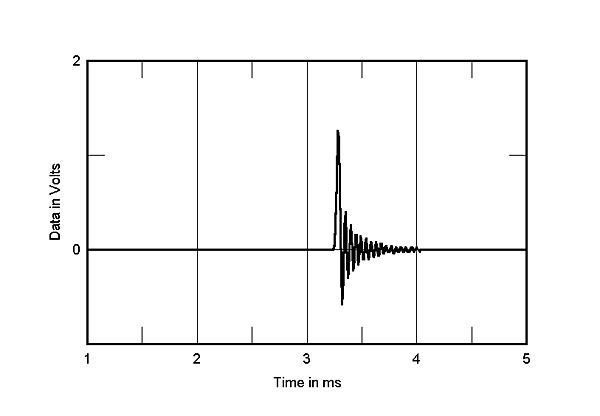
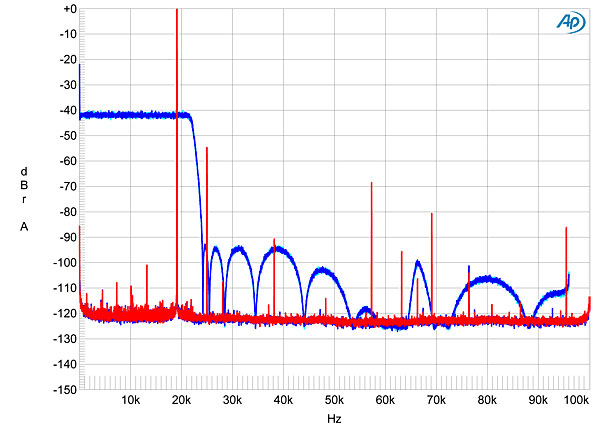
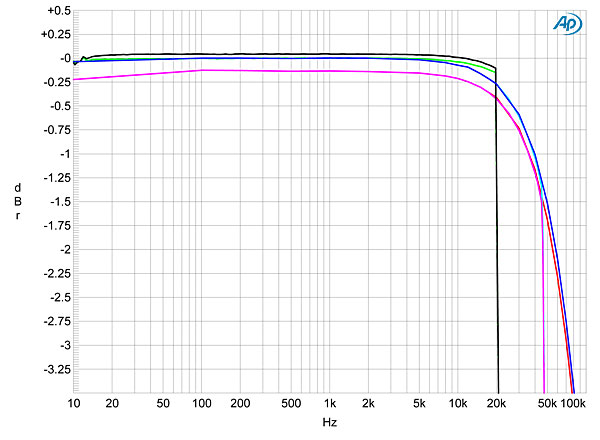
Fig.3 shows the conventional plot of frequency response, taken with data sampled at 44.1kHz (green and gray traces), 96kHz (cyan, magenta), and 192kHz (blue, red). The ultrasonic responses with the two higher sample rates are very similar, the 96kHz response dropping sharply above 47kHz, the 192kHz response smoothly rolling off to reach –3dB at 70kHz. The CD response (green, gray) is a little different, in that the rolloff at 20kHz is not as pronounced as at the higher sample rates, and the channel levels are better matched. Channel separation (not shown) was good rather than great, at 71dB at 1kHz from the line output, 59dB from the headphone output.
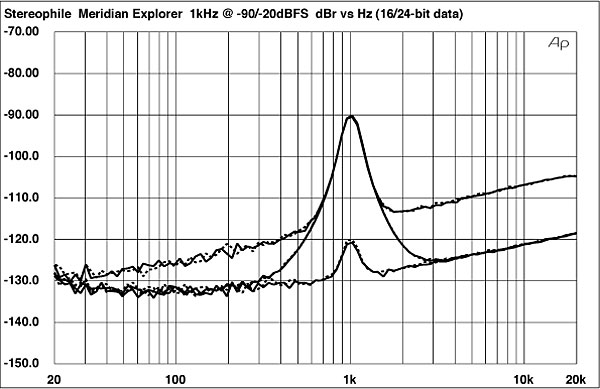
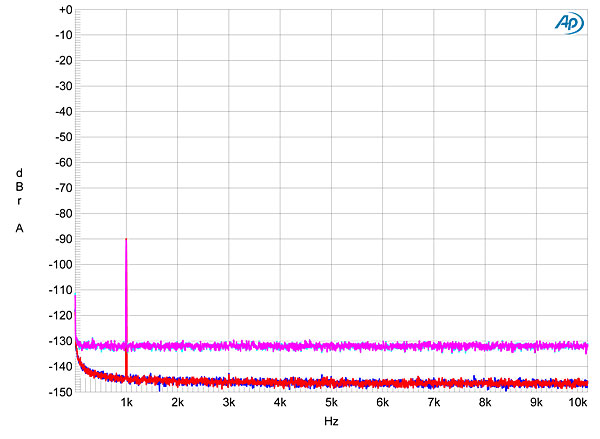
Consistent with Stereophile's tests of digital products going back a quarter century, my primary test of resolution is to sweep a 1/3-octave bandpass filter from 20kHz to 20Hz while the DAC reproduces a dithered 1kHz tone at –90dBFS with both 16- and 24-bit data. The result is shown in fig.4: with both 16-bit data (top pair of traces) and 24-bit data (middle pair of traces), the spectrum peaks at exactly –90dBFS, implying low linearity error. (This was confirmed with a separate test, not shown.) The 16-bit noise floor in this graph is actually the spectrum of the dither used to encode the data. With 24-bit data, the noise floor drops by up to 15dB, suggesting resolution approaching 19 bits, which is excellent considering that the Explorer is powered by the host computer's USB bus, and readily enough to allow the Meridian to resolve a 24-bit tone at –120dBFS (bottom traces). Modern FFT analysis (fig.5) confirms the excellent resolution.
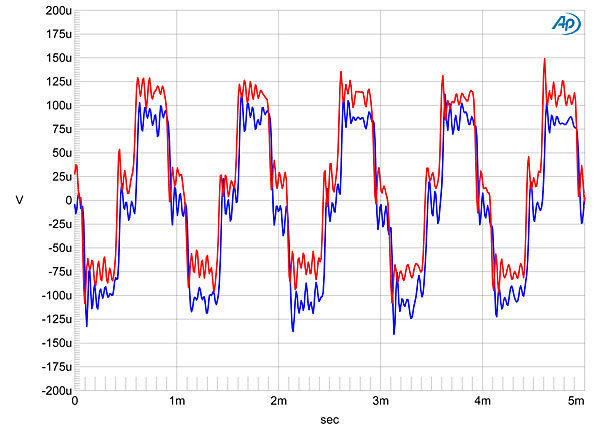
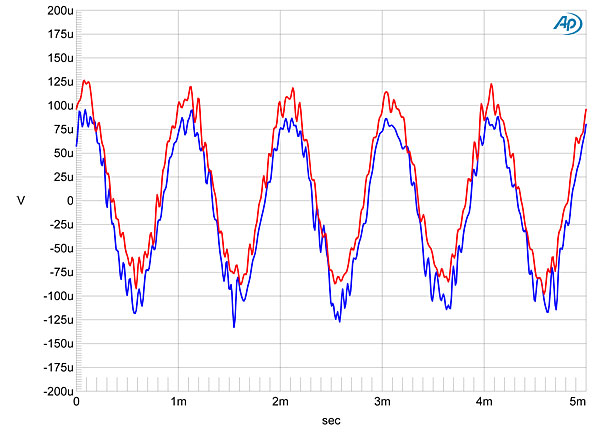
With its low noise and excellent resolution, the Explorer had no problem reproducing an undithered 16-bit tone at exactly –90.31dBFS (fig.6), with a symmetrical waveform clearly describing the data's three DC voltage levels, and with a hint of the reconstruction filter's asymmetric ringing on the leading edges. With 24-bit undithered data (fig.7), the Meridian output a clean sinewave despite the very low signal level.
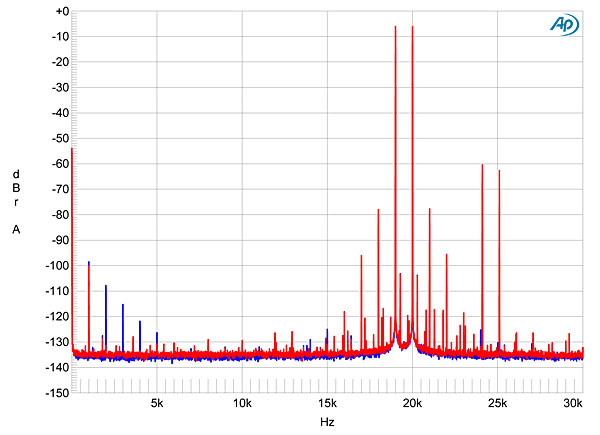
The Explorer offered very low levels of distortion from its line output (fig.8), with the highest-level harmonic into the high 100k ohm load the subjectively innocuous second harmonic, at a very low –96dB (0.0015%). This graph indicates that the left channel (blue trace) had slightly higher levels of higher-order harmonics, though not to any significant extent. The Explorer's headphone output, tested into a lower load of 300 ohms (fig.9), both had higher levels of distortion—the second harmonic is still the highest, at –80dB right (red trace, 0.01%) and –86dB left (blue, 0.005%)—and a regular, if low-level, series of higher-order harmonics visible. Tested for high-frequency intermodulation (fig.10 shows the line output spectrum; the headphone output was similar, if somewhat worse), the Explorer shows only mild rejection of the imaging products at 24.1 and 25.1kHz, though actual intermodulation products are low in level. Again, the left channel is slightly worse than the right.
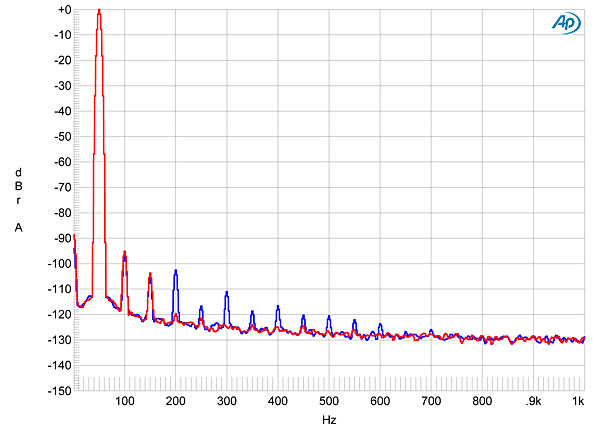
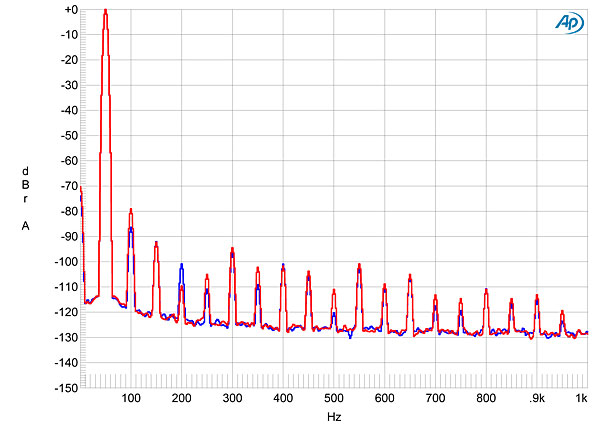
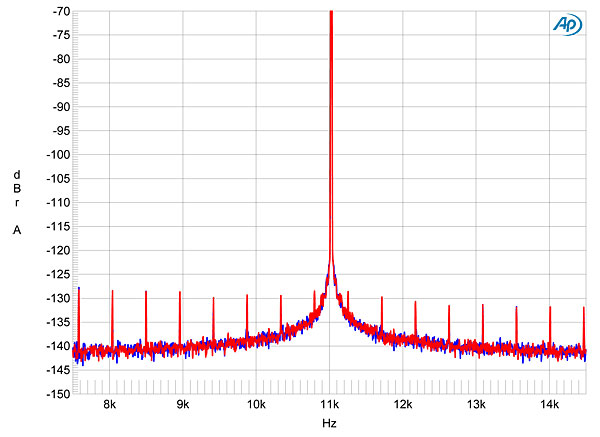
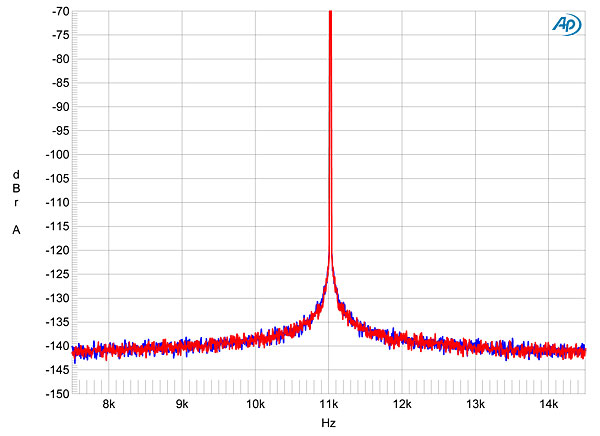
With a USB connection operating in asynchronous mode, a DAC should be immune to the effects of interface-related word-clock jitter. Tested with a 16-bit version of the Miller-Dunn J-Test signal, the Explorer hardly affected the levels of the odd-order harmonics of the low-frequency, LSB-level squarewave (fig.11), though some low-frequency, random spectral spreading of the spike that represents the high-level 11.025kHz tone can be seen. With 24-bit J-Test data (fig.12), the harmonics and sidebands have disappeared as expected, but the spectral spreading is still evident.
Even without considering that it has to operate on the 5V supply available from the USB bus, Meridian's Explorer offers generally superb measured performance.—John Atkinson